By Thomas Bainbridge
Cuthbert is among the most cherished figures in Northumbrian history, so much so that the people of the region were once known as ‘Cuthbert’s people’ due to their extreme devotion to his legacy. The body of the Saint was equally regarded with extreme reverence. This history of the remains is a remarkable and peculiar one.

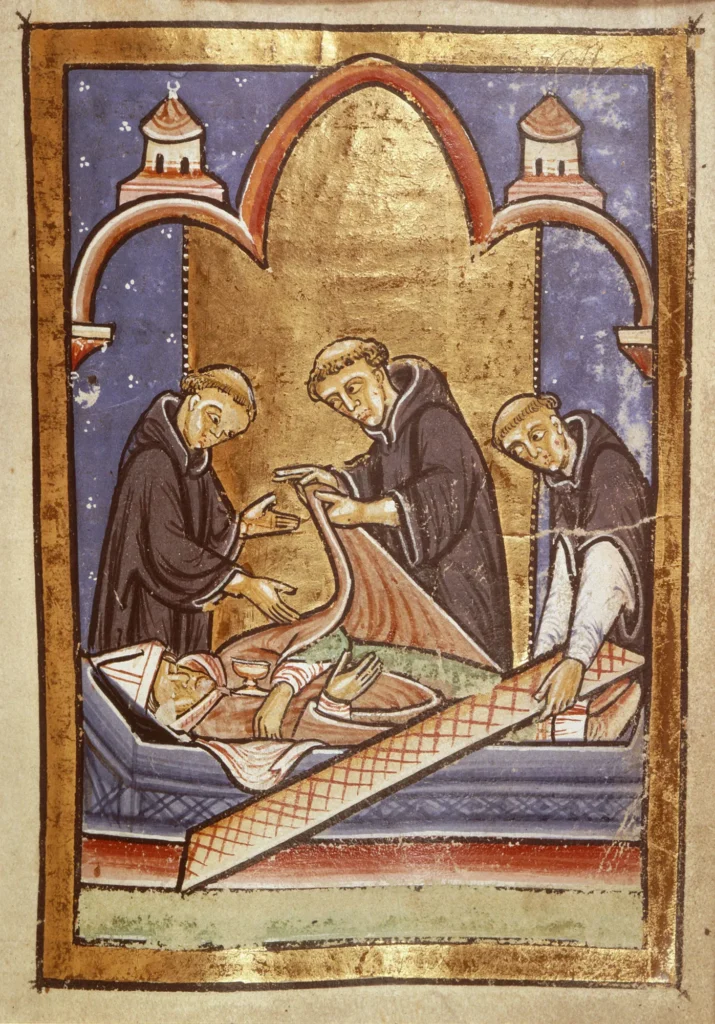
The Venerable Bede, the great historian of England, provides the first chapter. In his Life of St. Cuthbert (721), he recounts that the saint was first buried within the grounds of the monastery at Lindisfarne, as it had been the site of many of Cuthbert’s miracles during his lifetime. However, after ten years of tranquillity, the tomb was opened with the purpose of exhuming what would presumably be the saint’s skeleton, in order to then preserve the bones as relics for veneration. However, Cuthbert was instead found to be perfectly presevered, including the fabric of the clothes that he wore. As Bede described,
“opening the tomb, [they] found his body entire, as if he were still alive, and his joints were still flexible, as if he were not dead, but sleeping. His clothes, also, were still undecayed, and seemed to retain their original freshness and colour.”
The discovery was deemed miraculous, and obvious evidence of the favour that God had bestowed on the dead figure. In order to honour this revelation, the monks placed the mummified remains into a lighter wooden coffin which was then placed on the stone floor at the side of the altar. Supposedly it remained there for over a century, where it became a site of pilgrimage to many including the clergy and nobility.
However, this peace did not long survive, and in 793, Viking raiders sacked Lindisfarne monastery, massacring its monks and plundering the gold and silver ornaments contained within. This was repeated with ferocity a year later, and still, by another miracle, Cuthbert’s coffin remained peacefully situated at the altar — for which the rampaging Vikings seemed to have no interest.
The monastery soon regained its vitality, and it was another 80 years, in 875, before it was disturbed by the threat of another Viking incursion. This time, the coffin was hastily removed, in which was also placed the head of St. Oswald, a few bones of St. Aidan, the bones of the Bishops Eata, Eadfrid, and Ethelwold. The monastic brothers tasked with the transfer of these relics escaped in time, before the Vikings laid waste to the site once more, leaving it now in a smouldering heap of ash.
The destitute monks wandered for seven years amidst the Northumbrian hills, carrying with them the body of their venerated Father. It was claimed that at each village in which they received protection, a Church was built in honour of their saint and protector.
Still fearing for its safety, it was decided that the body should be sent even further distant to Ireland. However, the ship carrying it was prevented from leaving the bay due to tempestuous weather, which was viewed as a sign that Cuthbert’s body should remain. The body was then carried into the highlands of Scotland before the monks returned once more to Northumbria.

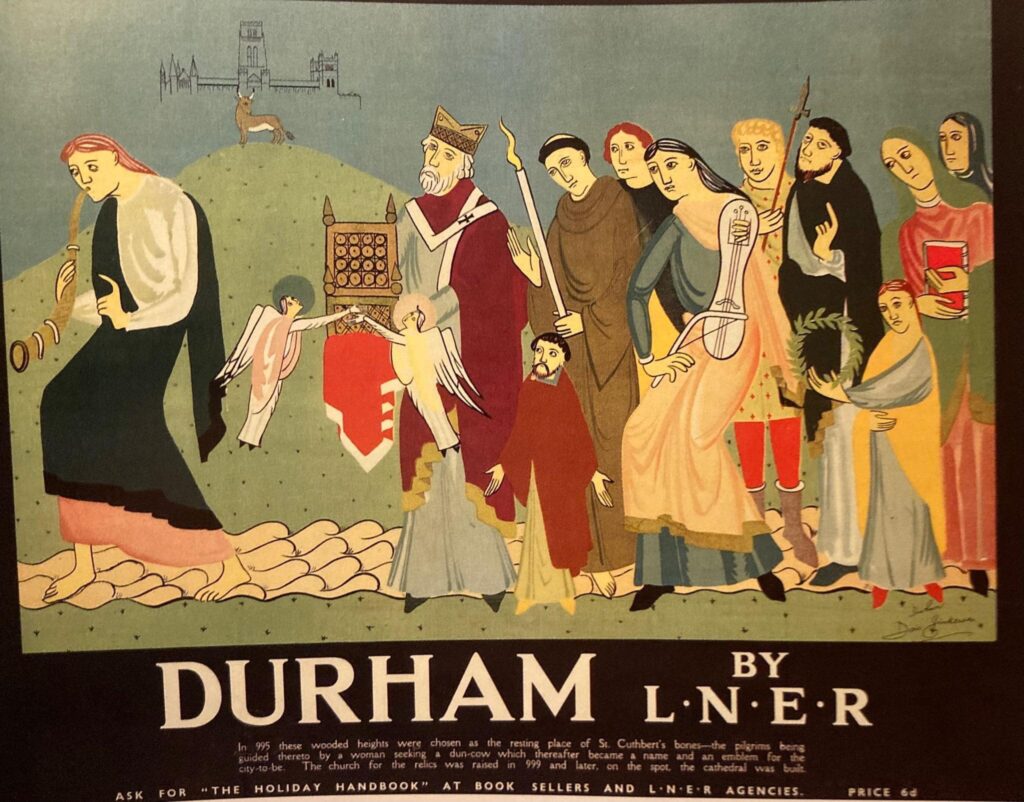
Eventually, they settled upon Chester-Le-Street as the location in which to lay it to rest. But of course, it was uprooted once again by the continued ravages of the Danish Viking invaders and transferred to Ripon and finally to Durham in 995, where the coffin would move no further. So it was in Durham that Cuthbert would finally repose, and around him sprang the great Cathedral as a monument to his memory. It was not long after this, in 1022, that Saint Bede‘s bones were enshrined at Durham, where they too remain to this day.
Durham soon became the seat of the Prince Bishops, who wielded temporal as well as spiritual power in a region largely beyond the reach of southern-based kings. However, numerous further calamities befell England, in which it was deemed necessary again to transfer the body. In 1066, during the Norman invasion of England, it was feared that the Northumbrian patron’s body would be defiled and, in a wholly ironic twist, it was taken back to its initial resting place — Lindisfarne.
However, when its safety was assured, it returned once more to the banks of the Wear, where it resided at the altar of the Cathedral. The body was then able to rest for five centuries until Henry VIII’s marital status was brought into question, and the English Reformation led to the Dissolution of the Monasteries, and the prohibition of Catholic aspects to religious worship, including the over-veneration of saints and relics. The accounts of the subsequent desecration of Cuthbert’s shrine and body were related in The Rites of Durham, published in 1593:
“perceiving the chest he lay in strongly bound with iron, the goldsmith, with a smith’s great fore (forge) hammer, broke it open, when they found him lying whole, uncorrupt, with his face bare, and his beard as of a fortnight’s growth, and all the vestments about him, as he was accustomed to say Mass, and his metwand (measuring rod) of gold lying by him. When the goldsmith perceived he had broken one of his legs he was sore troubled at it and cried, “Alas, I have broken one of his legs!” which Dr. Henly hearing, called to him, and bade him cast down his bones. The other answered, he could not get them asunder, for the sinews and skin held them so that they would not separate.”
From there, it was attested that the body was interred in the floor of the Cathedral. However, this gave rise to controversy when the vault that covered it was opened in 1827, revealing now a wholly decrepit skeleton. Many claimed that this was obviously not the body of Cuthbert, whose flesh would naturally remain preserved, the skeleton was but a replacement. The mystery has given rise to wild speculation and numerous conflicting theories about the true resting place of the body.
The Cuthbert Code
In a continuation of the journey of the hardy monks who braved the wilderness, a story arose that during the Dissolution, the body was moved yet again to a secret place where it remains to this day, with the location known only to an inner circle of monks and clergy, including the Abbot of Ampleforth and the Archbishop of Westminster. This group comprises from three, to upwards of twelve, who maintain the secret between them through successive generations.
Possible locations include:
- Westoe in South Shields
- Crayke Abbey in North Yorkshire
- a site still within the environs of Durham itself
Sir Walter Scott alluded to the legend in his epic poem, Marmion: A Tale of Flodden Field (1808):
“There deep in Durham’s Gothic shade
His relics are in secret laid,
But none may know the place
Save of his holiest servants three
Who share that wondrous grace.”
It seems this tradition was the reason for opening the tomb in 1827, when it was found that Cuthbert’s body had turned to dust. But during this uncovering, inside the original innermost coffin carved with exceptionally early Christian art, a number of priceless artefacts were found, including an ornate jewelled cross as well as a miniature Gospel of St John, both from the 7th century.
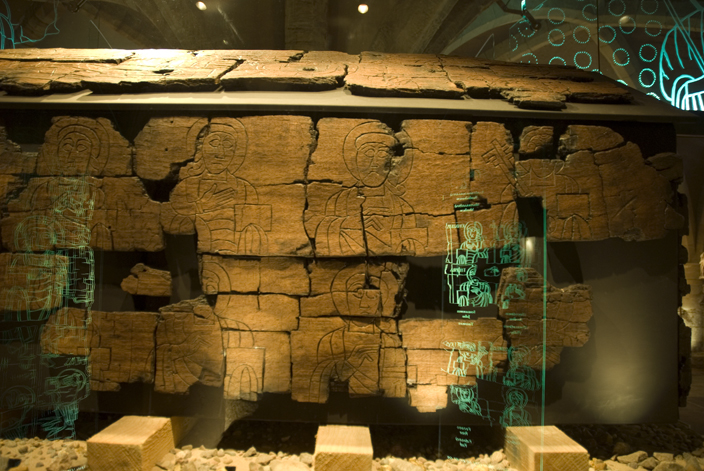
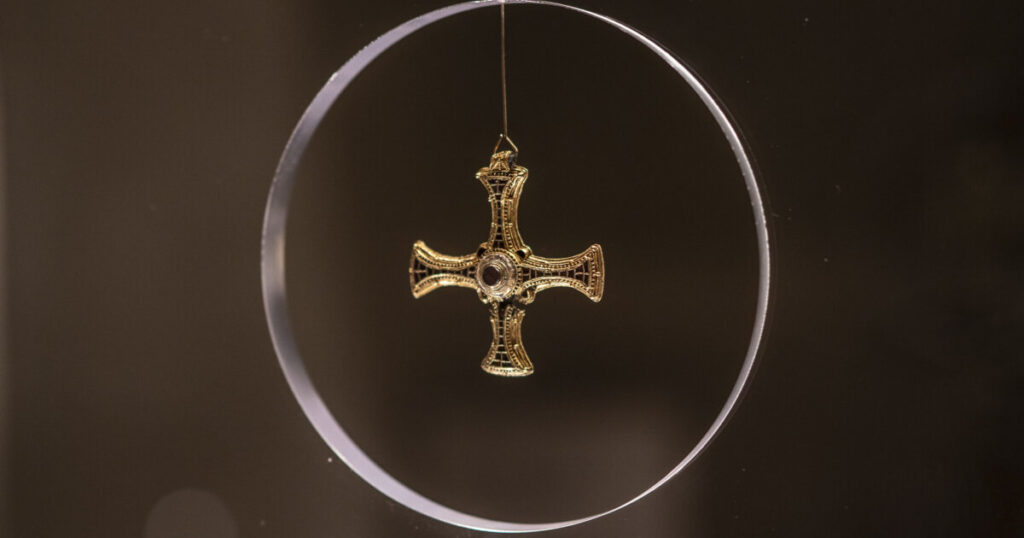
The reason this mysterious folklore exists is that for many centuries the utmost secrecy has been integral to the preservation of the body. Concealing the coffin, the objects within it, and the knowledge of its whereabouts and intended destinations, has prevented desecration and safeguarded the relics.
Thus a culture of monastic silence surrounding the saint had persisted down the ages in the face of massive upheavals, from the barbarism of the Great Heathen Army, to the merciless Harrying of the North, to the vandalism of the Dissolution.
Through the ages, Saint Cuthbert’s shrine has served as one of the foremost places of pilgrimage in Christendom, and for the last thousand years that shrine has been guarded by the sanctity of Durham Cathedral. The Cathedral as his true home is nowhere captured more sublimely than in this verse by the Churchman Frederick Faber:
“Once more shall host and sacrifice be thine,
When Cuthbert’s bones, concealed from curious scorn,
Down the grand aisles in triumph shall be borne
With jubilant psalms, by some new Palatine.”

A couple if things always puzzled me about the monks carrying the coffin. They are said to have set off in 875 and the coffin arriving in Durham in 995 and the cathedral built because of that
Obviously it wasn’t the same monks who set off and monks didnt marry and have children so where did the replacement monks come from?
Secondly they reached Durham in 995 but the cathedral wasnt built till 1093 under Norman influence so was there a small chapel before the cathedral on the same land? a bit like Tynemouth Priory being built on the site of the much older wooden chapel
I must admit those questions were in my mind when writing. Even a detailed account such as Consitt’s Life of St. Cuthbert does not provide satisfactory answers. We can assume that replacements perhaps arrived after being despatched from other monasteries across the region. Perhaps joined by their brothers from Lindisfarne? Also the body rested for some time at Crayke in York, where Cuthbert had founded a monastery in his lifetime, so possibly the wandering monks were joined by some from here when they continued their journey?
And yes, the wooden ‘White Church’ existed on the site to house the body, which was then replaced by a stone one that was under construction until the Norman conquest. Then it was demolished under the direction of William of St. Calais and replaced once more by the more imposing Cathedral we see today.