
By Thomas Bainbridge
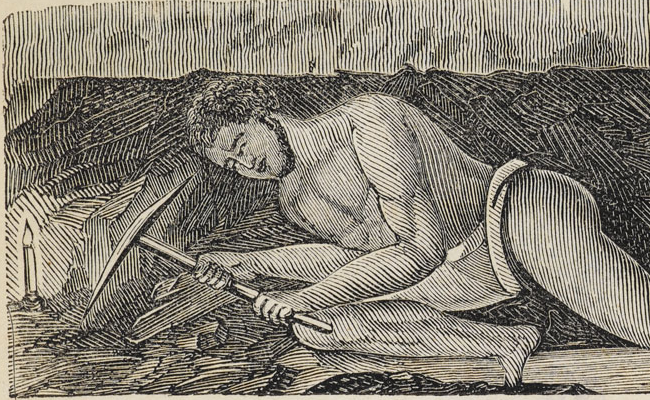
Coal was the lifeblood of the burgeoning industrial might of England. Across the nation, men toiled deep underground in the pitch darkness, smashing and rending black diamonds from the rockface. This work was fraught with danger due to the elemental forces that opposed the defenceless bodies of the miners. One of these dangers was firedamp. This gas, which collected in the pockets of the winding passageways and mine shafts, could ignite producing an explosion of monumental destructive force.
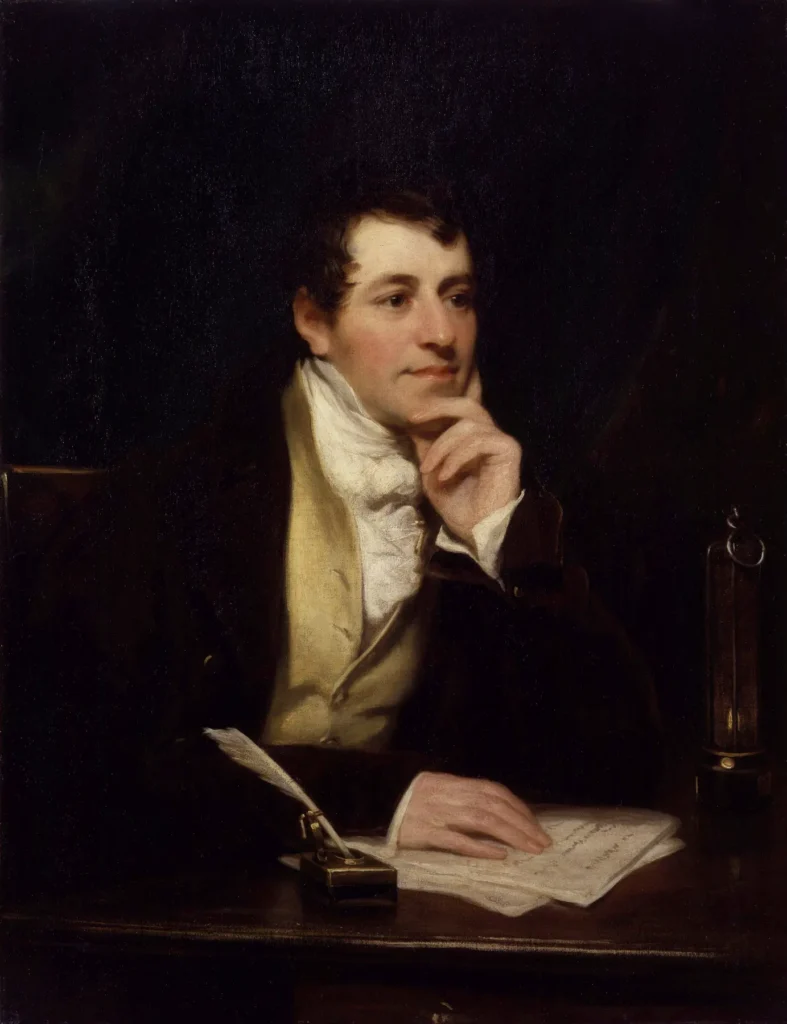
It is commendable that anyone should have sought to alleviate the terrible danger in which the miners worked and in the midst of this crisis, it was Humphry Davy and George Stephenson who stepped forward to bring newfound advances in physics to save the lives of countless miners.
Overcoming Adversity
Born at opposite ends of the country, each shared a common interest. From humble stock (Stephenson more so than Davy), they groped their way to the top by their diligence and intellectual aptitude. Davy, born to a woodcarver, was able to attend a grammar school, showing his early scientific inclinations, and soon became apprentice to a barber-surgeon (akin to a physician). Through his intrepid investigations, he soon rose to prominence for his startling ideas, becoming a fellow of the Royal Society at the age of twenty-five.
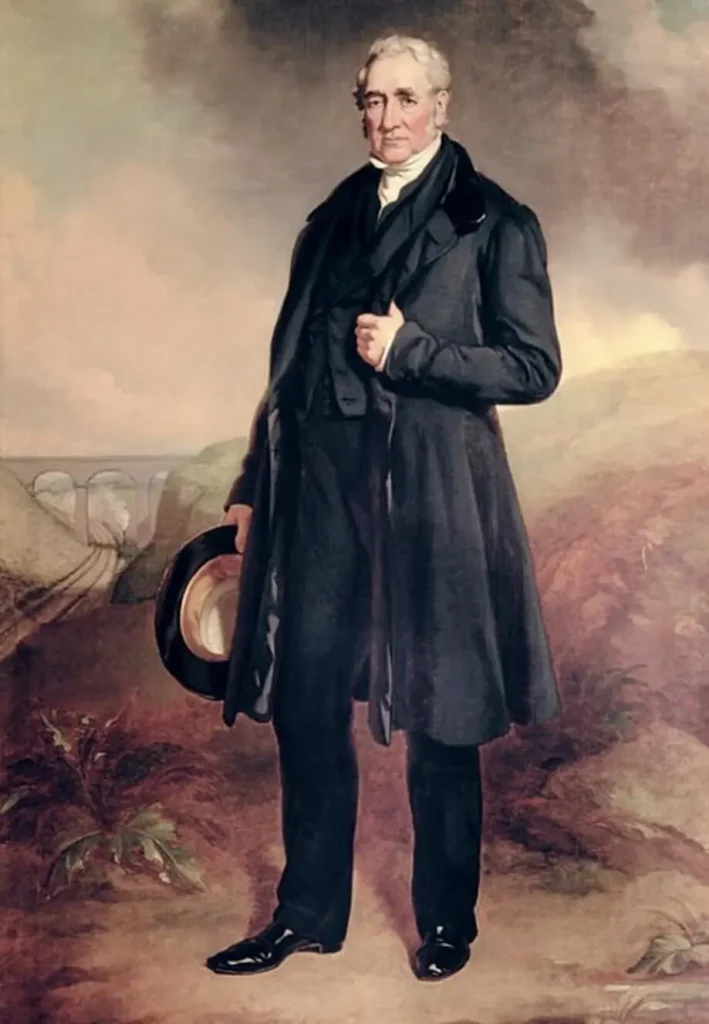
Conversely, Stephenson was born in Wylam, amidst the rough mining country of Northumberland. Not as fortunate as Davy, he received no early formal education, but largely taught himself to read and write by the age of eighteen, in which time he also worked in grinding conditions, hauling and sifting coals at the local colliery. He was soon employed at a higher level at Killingworth working with pumping engines which sparked his mechanical interests. He also mended clocks and made shoes in his spare time as a means to gain some much-needed extra income.
We can imagine that, as he worked at these cathartic activities away from the aggravation of the hectic colliery, dynamic processes were taking place in his mind which would soon revolutionise the globe. However, industrialisation wrought more immediate problems. Naturally, the plight of miners was not far away from the thoughts of either man. Davy, as a Cornishman, knew of the conditions of the tin and silver mines that dotted his rugged homeland. Stephenson had himself witnessed the plight of close friends and family engaged in the degrading conditions.
Tragedy Strikes
The galvanising event occurred at Felling Colliery in 1812. Though the pit’s conditions had previously been considered exemplary, on 25th May it was shaken by an explosion that tore through the ground, raining clods of earth across the country and even blocking out the sun. Overall, ninety-two men and boys were recorded to have perished in the disaster. Fire-damp was the cause.
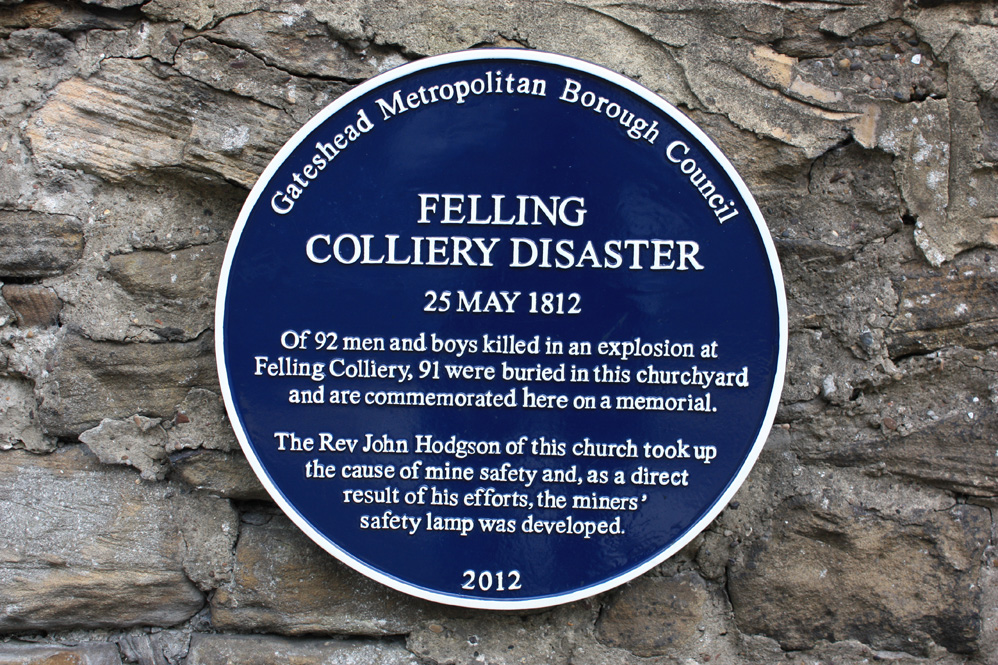
Soon, a “Society for Preventing Accidents in Coal Mines” was convened in Sunderland, which included such local luminaries as Ralph Milbanke, Rev. John Hodgson and John Buddle. The Society immediately determined to request the help of the eminent scientist, Sir Humphry Davy. He replied,
“It will give me great satisfaction. if my chemical knowledge can be of any use in an enquiry so interesting to humanity.”
James Kendall, Humphry Davy: Pilot of Penzance, 118-127
Sparks of Genius
Davy immediately directed all his powers of experiment towards the deadly problem. This soon bore fruit and he penned numerous papers to the Royal Society between 1815 and 1817, charting his success, and revealing his lamp design, hopeful to prevent future calamities. The coal magnate John Buddle, rejoiced that, “we have at last subdued this monster”.
However, George Stephenson, no stranger to deadly mine blasts, had long been working independently on a design, in which he had also met with success after risking his life to test it in a fire-damp section of mine at Killingworth. Following further refinements and extensive testing at the coal face, Stephenson demonstrated his lamp at the Literary and Philosophical Society on 5th of December, 1815.
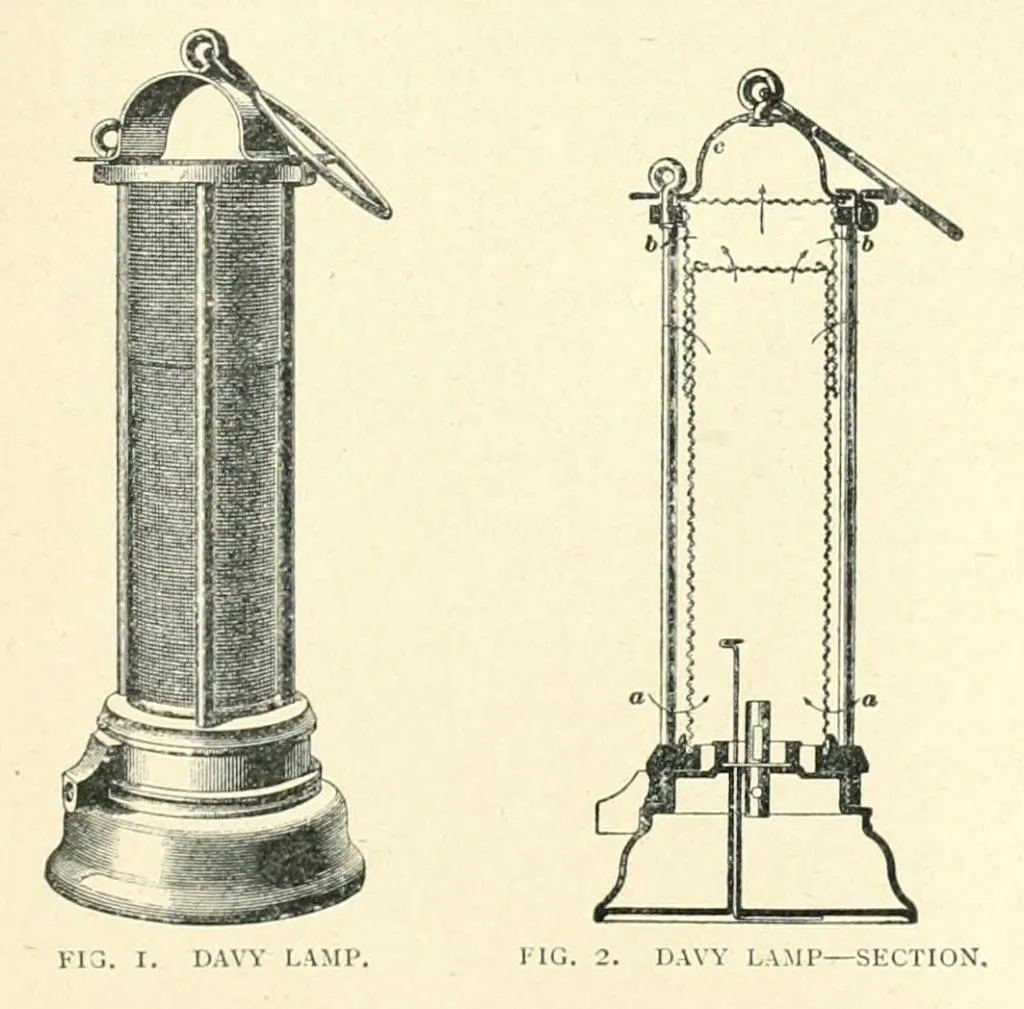
The general principle of either lamp was the same. Davy explained that,
“Explosive mixtures of mine-damp will not pass through small apertures or tubes: and that if a lamp or lanthorn [lantern] be made air-tight on the sides, and furnished with apertures to admit the air, it will not communicate flame to the outward atmosphere.”
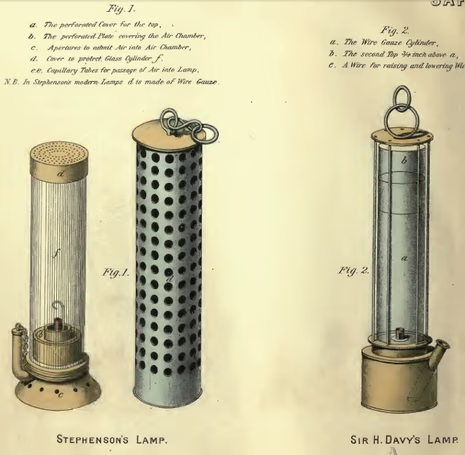
Davy achieved this by a wire gauze that surrounded the flame. Stephenson’s “Geordie Lamp”, on the other hand, featured capillary tubes at both ends and a metal sleeve that protected the lamp. Though this gave off less light, it was safer, as Stephenson’s lamp was designed so that the flame would extinguish when the dangerous firedamp was present. Davy’s lamp on the other hand remained bright but also heated up considerably.
Stephenson’s design may be considered all the more remarkable given that, unlike Davy, he did not have access to the funding and materials provided by the Royal Institution, as well as the foremost laboratories in Europe. Stephenson had produced his lamp by continual and unretiring effort.
Davy’s Dishonour
Both men were recognised for their efforts, receiving extensive congratulations and tokens of immense gratitude from the mining communities. In September 1817, the people of Newcastle held a banquet in honour of Davy and unceasingly toasted his invention and character. A committee presented him with a gold plate worth over £2500. Stephenson too received high commendation. However, though he presented his findings earlier, he had received a silver tankard worth £1000. Though still a great sum of money, this might have stung, especially as Davy began to deride his efforts.
Despite the synergy of their ideals, Davy’s ego entered the picture, degenerating into bitterness and animosity over the legitimacy of Stephenson‘s invention. Davy tried to discredit Stephenson in private and public. He described Stephenson viciously as an “illiterate pirate”, claiming that his lamp was both stolen and inferior. Still, Stephenson was obstinate in his defending his name, “My facts and dates are before the public”, he asserted in a letter to the Newcastle Chronicle in 1817.
The timeline of developments is incontrovertible: By the time Davy had presented his lamp to the public on 9th November 1815, Stephenson was already constructing his third lamp based on previous observations and experiments, without hearing of Davy‘s rarefied endeavours.
Stepehenson’s first biographer, Samuel Smiles, wrote of the snobbery surrounding the credit for the invention:
“Sir Humphry Davy carried off all the éclat which attached to the discovery. What chance had the unknown workman of Killingworth with so distinguished a competitor? The one was as yet but a colliery engine-wright, scarce raised above the manual-labour class, without chemical knowledge or literary culture, pursuing his experiments in obscurity, with a view only to usefulness; the other was the scientific prodigy of his day, the pet of the Royal Society, the favourite of princes, the most brilliant of lecturers, and the most popular of philosophers.
No small indignation was expressed by the friends of Sir Humphry Davy at this “presumption” on Stephenson’s part. The scientific class united to ignore him entirely in the matter. In 1831, Dr. Paris, in his ‘Life of Sir Humphry Davy’, thus spoke of Stephenson, in connexion with his claims as an inventor of the safety-lamp:— “It will hereafter be scarcely believed that an invention so eminently scientific, and which could never have been derived but from the sterling treasury of science, should have been claimed on behalf of an engine-wright of Killingworth, of the name of Stephenson — a person not even possessing a knowledge of the elements of chemistry.’’”
Davy had further claimed that Stephenson’s lamp would “endanger the lives of the workmen”. However, the Geordie Lamp was considered the safer of the two in that it extinguished, rather than increased in heat, when it encountered flammable gas.
At any rate, Davy’s aspersions did not give him cause to insist that Stephenson had outright stolen the idea. Certainly, this shameful charade is perhaps the only thing that discolours Davy’s otherwise vibrant scientific and humanitarian legacy. Indeed, when pressed to file a patent on the lamp, he had refused, allowing it to be used freely, even where he would have otherwise stood to make a fortune.
Regardless, the Geordie and Davy lamps spared untold lives. Men of keen intelligence and ingenuity had proved the value of scientific methods to achieve the betterment of humanity. Yet it was undoubtedly Stephenson who had the last laugh. He became renowned for another vital creation, the steam locomotive, for which he is far more well known compared with the relative obscurity of Davy. As Smiles put it:
“But Mr. Stephenson was really far above claiming for himself an invention which did not belong to him. He had already accomplished a far greater thing than even the making of a safety-lamp—he had constructed the first successful locomotive, which was to be seen daily at work upon the Killingworth railway. By the important improvements he had made in the engine, he might almost be said to have invented it; but no one—-not even the philosophers—detected as yet the significance of that wonderful machine. It excited no scientific interest, called forth no leading articles in the newspapers or the reviews, and formed the subject of no eloquent lectures at the Society; for railways were, as yet, comparatively unknown, and the might which slumbered in the locomotive was scarcely, as yet, even dreamt of. What railways were to become, rested in a great measure with that “enginewright of Killingworth, of the name of Stephenson,” though he was scarcely known as yet beyond the limits of his own district.”
Further Reference:
The Life of George Stephenson by Samuel Smiles (1857). The first, and best, biography of the Father of the Railways.