
By Thomas Bainbridge
The City of Durham boasts a great Christian and medieval heritage. It is the site of a monumental Cathedral — the shrine of Cuthbert — and a formidable castle which dominates the surrounding landscape. And yet, little is commonly known of the more ancient origins, obscured by the wastes of time that presaged the supposed discovery of Durham by the wandering brothers of Lindisfarne.
In fact, Durham was once the location of a significant fort, and subsequently a crucial crossroads in Rome’s dominion over Britannia.

Maiden Castle Fort
The winding of the River Wear has, in all eras, offered distinct defensive capabilities. In the Iron Age this was already recognised and the area southeast of Durham called Maiden Castle, became the site of a promontory fort, unassailable on three sides due to the steep banks of the Wear, leaving a fourth side more easily defended. One description by the antiquarian William Page reads,
“The north, south and east slopes are very steep, especially the last, which rises about one hundred feet above the River Wear’. Indeed, one theory regarding the etymological origin of the fort is that it is thought to mean ‘impregnable’.”
The Victoria History of the County of Durham. vol 1, p 348 (1905)
Though the course of the river has altered with time, the fort remains a noted archaeological site. William Hutchinson provided a lucid description:
“On the right and left the steep sides of the mount are covered with a thick forest of oaks: The crown of the mount consists of a level area or plain, forty paces wide on the summit of the scar, in the front or north east side, one hundred and sixty paces long on the left-hand side, and one hundred and seventy paces on the right. The approach is easy on the land side, from the south-west, fortified with a ditch and breast work: The entrance or passage over the ditch is not in the middle, but made to correspond with the natural rise of the outward ground.”
The History & Antiquities of the County Palatine of Durham, vol 2, p 395 (1823)

Furthermore, Maiden Castle (B, below) offers an intriguing example of a promontory fort that makes use of a river, whereas most examples are on islets and peninsulas around coastal regions, notably in Cornwall and Brittany.
Equally as intriguing, to the north of Maiden Castle, and to the east of Durham lies a small clump of farm buildings and gardens, called Old Durham. On a summer’s day, this is an idyllic spot, swathed in trees, brambles and foliage, and bounded by ornate Tudor gardens and hedges developed by John Heath in 1569. Before that, Old Durham went through numerous iterations.
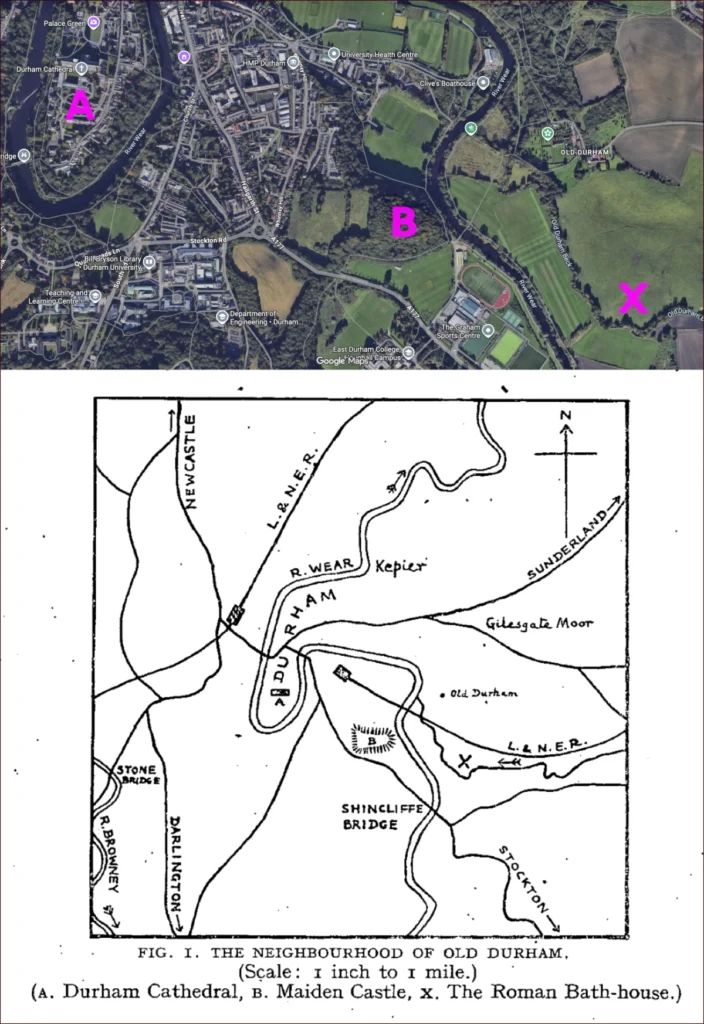
Roman Settlement
In 1940, a great discovery was made by the discerning eye of a local man. While working with the Durham City Sand and Gravel Company, Jack Hay noticed some white rubble that became exposed at the local quarry. Having an interest in local history, Hay thought there might be some significance to the finding. He therefore contacted B. Cosgrave and Rev. Thomas Romans, who set about investigating the case.
Before long, a Roman roof tile was unearthed, confirming Hay’s suspicions. Thus, not unlike the vital excavation at Sutton Hoo undertaken around the same time, the ground of Old Durham was scoured for its ancient secrets. Though the war raged on (and Cuthbert’s mist descended on the city), a year hence in August 1941, they discovered the red cement of a Roman bath, decorated plaster of a green leaf design, fragments of Samian pottery and an iron key, each dating from between the second and fourth century AD.
Bathhouse Excavations

The slow archaeological process, made even slower in war-time, yielded significant results. By 1944, the uncovered remains consisted of three bathing chambers:
- Caldarium — a steam room heated by a pillared hypocaust (underfloor heating powered by a furnace).
- Laconicum — a dry heated room
- Frigidarium — a cold bath.
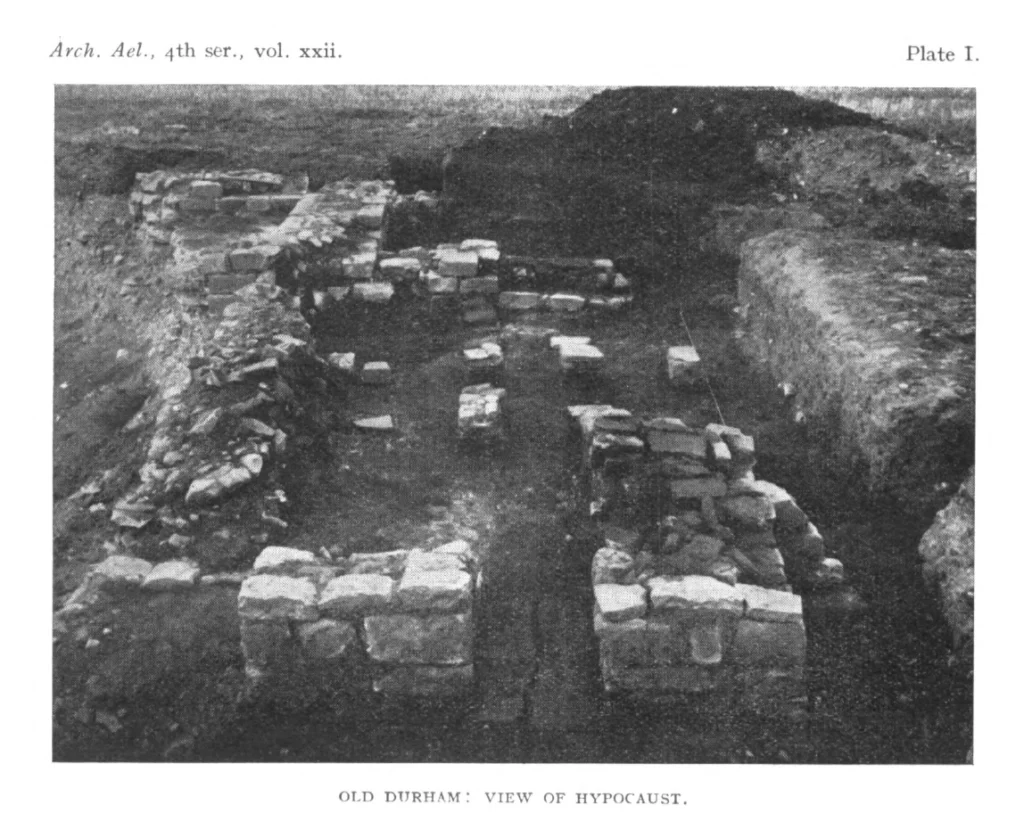
This luxuriance was not uncommon of Roman households, in which hygiene was prized. What was more significant was just how far north these remains were. The territory of the Empire stretched across the entirety of Europe and much of North Africa. Its expansion only recoiled before the baking sands of the Sahara and the barbarians of northern Britain. The Emperor Hadrian had constructed a vast Wall to counter the encroachments of the latter and stabilise the region.
However, the baths at Maiden Castle were not large enough to have been for military use, but seemed to have a merely civilian function. This contradicted many of the preconceptions then in vogue: that northern England had been a heavily militarised region of continuous forts, not without their bathing conveniences, as further digs at Vindolanda, Chesters, Wallsend, Carlisle and Chester-le-Street just up the road (a Roman Road, i.e. Cade’s Road), have shown us.
But as for civilian adoption of the Roman way of life, the most northerly Romano-British villa was then thought to be Middleham in North Yorkshire, some fifty miles to the south. Indeed the profusion of villas in Britain ends in North Yorkshire. But following this find in the 1940s, more tranquil scenes of rural existence could now be vaguely perceived in Durham.
Richmond, Romans and Wright even speculated that the remains might indicate a hitherto unknown number of civilian settlements as far north as South Shields, but buried by years of industrial and agricultural activity.

Fruits of Civilisation
Those that once dwelled at Old Durham, we can imagine, were Romanised Britons, who had inhabited the land prior to conquest. Alternatively, it is possible that they had arrived with the Romans or were Roman themselves: ex-soldiers perhaps who had been granted land for their services or otherwise remained in Britain after the conclusion of their years of service.
Indeed at the time, the discovery was readily explained quite easily: the legions that guarded the long and lonely miles of Wall required sustenance, and the land around Durham was fertile and well-watered. The army thus provided a consistent market to produce more than just subsistence level produce.
Again though, it can now be seen that at least along the eastern section of Hadrian’s Wall, typically a mile north of it, lie a series of smaller and more basic Romano-British farmsteads, presumably existing to supply the forts. No bathhouses or similar statements of luxury have been uncovered there.
Could it be then, that the people who lived at Old Durham and Maiden Castle were of more significance than ordinary client farmers and had accrued additional wealth by engaging in wider trade, primarily on the River Wear?
Further Reference
‘A Civilian Bath-House of the Roman Period at Old Durham’, Archaeologia Aeliana, Series 4, pp. 1-24 (1944) by I.A. Richmond, Rev. T. Romans, R.P. Wright
Further Notes
- It is unclear what happened to the remains. They were likely either reburied, removed or destroyed.
- Albeit in the historic county of North Yorkshire, there is another example of a Roman villa and bath complex further north than Middleham in Wensleydale. Located in Stockton, Teesside, is the Ingelby Barwick Villa, unearthed in the 1990s. This represents a halfway house in the villa frontier between North Yorkshire and Durham City.