By Thomas Bainbridge
The battles of the Hundred Years’ War are well known: Crecy, Poitiers, and most famously Agincourt — in which a motley band of brothers fought and defeated the flower of French knighthood, wreaking devastation upon their ranks with the trusty longbow.

Lesser known in the annals of history is a battle fought on English soil in this same period in which the Scots received just as gruesome a fate.
In 1346, Edward III aimed to reclaim the Kingdom of France for the English crown, after it had been lost in the preceding century. He laid siege to Calais, from which he intended to ferry more troops across the Channel.
Invasion Force
Philip VI of France was intent on stamping out this threat immediately. The Auld Alliance with Scotland remained strong and the brash young Scottish King, David II, son of Robert the Bruce, was “stout and right jolly, desirous to see fighting.”


With English wounds still smarting from the Scots’ victory at Bannockburn a generation earlier, David, at the behest of Philip, prepared to invade the lands of his ancient foe. A great army of 18,000 men was assembled, composed from the clans and houses of Scotland: the greater and lesser nobility, earls and dukes, highlander and lowlander alike, all ready to do battle for their liege lord.
Into England
This formidable force crossed the marches into England virtually unopposed. They entered Cumberland with ease, successfully laying siege to Liddel Peel, and from there continued swiftly along the Tyne to Hexham. Here they sullied that seat of pious reflection and sacked the Abbey over the course of three days.
Coming to the village of Ryton, the forces crossed the river, determined to march south on Durham, the seat of the Prince-Bishops, and thence take the Castle.
One story alludes that King David, upon reaching the boundary of Durham, received a vision of Saint Cuthbert, who bade him not to despoil the lands that he held so dear. Still, David ignored this mental aberration and stayed his course. The initial predations of the Scottish army were to raze the county. They imposed a ‘capitation’ tax upon the local population to grant them ‘protection’ — though it might just as easily have been dubbed a de-capitation tax, since that was the morbid result of non-payment.
English Response
Ravaged by invasion, the English were not wont to meekly accept this incursion. Their blood was up, appalled by the barbarities of the Scots.
Under William de la Zouche, the Archbishop of York, a rival force was convened at Auckland Park. This was joined by smaller detachments as they marched north. The combined might consisted of 1200 knights and men-at-arms, 3000 Lancashire archers, 7000 spearmen, and some veteran soldiers who had been diverted from Calais, It was a force roughly equivalent, if a little less, than that of the Scots.
On the 16th of October 1346, a scouting party under Sir William Douglas spied the vanguard of the English army to the south of Durham. An initial skirmish at Sunderland Bridge, Croxdale, led to the loss of three-hundred Scots, the remainder of whom retreated towards the main Scottish force.
Going on the defensive the following day, the Scots formed up on the moorland to the west of Durham Castle. The English followed in step and entered the vicinity of the town, facing the enemy. Though initially covered by the fog that had descended in the morning air, as it dissolved, the Scottish troops found themselves overexposed and at a great disadvantage in elevation. Furthermore, the sun now threw beams of light squarely onto their lines, obscuring their vision.
From a distance standing atop the tower of Durham Cathedral, the monks prayed for the defeat of the Scots, lest they should face the same abuses as their brothers at Hexham. In order to embolden the English army, another group of monks walked directly to the field of battle holding above their heads the white shroud that had been laid over Cuthbert’s body .
The English forces advanced in four divisions, each led by its own commander. Ralph de Neville took up the left flank, marching against the Earl of Moray’s troops. On the right, Henry de Percy advanced squarely on the position held by King David. In the rear, the Archbishop of York brought up reinforcements to plug the centre. Each flank was anchored by ridges, and a burn running north to south funnelled the opposing armies into confrontation.

- We may think the role of an archbishop is to be a leader of the Church and spiritual guide for the nation. However, the Archbishop of York, William de la Zouche, was also Lord Warden of the Marches, and so charged with the defence of the northern frontiers of the Kingdom.
Battle Unfolds
The Scottish tactic was to form schiltrons, in other words a dense hedgehog-like pike wall. These formations had been decisive at Bannockburn 32 years prior, but were used here to less deadly effect. Though a schiltron could easily see off cavalry, it was less desirable against unmounted troops.
Soon, the English, with their great number of archers, began to pick apart the clustered ranks from afar. The sky darkened as arrows rained down on the Scots while they sprawled in the mire of broken ditches.
One knight, Sir John Graham, sought to ride against the archers and silence them, but was countermanded by King David, who over-cautiously wished to avoid a disintegration of the schiltrons. Graham, incensed, attacked with a smaller force, but was thrown from his lifeless horse, and there retreated from the field.
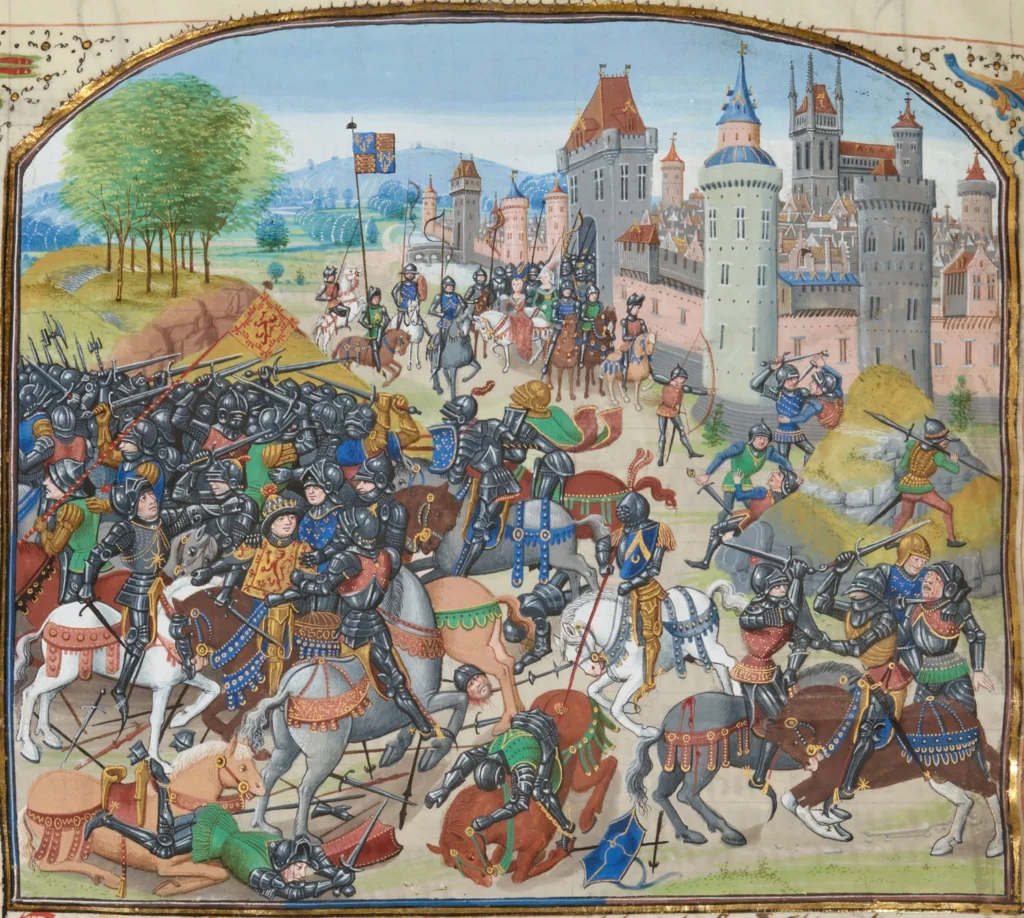
The left flank of the English army under Neville then advanced, coming to blows with the Scots. The fighting was brutal. Locked in a life and death struggle of hacking and thrusting, the bodies piled up.
On the right flank, the Scots had more luck. Less pinned down, they made a general attack upon the English, commanded by Percy, in which the line almost crumbled. However, the Northumbrian detachment at the rear forged ahead in time to prevent the collapse. This sent the Scots, led by Robert, High Steward of Scotland, reeling, leading to a total retreat from the field.
Though victory was in grasp, the fighting continued for hours, in which the Scots, unwilling to yield an inch, were slaughtered en masse.
King Captured
As the sun reached its peak in the sky at noon, one English knight undertook a risky endeavour.
Amid the clamour of the battle, John de Coupland engaged King David in open combat, knocking the sword out of his hands. In retaliation, David struck the knight, spattering blood and teeth onto the ground. Undaunted, Coupland took the King hostage. Riding hard to prevent the recapture of his quarry, he travelled for 34 miles before reaching Ogle Castle near Whalton, Northumberland, to imprison the monarch.
Even so, the battle still raged on, the Scots, though having lost their King, fought doubly hard. However, the fighting degenerated into mere butchery. Struggling Scots were cut down without remorse, while others took to the roads leading north in a bid to return home.
In the final tally, the Scots lost upwards of 3000 troops, including 37 high-ranking nobles. King David was captured alongside many of his retinue, John Graham included, who was later to be hanged, drawn and quartered.
Of course, this was not quite the magnitude of the later French loss at Agincourt, but the extent of the humiliation for the Scots was perhaps greater: their King in bondage and their men massacred. One must only consider the difference in population between Scotland and France to see that the battle had been a devastating one.
For the English, it was a thrilling victory with negligible losses. The Scottish army, the lackey of France, had been entirely defeated. Their monarch would languish in London and Newcastle for eleven years. The Scots had also lost their holy relic, the Black Rood of Scotland — a supposed piece of the Cross upon which Christ had been crucified. This was ironically sent to Durham Cathedral to adorn the shrine of Cuthbert — of whose appeals, David had taken no notice.
Never miss an article. Enter your email or give our FB page a like