
By Crasterfarian

When most people think of Craster they picture kippers, the harbour and Dunstanburgh Castle. Few realise that for many years it was also a thriving industrial port exporting thousands of tons of whinstone to help build Britain’s roads.
By 1912 the quarries on the way into the village were producing so much stone that loading ships had become a real bottleneck. Steamers had to berth alongside the North and South Quays where the water was shallow, restricting them to vessels carrying around 350 tons.
Something had to change.
The answer was one of the most impressive pieces of industrial engineering ever built in the village.


An aerial ropeway, constructed by Messrs. J. M. Henderson & Co. of Aberdeen, carried crushed whinstone around 200 yards from the Quarry to the South Pier head, where it was discharged into enormous storage bins capable of holding around 1,000 tons of road stone.

The bins were designed by Mr A. H. Clark of Messrs. McLaren & Prowde Ltd. of Newcastle upon Tyne, the lessees of Craster Whinstone Quarries.
They were an engineering marvel.
The structure consisted of three enormous elliptical timber wells, each measuring approximately 16 feet by 10 feet in section and plunging 50 feet deep.

The tremendous sideways pressure exerted by a thousand tons of stone was resisted by dozens of heavy flat steel hoops interwoven with substantial vertical timbers running from top to bottom of each bin. The whole structure was heavily braced to withstand both the weight of the stone and the fierce North Sea winds that regularly battered the harbour.
The bins were mounted on a reinforced concrete bridge spanning the Pier head, the only part that remains visible today, with six discharge doors positioned some 23 feet above ordinary high-water spring tides.
When a steamer berthed alongside, those doors were opened and the crushed whinstone simply gravitated down steel chutes into the ship’s hold below.
The objective was simple: speed.
The new deep-water berth could accommodate vessels of up to 1,000 tons, almost three times the size previously able to use the harbour, and it was expected that a full cargo could be loaded in around two hours.
Just think about that.
A thousand tons of stone loaded in two hours, using nothing more than gravity.
As an engineer, I also find the construction of the South Pier every bit as fascinating as the loading plant itself. In the days before CAD and Finite Element Analysis on dynamic loading including side shear and stress from breaking seas and wind, they manged to build something that lasted

The Pier had to extend well beyond the rock end of whin sill, pictured above before the construction started, to reach water deep enough for the larger steamers. That meant the very section which would eventually support the immense weight of the loading bins wasn’t founded on solid rock at all, but on sand beyond the reef.
Getting those foundations right was absolutely critical.
Had the piles settled unevenly, or failed under the enormous load, the end of the Pier could have broken away and collapsed into the harbour mouth. That would have blocked not only the export of whinstone but also Craster’s fishing fleet, the very lifeblood of the village.
Considering the equipment available in 1912, it’s another remarkable achievement by the engineers who built it.
According to The Times of 20 March 1912, the Board of Trade had just approved the scheme.
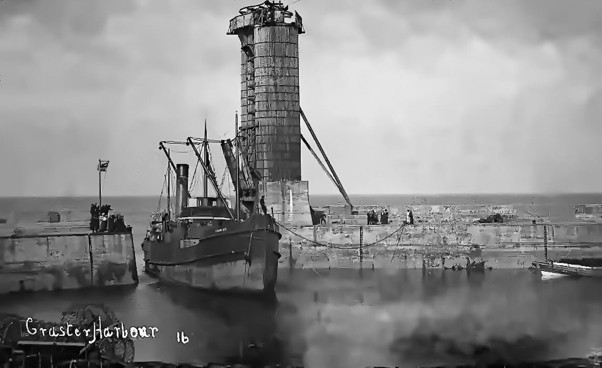
Barely four months later, the S.S. Latchford became the first vessel to load from the new bins. The Alnwick Guardian and County Advertiser reported that she berthed at around 7 pm on Monday evening and sailed again by 9 pm, carrying 450 tons of crushed whinstone.
Not bad going for over a century ago.
Sadly, the loading bins didn’t survive.
Although built mainly from timber, they were bound together by dozens of substantial flat steel hoops.


During the Second World War, when the Chain Home Low Radar Station was established on the Heugh, it was discovered that this enormous concentration of steel interfered with the radar equipment.
The solution was simple, but rather sad.
The loading bins that had served Craster’s quarrying industry so well were dismantled, becoming yet another casualty of the War effort.
I find it strangely fitting that a structure built to help construct Britain’s roads eventually had to disappear to help defend Britain itself.
Sources:
The Times, 20th March 1912
Alnwick Guardian and County Advertiser, 13th July 1912
With love from the Crasterfarian xx
Further Reading: