Coming Soon
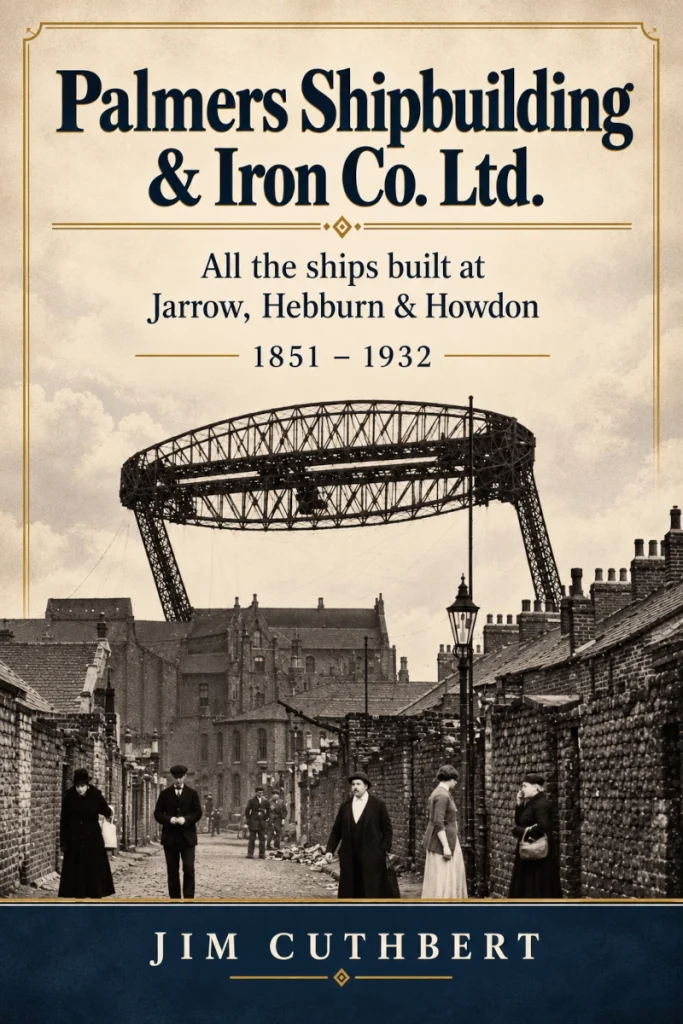
Introduction by Peter Flannery and Foreword by Tom Lynch.
Pre-order your copy by emailing: luan@penbalmedia.com
INTRODUCTION
When I was growing up in Jarrow in the 1960s my next door neighbours had three grown up sons. They were Wyndham, Alec and Jim Cuthbert and all of them helped and encouraged me in my early ambition to one day become a writer. They gave me paper and pencils and they paid attention to my childish efforts to write. It was Jim who took me to visit my first proper bookshop. He waited patiently as I looked at almost every book in the place before finally making my choice: a dictionary. He seemed surprised that I didn’t want something with a story — but that book had all the words necessary for writing my own stories. All I had to do was discover the right order to put them in. I’m still trying — and I still have that dictionary 65 years later.
I have a lot to thank Jim and his brothers for. I’ve never forgotten their help. And so it’s a real pleasure to add my voice to the chorus of welcome for Jim’s “Palmers of Jarrow” — a timely work of research and scholarship, and an invaluable addition to the history of our home town.
Peter Flannery
Playwright and Screenwriter
FOREWORD
Dirty British coaster with a salt-caked smoke stack
Butting through the Channel in the mad March days,
With a cargo of Tyne coal,
Road-rail, pig-lead,
Firewood, iron-ware, and cheap tin trays.
Cargoes
John Masefield
The image conjured up in these well-known lines owes more to poetic licence than the reality of the Tyne-based coal-export trade; the ships that traded down the key east coast shipping lane to feed the households, gas works and power stations of our capital city for over a century were colliers, not coasters, and they carried exclusively coal or coke, leaving the rest of the cargoes mentioned above to others. The steam-powered collier that revolutionised this trade was built at Palmers, Jarrow in 1852, and was called John Bowes.
Before John Bowes, coal was shipped in collier brigs, wooden sailing ships that relied on the wind to make their passage south, a voyage that usually took around a month. When the ships arrived on the Thames, they were allocated a number at Gravesend, and then moved up the river in ‘turn’ order, eventually arriving at the Pool of London, where the coal was discharged into lighters, small flat bottomed craft used to transport goods from moored ships to shore. Once the ship was empty, the master had to arrange for ballast to be purchased and loaded, putting the ship in ‘ship shape’ trim for the return voyage north, where the process was repeated.
All these stages created obstacles for a quick turn round and were the points Palmer would have considered when looking to increase the output of the Bowes collieries, his prime objective as managing partner.
Charles Mark Palmer, born in King Street, South Shields in 1822, son of a merchant and shipowner had a reputation in the early 1840s of having shrewd business ability. He was a coal factor and by 1847 managing partner in John Bowes Esquire & Partners, a leading coal-mining company. It was said of Palmer (Hutt writing to Bowes in Paris) — “he was an active and pushing young man who has cut many of the old stagers out of their best business to their great astonishment and annoyance and hence he is on this account almost universally detested among the merchants of Newcastle.”
Palmer would have been fully conversant with the constraints of the loading of ships — under the provisions of the Coal Turn Act — when he was investigating how to obtain a quick turn-round at this end of the trade. The Coal Turn Act was first enacted in 1766. The proper title — an Act to regulate the Loading of Ships with Coals in the Port of Newcastle and Sunderland. Palmer got round this by erecting a steamer staith at the Jarrow terminal of Bowes and partners
Palmer would also have been familiar with an earlier attempt at improving the sea coal trade. This was the Tyne-built Q.E.D. a sailing vessel with a water ballast system and auxiliary engine which was intended to be used when arriving and leaving port, in particular for the trade to Rouen up the Seine. Whatever the problems were, the Q.E.D.’s machinery was removed about 18 months after it was built, thus removing the ability to pump out water ballast. When used on the London coal trade it would also have to wait its turn along with the sailing colliers.
How exactly the concept of the steam collier was initiated by Palmer with the backing of John Bowes is open to some debate. However, Palmer cites the threat of the railways. Palmer had an insight into railway matters during his dealings around coke contracts etc. Also at this period there is what historians call ‘railway mania’, when it appears that everybody was trying to promote a railway.
Palmer is not the only one to see the railways as a threat to the coal trade. The civil engineer James Rendel who specialised in harbour and river engineering was commissioned by the Tyne River Committee, pre-Tyne Improvement Commission, to make a study of the Tyne. He made a report in 1851 and makes a specific reference to the gradual increase of railways making competition for the coasting trade and therefore the need for various improvements. However, it was many years before the railways made any impression on the sea-coal trade. But in the late 1840s there was a growing disquiet about railways by those who thought their businesses would be affected.
Palmer was not a shipbuilder but a business man who knew the coal trade and had ideas about how to improve it. He foresaw coal being delivered to the Thames on a regular basis and not at the whim of the wind and weather. With the financial backing of John Bowes, he started an iron shipbuilding business at Jarrow with his brother George. John Bowes was the second vessel built by the new company. It should be remembered this was a prototype, but nevertheless a well thought out design for the trade for which it was intended. Launched on June 30, 1852 it had the capacity of 650 ton or 30 keels, about the same as two average sized collier brigs. Palmer was good at self-promotion and made a big event of the launch, including getting an illustration in the Illustrated London News; at which there were about 350 guests included all the local Mayors. After the vessel was safely afloat, lunch was served to over 200 people in the yard and included champagne on ice. It was more usual at most yards for many years to entertain the launch party to refreshments in the joiner shop, (the cleanest work space in a shipyard). At 6 pm the tables were cleared and a ball commenced; special trains were arranged to take the guest’s home.
John Bowes left the Tyne on July 29, 1852, on its maiden voyage (calling at Sunderland possibly because of engine problems, as the passage was made at reduced speed). Palmer had arranged for John Bowes to discharge in the new Collier Dock. There is an illustration in the Illustrated London News, I have always attributed this to Palmers PR guru, however I now believe it is the PR department of the authorities on the Thames, highlighting the dock facilities with the new Armstrong hydraulic cranes for rapid unloading and direct access to the railway. If the dock was used more, it would be a positive step towards easing the congestion of the Pool. John Bowes arrived on Saturday and was immediately cleared to sail. To get this clearance the vessel would have to have paid the coal duty, in this case it would have been calculated from the loading certificate supplied in the Tyne. Using this alternative Palmer avoided the use of meters and lighters, and also of using coal-heavers whose delivery rate was 49 ton per day and was rarely exceeded. John Bowes returned to the Tyne in less than a week having completed a very successful maiden voyage and meeting Palmer’s expectations.
As a prototype there were problems, the water ballast system gave serious problems, information is sketchy but Palmer speaking in 1855 at an Institute of Civil Engineers meeting said “we tried water ballast in a double bottom with an iron tank top, this leaked so we replaced it with a timber tank top this also proved unserviceable. We then tried large tanks in the sides, but were compelled to remove them. We then had recourse to bag-ballast, which was also rejected.” Eventually a workmanlike double bottom arrangement was developed, known as McIntyre tanks. McIntyre was the manager of the Jarrow yard and the man responsible for building John Bowes.
Was the John Bowes a success? Technically yes, as this steamship is recognised as the precursor to the modern bulk carrier. Most cargo ships built for many years are in many respects larger examples of John Bowes, with machinery and accommodation aft and an adequate water ballast system.
The Palmers shipyards and steelworks were the catalysts behind the rapid expansion of Jarrow from a small pit village to an industrial powerhouse in the late 19th century, at one time the largest shipbuilder in the world by tonnage launched. The company took a lead in building Jarrow Mechanics Institute, opened in 1864, followed by Palmers Memorial Hospital a few years later, with the workforce contributing to the upkeep of the hospital by deduction from wages.
The company operated a smaller yard on the north bank of the river at Howdon, which was eventually closed when they acquired the former Stephenson Yard at Hebburn in 1911, which became Palmers Hebburn Yard. In 1919 they opened a large hostel, midway between the two yards, to house some of their larger workforce.
The business went through the usual peaks and troughs over the decades, and played a significant role in building war and merchant ships for the Great War. But by the time of the depression of the late 1920s there was an overcapacity in shipbuilding — too many yards chasing too few orders. A decision was made to rationalise the industry, and when Palmers’ financial situation became critical, the business was purchased and summarily closed.
The resulting mass unemployment and deprivation lead directly to the Jarrow Crusade, one of the iconic events of the 1930s. Images of the men of Jarrow marching behind their banners, often led by the town’s feisty MP, Ellen Wilkinson, were seen across the world; a sharp contrast to the images of men marching under Nazi and Fascist symbols, which otherwise led the newsreels of the day. Watching the columns of men leaving Jarrow was a five-year-old Jim Cuthbert, standing with his father on an October day in 1936.
A year later, he recalled again standing in the centre of Jarrow as the huge Palmer cranes came crashing to the ground, their twisted metal heading for the scrapheap, where his town of Jarrow seemed to be also heading.
Jim’s schooldays were spent during World War 2, and then he followed a well-trodden path when he completed an apprenticeship as a marine fitter on the banks of the Tyne, followed by National Service in the RAF, and a long career with Post Office Telephones, later BT.
He never forgot the images of his early Jarrow years, and when he retired in 1991, he embarked on a project to create a comprehensive list of every ship built by Palmers Shipbuilding & Iron Co. Ltd. of Jarrow, in their shipyards in Jarrow, Hebburn and Howdon.
Palmers took in iron ore at one end of their yard, and from the iron and steel they created over 900 ships, a classic and rare example of vertical integration. Their production ranged from humble colliers to Dreadnought battleships, and much in between, and in the process developed Jarrow from a small village to an industrial powerhouse. Some ships had long and eventful careers, others were lost through war, or just left port and disappeared without trace.
Jim handed me his formidable history project, which took him over 15 years to complete. He researched ship launch information, technical data and subsequent history; primary research carried out in archives, libraries and newspapers of the day. I have edited and proofed it, and added some photos. In this, the 90th anniversary year of the Jarrow Crusade, I am delighted to help bring Jim’s work to the wider audience it deserves.
Tom Lynch