
By Thomas Bainbridge
The North East has produced countless innovators whose contributions have shaped almost every aspect of the modern world.
From coal production and shipbuilding to the development of the steam engine and hydroelectric power, pioneers from across the region played a leading role in driving technological and industrial progress, as vast new industries emerged to meet the demands of the Victorian age.
Mastery over Nature
Above all, it was the invention of the electric light bulb that would herald modernity: to snatch from the darkening skies of winter so many more hours, unhampered by the gloom of candlelight or the inconvenience of the gas lamp. To simply flick a switch and go about one’s day without a second thought is the culmination of humankind’s mastery over nature.
However, its creation was not instantaneous, requiring the fervid efforts of a modern Prometheus to crack the problem. One man more than any other would illuminate the world:
Joseph Swan
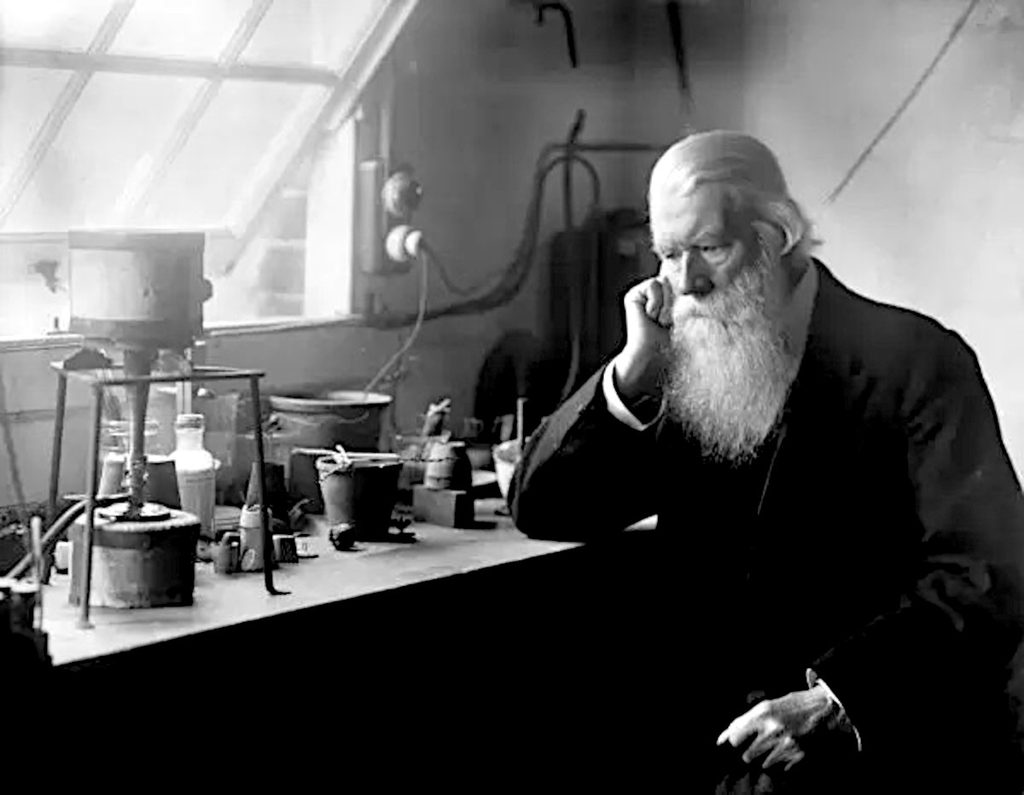
Swan was born in Pallion Hall in Sunderland, 1828. An extremely bright boy, he read prodigiously in the nearby library, and attended public lectures at the Athenaeum, where Sunderland’s Lit & Phil Society was based.
He was fascinated by early efforts to produce incandescent light by the use of an electric current, such as the work the American John Starr conducted in 1844. As there were not scholarly outlets for Swan’s advancement, he instead became apprenticed in Newcastle to a pharmaceutical company owned by John Mawson, operating at 13, Mosley Street, which was at the time, the town’s showcase thoroughfare.
With access to a laboratory, Swan continued his research, and made use of the chemical materials allotted to him. Having also been drawn to another burgeoning technology, photography, he successfully replicated a technique employed by fellow Englishman, Frederick Archer, synthesising collodion in order to reduce the exposure time required to produce a photographic image.
Mawson began to sell the substance, and, seeing the value of Swan’s potential, made him a partner (aged only eighteen), the company then being renamed to Mawson, Swan and Morgan. As an early adopter of the method, the company turned over a handsome profit, while Swan worked tirelessly to continually make improvement.
A New Idea 💡
In 1850, he began to experiment by varying the current and type of material used as a filament encased in a glass bulb.
Still, his early efforts were stunted by the scientific limitations of the day, as there was not yet a device to produce an effective vacuum, without which the filament merely fizzled out.
Swan thus had first to overcome this hurdle. Here too he was a trailblazer. He worked for over a decade, and in 1863 exhibited a design at the British Association for the Advancement of Science. He mocked up a pump using mercury which trapped air as it fell, thus allowing it to be slowly evacuated from a glass tube. Notably, this was two years before the same mechanism was said to have been invented by the German scientist, Hermann Sprengel. Still, it would be another 10 years before Swan was able to make any considerable further advance.
In this period, Swan faced some severe blows. His mentor, Mawson, was killed while handling nitroglycerin, a component of dynamite, and then in 1869 his first wife Frances died. He would later marry her sister Hannah in 1871.
From 1869, Swan lived in Underhill on Kells Lane in Low Fell, Gateshead, working continually in the makeshift lab he had fabricated in the conservatory, striving to achieve his goal. Ten years later he finally met with success…
Illumination
On 18th December 1878, a public demonstration was held before the Newcastle Chemical Society in which Swan unveiled a singular light bulb. Running the current through it, it emitted a warm glow to the amazement of the meeting. However, it sputtered out after a few minutes.
Undaunted, Swan went back to the drawing board and honed the specifications of his invention. Within three months, on 3rd February 1879, he made another public demonstration, this time in the reading room of the Literary and Philosophical Society in front of seven hundred onlookers, packed tightly to catch a glimpse of the miraculous creation.
In a theatrical twist, all seventy gas-lamps were extinguished and the room hung in darkness, then instantaneously, thirty bright glowing orbs appeared, flooding the room with light.
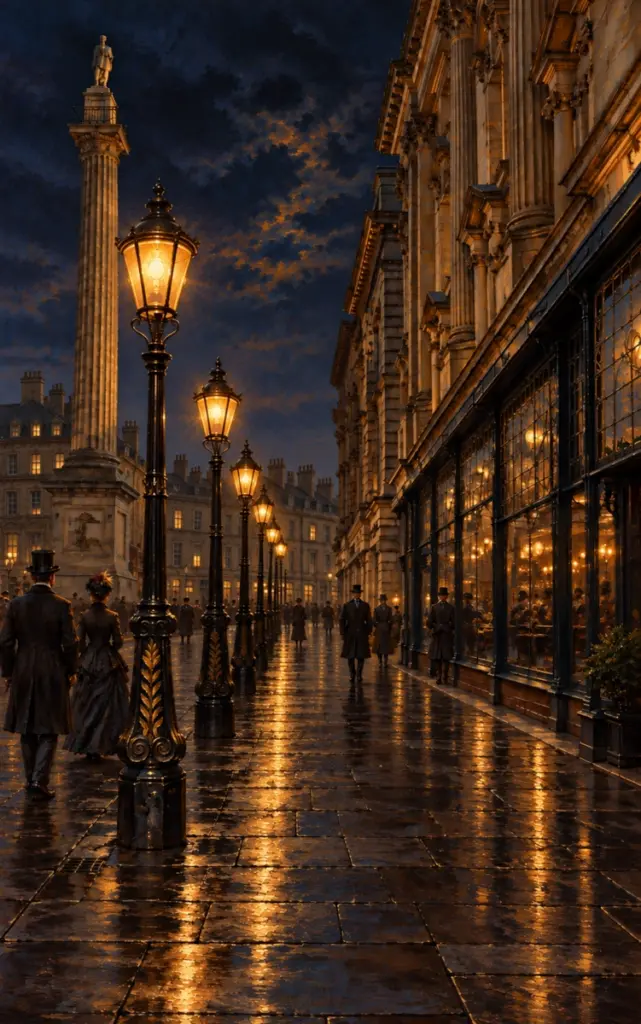
The advantage of electric light was obvious, and the Lit and Phil was permanently bedecked with the system, while elsewhere there grew increasing desire to adopt it.

The World’s Most Advanced House
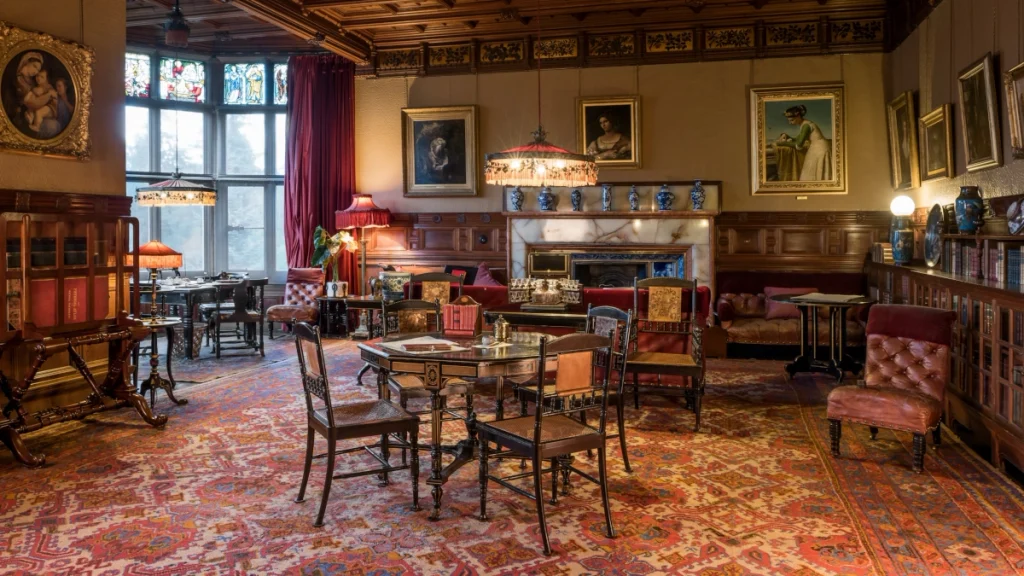
As Swan had already employed it in his own home, he was approached by his friend and fellow industrialist, Sir William Armstrong, to also rig out his Northumberland country home, Cragside.
Together they sought to use the elemental forces of nature by harnessing the energy produced by Cragside’s lake and flowing streams, and so were the earliest proponents of hydroelectricity.
By this method, they successfully lit a single arc lamp in Armstrong’s art gallery in 1878, and later installed the system in the library in 1880.
Business Grows
In 1881, at the age of 53, Swan formed a company to manufacture his bulbs at Benwell, exporting them across various markets, being fitted into the naval ship HMS Inflexible that same year.
Swan also turned his mind to a more formidable problem, the very same that Stephenson and Davy had vied over fifty years earlier: How to improve the lot of pit-men?
Though the lamps of the pair had been important milestones, there was still much to be done. Swan believed that electricity held the key. In May, 1881, he exhibited a prototype lamp which required a wired power supply, though it was some years until a battery system was effectively developed.
The problem was complex, but an electric bulb, being both more luminous and safer than a flame, slowly became the most viable and practical option.
The further applications of Swan’s invention were limitless. In 1883, the Savoy Theatre approached Swan to install electric lighting, arousing the delight of the audiences who had been so used to dimness from the stage.
Formidable Competition
During this time, however, across the Atlantic, another tinkerer, Thomas Edison, was himself engaged on the same problem.
Having read of Swan’s method, Edison replicated the results, creating a working bulb in 1880, which lasted 1,200 hours.
Though Swan was the first to make the initial breakthrough, through the intricacies of patent law, Edison was able to file his own design which was supposed to have made minor improvements.
Certainly, Edison had hit upon a slightly more desirable material by using carbonised bamboo for the filament.
Still, the basic design was Swan’s. Legal action ensued: Swan sued Edison in Britain, while Edison sued Swan in America. The British courts upheld Swan’s patent, and Edison, fearing that he might lose in America also, negotiated a merger.
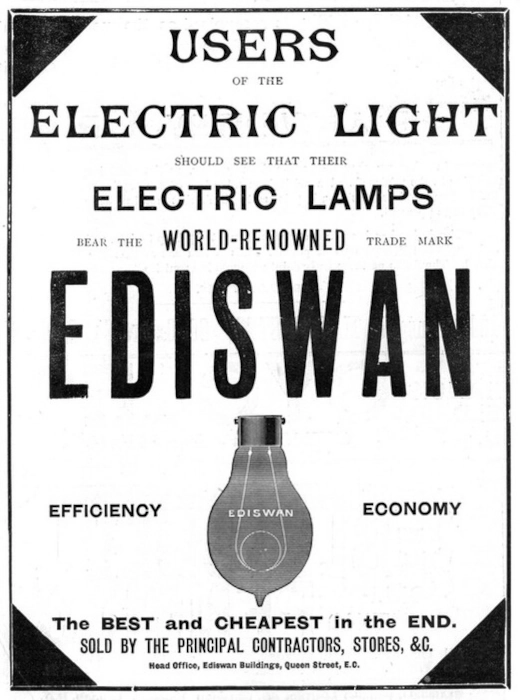
In 1883, the pair formed a partnership, creating the Edison and Swan Electric Light Company, billed as Ediswan. The design of the bulb was merged, using Swan’s bulb and Edison’s filament. The company retained premises in Deptford and Pallion, Sunderland, where Swan had been born, until 1964, then being renamed British Lighting Industries.
In his time, Swan was widely recognised for his invention. Among the honours bestowed on him, he was knighted in 1904, and despite his lack of official scientific credentials, was made a member of the Royal Society in 1906. In fact, it was in France where he first met with plaudits, as he was made a Chevalier of the Legion of Honour, as his electric light was displayed in the 1881 Paris Exhibition, where it would soon radically transform the city, alongside all the capitals of Europe and the world.

Never miss an article. Enter your email or give our FB page a like
In PenBal articles, AI imagery is sometimes used where an appropriate historical photograph or illustration doesn’t exist.