By Crasterfarian
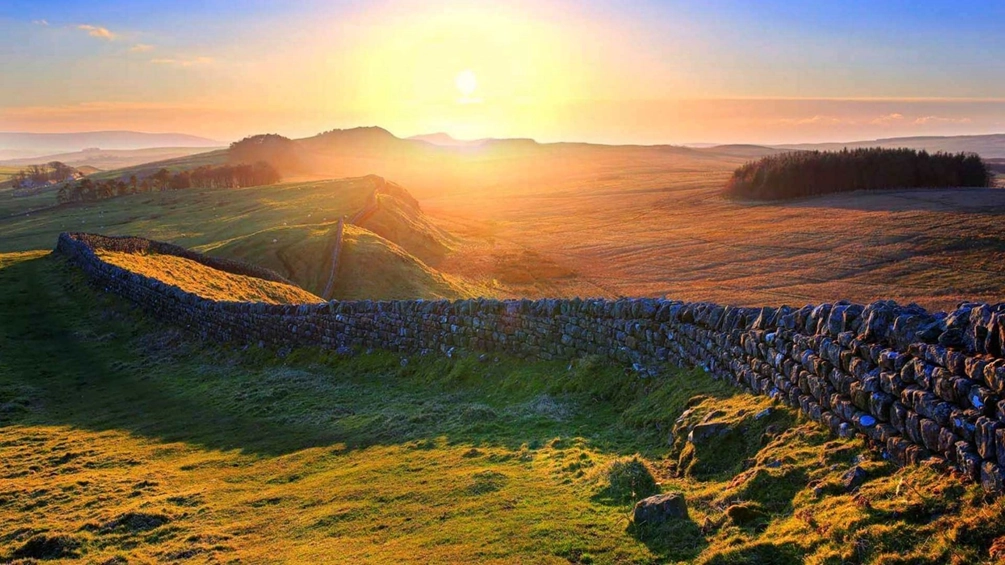
Many people travel from all around the world to visit our World Heritage Site at Hadrian’s Wall, and rightly so. They “ooohh” and “ahhh” at the remains of the Roman marvels that lie scattered over our stunning landscape. Yet they miss one of the Wall’s greatest survivors, forsaking it for other, seemingly more worthy sites.
They wish to soak up the atmosphere of what a true frontier existence must have been like for those stationed here two thousand years ago.
Early pre-Wall sites like Vindolanda provide a human element, with all the amazing work carried out by the Birley family, who purchased the site in 1930. The selfless and tenacious work of the family and their dedicated staff continue to this day, with annual digs that can be enjoyed by members of the public. The discovery of the Vindolanda Tablets being the crowning glory of the site, do yourself a favour and visit.
Humanity
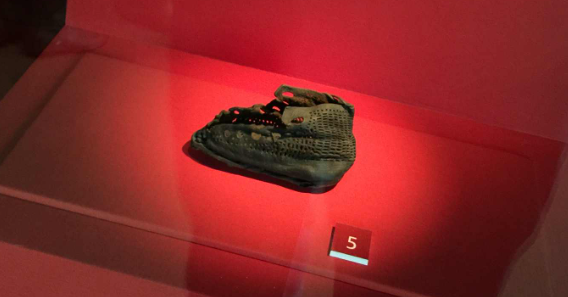
The handmade child’s shoe in the museum always brings a tear to my eye. A beautiful thing, made with love and care, not the mass-produced shite we see cramming every nook and cranny of the world now.
Artisan, beautiful, made with love.
I often wonder who its owner was, their feet clattering over flagged floors, running, playing chase, and giggling with their siblings or friends to see their Mammy to ask something, just like kids of today. Did they join the legions and march off into the unknown? Were they to suffer illness or disease and die in childhood, as so many others did? All lost in time now, like tears in the rain.
Golden Hour
The Wall itself skirts the Whin Sill like architectural fairground bunting, its forts and milecastles suspended from it like banners of superiority that echo down through the millennia from a time when the land was ruled by the iron fist of Pax Romana.
People stand upon the highest point at Steel Rigg, with their arms round a loved one, or with the setting sun silhouetting their children, and watch the remains of the Wall illuminated in the golden hour as it dips below the western horizon. It’s very moving, and something you should all do at some point.
It grounds you and reminds you that nothing is forever.
Deployment
However, I bet those hard-pushed legionaries of the 6th, Legio VI Victrix, thought differently.

They had just arrived at York from southern France and were tasked with the construction of the Wall. Canny posting. I bet there was some whingeing in the barrack blocks of Eboracum, rain, sleet, snow, wind, damp boggy ground, and oh, you must build a wall that’s 80 Roman miles long across some of the most challenging terrain in the Empire…
I bet there was many a legionary who regretted their decision to join, especially as they were here to replace the Legio IX Hispana, who had recently ‘disappeared’ somewhere north of the Stanegate road (aye, I know they probably didn’t, but I like to think they got howked airl owa by some of the lads from Rothbury or Alnwick while on the lash in the Bird and Bush or the Blue Bell on Clayport Bank).
It’s also worth adding that the Sixth Legion weren’t the only legions involved in the building of the Wall. There was also the 20th Valeria Victrix, based at Deva (Chester), and the 2nd Augusta, based at Caerleon (Carlisle).
As they constructed the Wall from east to west, they will have had pride in what they did and would have thought, “Who will better this?” — “This will remain forever!”
Thick walls with stout turrets and milecastles will have seemed like an eternal legacy to them at that time, all cemented together with a mortar so resilient it was sampled by scientists in the 1950s as a potential casement cement for moving nuclear waste.
Yet here we are now, with a little over 10% of the entire Wall left, wiped from history and robbed to its footing as a ready-made masonry quarry or food for lime kilns.
If it wasn’t for the central section and its precipitous height, which meant it avoided the wholesale destruction of General Wade’s military road in the mid-18th century, there may have been nothing left at all.
A Remarkable Survivor
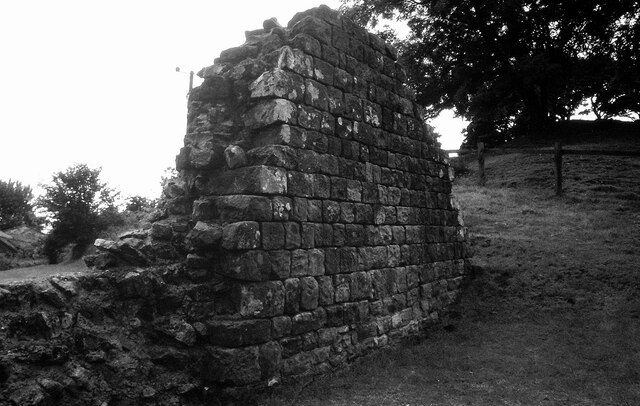
Yet, hidden away off a small farm track to the west of Banna Fort at Birdoswald, lies Hare Hill.
You’ll find it here: https://w3w.co/digit.splint.fattening
Unless you’re walking the Hadrian’s Wall Trail, you’ll likely miss it, it’s off… just off, the beaten track.
Tucked away on the back roads of east Cumbria, it’s lain largely unnoticed for almost 2,000 years.
While most visitors head for Lanercost Priory, I’d urge you to pop ya heed roond the corner and pay your respects to this remarkable survivor.
No one knows for certain why it endured when so much else was stripped away.
There’s speculation it may once have been tied into a medieval timber building, but hard archaeological evidence is thin on the ground.
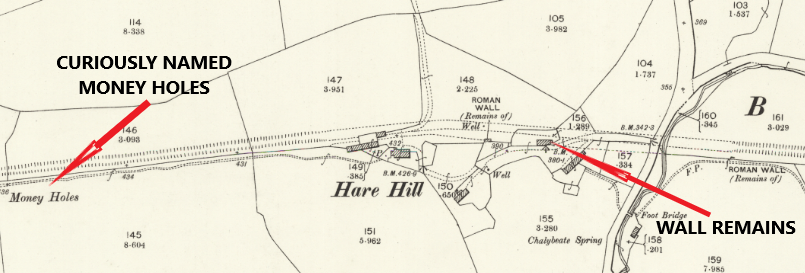
What makes Hare Hill truly extraordinary is its height. It is one of the very few places along Hadrian’s Wall where the masonry still rises close to its original scale. Elsewhere, the Wall was robbed down mercilessly, often to its foundations.
The contrast is stark when you realise that Milecastle 53, barely eighty metres away, was completely robbed out.
Against that level of destruction, this survival feels little short of miraculous.
The stone still stands some 4.5 to 5 metres high, the tallest in-situ remnant left to us. Its Roman core remains exactly where it was laid nearly nineteen centuries ago, probably by men of Legio VI Victrix, still holding its line against wind and weather.
Though the upper courses were rebuilt in the nineteenth century using fallen Roman stone, the height and mass remain true to the Wall’s original intent. Nowhere else does Hadrian’s Wall speak so plainly of what it was meant to be.
What else happened here during the Roman occupation?
Was it ever attacked by radgie locals hellbent on revenge for having their land taken, or their tribe split in two by a stone frontier?
The curiously named ‘Money Holes’, marked on older maps, may offer a small window into that past.
Was a Roman coin hoard found here in the days before such discoveries were recorded or declared?
Could it mirror what I’ve written about previously at Milecastles 11, 12, and 13, where similar hoards of Roman wealth came to light?
Once again, we’ll never know for certain, and perhaps that mystery is part of the place’s pull.

As we turn another year, and the sun sets on 2025, some 1,903 years after Hadrian’s Wall was first laid, it’s worth pausing for a moment to think about what really matters.
Remember, time and age corrupt, walls crumble, empires come and go, even the mightiest things fade with time.
What lasts is far simpler, the people we love, the moments we share, and the care we show to those around us.
Enjoy the here and now, cherish those close to you, and look out for anyone who needs a bit of support, because in the end, that’s what truly endures.
It’s not the contents of your wallet that matter as you reach the end of life’s journey but the love in your heart, as my 93yr old Mammy Joan always says ‘It’s a grand life if you don’t weaken’.
Happy New Year.
With Love from the Crasterfarian XX

Keep up the good work