
By Crasterfarian
I’ve written a few pieces lately on my interpretation of events in Bernicia around 630 AD, or “The Golden Age of Northumbria” as it was to become known, and I feel I’ve done both you and I, a disservice.
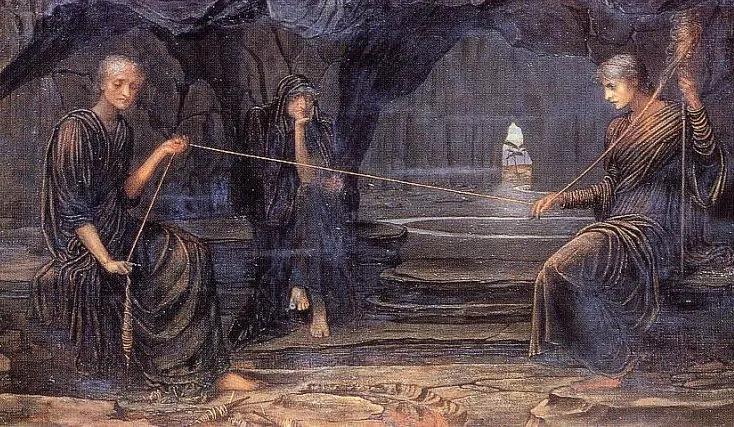
Rather than treating these events as separate stories, I want to try and thread them together, woven like the work of the Sisters of Wyrd, spinning the threads of our lives.
The Sisters of Wyrd were figures in early Germanic belief who personified fate itself.
In the Dark Ages, wyrd meant the unfolding of events, the pattern of what must become, effectively what we call fate or pre-ordained destiny. Once spun by the sisters, it could not be changed.
Later Norse tradition names them Urðr, Verðandi and Skuld, linked to past, present and future, and describes them as weaving or carving the destiny of all people. A modern comparison might be the precogs in the film Minority Report.
They were not worshipped as gods in the usual sense but feared and respected as the unseen force behind life’s course, the weavers of destiny controlling the lives of all on Middle Earth.
Last summer I wrote a piece on the Battle of Heavenfield and the events that led up to that monumental victory for the Northumbrians, based on historical fact and my interpretation of it.
Obviously, it was challenged by other schools of thought, and that’s brilliant.
One thing that has always sat uncomfortably in my ravaged heed is the actual timeline, the distances, the weather, and other factors, and how all of this could have occurred over a period of little more than a year.
What I’ve been thinking about, aye danger ahead, he’s been thinking, is that very timeline, the logistical challenges of the time and tying all these events together in a plausible, coherent manner.
I want us to have a think about feasibility with this one. I’m not saying ignore the historical record and Bede’s writings but let us not forget that Bede wrote his Ecclesiastical History around 100 years after the events of Edwin, Eanfrith, Oswald, Cadwallon ap Cadfan and Penda, and let’s face it, if someone tells me a story in the pub, it’s different, usually better and more flamboyant by the time I’ve telt wor lass at hyem.
Let’s Consider the Timeline (Map is numbered)
- Late 633 to early 634: Cadwallon ap Cadfan, allied with Penda, exploits the collapse during a prolonged campaign of devastation.
- Winter 633 to 634: Raiding, dispersal and attrition weaken both sides; central authority in Northumbria ceases to function.
- Late 633 or early 634 probable: The royal complex at Ad Gefrin is violently destroyed.
- Summer 634: Osric of Deira attempts to confront Cadwallon and is killed at York (Eoforwic).
- Late summer 634: Eanfrith of Bernicia, Oswald’s older brother, is murdered while seeking terms.
- Late summer or early autumn 634: Oswald emerges, gathering a small but cohesive force at Bamburgh (Bebbanburg).
- Autumn 634: Oswald takes position near Heavenfield by Hadrian’s Wall; battle follows.
- Aftermath: Cadwallon flees and is killed at Rowley Burn (Denisesburna).

As we can see on the map, the distances for that time are huge in relation to the tight timeline of events.
The traditional account of Heavenfield comes to us through Bede, writing with a clear theological purpose. Let’s not forget, Christianity had a feeble hold and stories to bolster the power of the Christ God would have been helpful.
His narrative is the power of God prevailing after a cross was raised, prayers offered and even the unconverted warriors in Oswald’s retinue bowed before battle.
The story of Heavenfield, in isolation, is a grand one of good over evil, believers in the new Christ God slaying the followers of Thunor and pagan ways. But when you widen the lens, the sequence becomes jumbled and the timeline and distances appear almost impossible.
As the Wyrd Sisters Weave
The saga starts immediately after the death of Edwin of Northumbria at Hatfield Chase in October 633.
No 1) the lowest point on the map above, it’s a huge distance from his home at Bebbanburg, the site marked on the map is also the most northerly possible location of the battle.
It’s near Lincoln and an eye watering 150 miles as the crow flies, not to mention all the difficulties of crossing rivers and streams. That would be a minimum of 2 weeks marching, everyday trudging in the changeable weather of Albion. Unless of course Edwin had already massed his army at Eoforwic (York), in which case 2 to 3 days march.
So we have to assume the latter, and that the call went out to the Fyrd to rally at Eoforwic, meaning some of the warbands of warriors will have travelled those 2 weeks to be there and will have been exhausted from the travel.
The defeat came late in the campaigning year, so we have to assume that any travelling men came after the harvest had been gathered. So the timeline fits so far.
Days were getting shorter, the age old and well-trodden Roman roads were breaking into mud, and the Northumbrian host did not retreat after the shield wall broke, they dissolved into the landscape to escape certain death.
Survivors of the battle, probably still in the warbands that arrived at Eoforwic at the calling of the Fyrd, will have scattered and attempted to disappear on their way back north.
Running and hiding as fugitives from the rout of the Welsh and Mercian pursuers.
The chase will have been short, as the victors won’t have routed them long, as the spoils of war on the battlefield will have been a huge draw. Men, particularly warriors, travelled with their wealth, it was tied up in arm rings, torques and other jewellery, not to mention fine swords, mail shirts and shields.
In these conditions Cadwallon ap Cadfan, allied with Penda of Mercia, did not need to pursue a single group of fleeing men.
Bede’s “year of devastation” will have been just that, a load of lads who had just won a scrap and wandering about taking whatever they wanted, meandering north into Bernicia, consuming the available resource. However, based on a minimum of 2 weeks march to Ad Gefrin and the burning of the summer palace at Yeavering, they must not have tarried long on the relentless surge north as it must have been destroyed between the Battle of Hatfield Chase and the slaying of Osric in the summer of 634.
The Burning of Ad Gefrin

Within a short span of time, from late October 633 to the destruction of the royal complex at Yeavering, Ad Gefrin, the events must have moved rapidly.
The invading forces of Cadwallon ap Cadfan and Penda of Mercia would have had roughly 150 miles to cover from Hatfield into northern Bernicia.
In the depths of winter, such a march would not have been swift. It seems unlikely that Ad Gefrin was destroyed immediately. A more plausible window may be early spring 634, after months of destabilisation and slow northern advance. Putting down any resistance on the way will have soaked up many days.
By this time Ad Gefrin may have been thinly defended, many warriors already lost at Hatfield or scattered in its aftermath.
Eanfrith of Bernicia, long in exile in Dál Riata, may have edged back toward the northern frontier of Bernicia upon hearing of Edwin of Northumbria’s march south, perhaps sensing opportunity should the campaign end badly.
When word of Edwin’s death reached him, he could have moved swiftly to Bebbanburg to assert his claim.
Meanwhile, Cadwallon’s forces, seeking to break Bernician legitimacy, may have struck at Ad Gefrin, the symbolic summer palace and visible heart of royal authority, either acting on intelligence of Eanfrith’s movements or simply targeting the most exposed emblem of kingship. The softer underbelly of Bernician rule would be that palace, undermanned, understaffed, weakened by the long winter. Ideal target for marauding Mercians and Welsh. A much softer, easier target than impregnable Bebbanburg. Perhaps a ruse to draw Eanfrith out into an open battle that failed.

The Facts of the Wyrd
Archaeology points to a violent end to King Edwin’s summer palace around this period, perhaps after the winter of 633 and 634, but the texts do not name an attacker. I am assuming it to be the Mercians and Welsh, though it may have been a warband rather than the Kings themselves.
If Cadwallon was engaged in Deira in the summer of 634, where Bede places Osric’s failed attempt to besiege him at Eoforwic, then Cadwallon cannot have been in two places at once. Assuming the siege lasted even a few weeks, the timeline becomes impossibly tight.
The distance alone makes that unlikely. The more plausible explanation is a divided effort, either a detached raiding force operating under Cadwallon’s overall direction, or a deliberate split between the allies themselves.
A division of labour between Cadwallon and Penda fits the political logic of the campaign. While Cadwallon focused on crushing resistance in Deira, plausibly centred on York, Penda’s Mercian forces had every incentive to range independently for plunder and to destabilise Bernicia while it was leaderless. That split may ultimately have weakened Cadwallon, particularly if Penda ranged north rather than remaining in support.
A northern strike against Yeavering would have been symbolically devastating at relatively low cost and would have avoided the impregnable fortress of Bebbanburg. It would also explain why Northumbria appeared to be under attack everywhere at once despite the limits of manpower.
By the summer of 634, that fragmentation had consequences. Osric, heir of Deira, was killed after confronting Cadwallon at York. Deira was once again without a king, leaving the wider region dangerously exposed.
They believed only one obstacle remained.

The Murder of Eanfrith

After failing to catch Eanfrith in Bernicia out in the open, Penda may have tried to goad him out into open battle by burning the summer palace at Ad Gefrin.
He was perhaps untouchable as he may have been holed up in Bebbanburg which, at that time, would have been impregnable, so they schemed and plotted to try another way.
Skullduggery was the name of the game now.
They offered Eanfrith a meeting to sue for peace and give terms for them to leave Bernicia alone. Eanfrith was a Christian man and must have decided to trust Cadwallon on this.
He rode south to his doom, taking only 12 warriors with him.
Bede gives no placename for Eanfrith’s death, which is telling.
It suggests not a famous city but possibly a royal camp defined by supply and access rather than walls, Cadwallon’s army camp.
At this point Northumbria had no king, no unified army, and no safe interior.
His fate sealed, the new King of Bernicia and his retinue were butchered like pigs, possibly in a feasting hall of a nearby neutral lord or perhaps in the tent of Cadwallon’s own camp.
Maybe they got him a little drunk and lulled him onto a false sense of security, then pounced in the night as the men slept.
Either way, it left the door wide open for the succession of the man we have all heard of.
Oswald.
A New Godly Broom

It is against this backdrop of horror, battles, forced marches and murder, that Oswald of Northumbria appears.
Bede’s phrase that Oswald advanced from Dál Riata with a small army is operationally precise.
Perhaps he crossed into Bernicia over the ford at Ubbanford, now Norham, a different approach than Eanfrith. Oswald was, by historical record, a wise and considered man, so not repeating the mistakes of his brother will have been high on his agenda.
What will have been on the agenda would have been revenge for the murder of his kin. Putting right the wrongs of Cadwallon, stopping the rot that had set in and the potential for the pagan gods to return in the form of the King of Mercia and his love of Thunor.
Canny craic, imagine the first day in your new job and you have to raise an army to take on a man that has already killed three kings, all related to you.
Oswald did not raise the full Fyrd of the North, he reassembled survivors.
His force was composite, a Bernician core of hearth warriors and veteran thegns who had not been annihilated at Hatfield, groups of experienced fighters who escaped north and gravitated back to the one truly safe place in Albion, Bebbanburg.
In the months that followed, the word will have gone out and the men came. When he had rallied enough of the Fyrd, he will have set off for this date with the history books. We can only be thankful for Bede and his writings.
Without those words scratched onto vellum and passed down we would know none of this. I’m sure it’s pretty biased and promotes the agenda of a One true God, but at least we have some detail, no matter how sketchy it is. I wrote recently about Oswald marching southwest along the Devils Causeway and him picking up men as he went.
Men from places like Ellingham, Eglingham and Edlingham among many other small now nameless hamlets long gone and ploughed into the earth.
The Alternative Battle Scenario

Cadwallon’s army, though still larger on paper, was also diminished.
A force campaigning for a year in hostile territory bleeds men through combat, sickness, desertion and dispersal.
Penda is not mentioned at Heavenfield, so we have to assume their combined army maybe numbered over 2,000 men. However, at some point between the slaying of Osric and Eanfrith, Penda disappears from this tale or into Bernicia raiding and burning halls.
I wrote a piece last year on the historically accurate version of the battle from Bede’s writings, with my own theories, but a little of it does not make sense.
Heavenfield, although a great spot for mismatched army sizes, is probably still the battlefield but it may have manifested itself differently.
Why would Cadwallon, as described by Bede, coming north on Dere Street from Eoforwic turn left at the Portgate to approach a standing army some three miles to the west, when his goal, Bebbanburg, was to the northeast of the Portgate along the very road on which he marched?
I have another theory of the actual approach and the site of Cadwallon’s camp prior to the battle.
That choice of ground is decisive, and my theory of Oswald hearing the tale of King Leonidas and his outnumbered band of 300 Spartans at Thermopylae from Christian missionaries from Rome still holds true.
He would have used the tract of land between Hadrian’s Wall and Brady’s Crag to narrow the battle front and stop Cadwallon’s vastly superior army taking advantage of its numbers, but maybe from a different side.
Anyone that has driven up to Heavenfield from the bridge at Chollerford will have seen the steep climb.
An approach from the west better fits the ground and the outcome.
The Maiden Way road ran to the west of the River South Tyne. Travel up Dere St from Eoforwic to where Scotch Corner is, then across the Roman Road that traverses west to Penrith, then up the Maiden Way. If pillaging why wouldn’t they? The route north may have been picked clean by Pendas army.
This would give two advantages.
It would allow Cadwallon to head north then approach from the west along a metalled road.
It also meant the only large river he needed to cross with his army to reach Heavenfield was the North Tyne, and if he followed the Roman Military Way that mirrored Hadrian’s Wall, which junctions the Maiden Way at Magnis fort (Carvoran), Greenhead, it would take him straight there.
This avoided the main route up through and over the Roman bridge at Corbridge and provided a more clandestine approach.
There was still a standing bridge at Cilurnum fort, now known as Chesters, at Chollerford. The Roman Wall and its road, the Military Way, crossed the North Tyne on a large bridge.
Seeing Oswald’s army on the hilltop on the approach, the only obvious way through the Wall after the bridge and before the battlefield would be the gateway at Milecastle 27 and Milecastle 26, just east of the North Tyne crossing and west of Heavenfield.
Milecastle 26 would be close to Oswald’s army, so my guess is that Cadwallon accessed the north of the Wall through Milecastle 26. This would allow his men to file through and form up into a shield wall before attempting to climb the rest of the hill, which would be easier than attempting it from Milecastle 27. His superior numbers would have made him confident of victory despite the climb.

Pushing a shield wall up that hill, tired, muddy and fighting gravity will have been Cadwallon’s undoing.
As they crested the rise, the rising sun in their eyes, aye that’s if it was sunny in October 634, the realisation that their larger number could not deploy due to Brady’s Crag would have been soul destroying for the men of Powys.
When their line broke, the retreat was dictated by topography, not choice.
The rout by the Northumbrians will have been a sight to behold, bolstered by religious fervour and driven by anger and emotion of so many of their kin lost at Hatfield Chase.
They would have been unstoppable.
Cadwallon and his men running downhill, being hacked at and slashed from behind, splashing along watercourses toward familiar ground and support, you can almost hear the shouts, Howay lads, back the way we came, but obviously in Old Welsh.
Bede tells us Cadwallon was killed at Denisesburna, commonly identified with the Rowley Burn within the “Devil’s Water” system.
This detail is not incidental, or the site of the killing nailed on
It suggests that Cadwallon’s operational line, his supplies, reserves, perhaps a rearguard, lay in that basin to the west of the Roman bridge at Cilurnum. Maybe they occupied the old Roman fort at Cilurnum or perhaps further west at Brocolitia (Carrawburgh).
It also opens a further plausible possibility.
If Penda had ranged north to strike Ad Gefrin with the intention of rallying later with Cadwallon in the fort at Cilurnum before a combined advance on Oswald, then his absence on the day of battle is possible.
Maybe he was caught up in the pillage of the north or simply could not be arsed with any more death.
Maybe he was just late, no clocks or maps, no sat nav. Maybe he was at the wrong place at the right time for Oswald.
News travels faster than armies. Scouts encountering the rout and the pursuit would have seen enough. A Mercian force arriving late, or receiving word of catastrophe, would sensibly avoid the area rather than throw itself into a broken fight against a victorious enemy.
Heavenfield is a story of sheer unadulterated refusal to accept the Wyrd Sisters’ spinning.
The Northumbrians would not simply roll over and hand all they had to this bully waving the old gods in their faces. No, they would stand and fight. Not only that, they would take the fight to Cadwallon, take him to task for all their shield brothers killed at Hatfield Chase, stand tall against the aggressor and if they failed, at least go down fighting for what they believed.
It was not about Gods, it was about their families and livelihoods, the little farmsteads they had carved out for themselves. It was about survival and standing in the way of genocide, just like our forefathers did in 1939.
Remember, our story is their story.
Their feelings and actions are still echoed down through time. We still make the same mistakes, we still do the same things. Nothing is learned, just perpetuated. Ah, the frailties of humanity.
Here we are 1,400 years later and we still talk of Heavenfield and Oswald’s victory. Good over evil always comes to the fore, but it wasn’t to stay that way, and the horrors of the Battle of Maserfield echo less down the centuries. But that is for the next story…
With Love from the Crasterfarian XX