By Thomas Bainbridge
Michael Heaviside
Born in 1888, Mick Heaviside, initially from Gilesgate, Durham, moved with his family first to Kimblesworth, and then to Sacriston, where his father worked in the local pit. Looking for alternate employment, and the government sorely needing men, he joined the Royal Army Medical Corps as a stretcher bearer, serving in South Africa during the Boer War.
Contracting enteric fever, Heaviside was returned to England, where he married his sweetheart, Elizabeth, and went down the pit after all, working in Burnhope Colliery, and then moving to Craghead.
At the outset of the First World War, he volunteered, joining the 15th Battalion, Durham Light Infantry.

Having fought in the trenches for two and a half years, Heaviside’s unit became engulfed in the Battle of Arras in May 1917, in which the British Army attempted to break the stalemate on the Western Front by mounting a massed attack along the entire sector.
After initial success in storming the German front lines, gaining more ground than had been achieved since 1914, a counterattack once more led to the resumption of static warfare.
The DLI were entrenched on the heights above the small village of Fontaine-les-Croisilles, not more than a hundred yards from the German lines. Disjointed artillery fire continued to fall around the beleaguered troops, and sniper bullets picked off unfortunate souls who reared their heads above the parapet for too long. Each side feared the renewal of the offensive by the other and waited with bated breath…
An observation post, eyeing no man’s land through a slit, spotted a slight movement out amongst the stillness of the battlefield. A canteen was jerkily waved in the air. Someone alive was out there: most likely wounded, if not dying. None dared to help the man, not wishing to put themselves in the line of fire. But Heaviside, remembering his training in Africa, was undaunted.
Taking up a first aid kit, he scrambled over the top, instantly receiving a burst of fire from the onlooking Hun. He then crawled for 60 yards across the barren, broken ground.
One fellow recounted:
“We could see bullets striking the ground right around the spot over which Heaviside was crawling. Every minute we expected to be his last but the brave chap went on.”

Reaching more than halfway across to the enemy trenches, Mick found the injured man lying in a crater and in a state of delirium, having been lying there over three days. He was close to death.
Heaviside bandaged him up and offered him water which he drank ravenously. However, it was going to be impossible to carry the man back with German bullets whizzing around them. So Mick bade him farewell, promising to return soon. Shuffling slowly, he reached the British lines unscathed.
That evening in the dark, Heaviside and a rescue party managed to retrieve the man, whereupon he was evacuated to a field hospital, his life saved.
Mick was heralded as a hero. He returned to England in 1917 to receive the VC from George V in a ceremony at Buckingham Palace, and later received a parade in his hometown of Craghead.
After the war, he returned to his humble occupation as a hewer, where he would spend the remainder of his days, dying peacefully in 1939, the eve of the second great conflict. Heaviside is buried in St. Thomas’ Church, Craghead, and his medals may be viewed in the soon-to-reopen DLI Museum.
Adam Wakenshaw
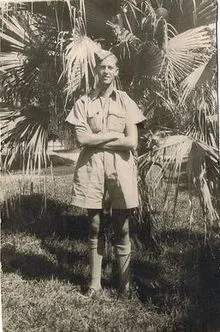
Wakenshaw was born in 1914 and went out to work at a young age in Elswick Colliery, living in Duke Street, near the crossing of Westmorland Road and St James’s Boulevard today — now aptly named Wakenshaw VC Junction.

As war broke out, thinking he would be of some use, and despite being in a reserved occupation, he joined the DLI, 9th Battalion. He then saw early fighting in France as part of the BEF, before taking part in the fateful yet heroic evacuation at Dunkirk.
Still, wars are not won by evacuation, and his unit was soon redeployed to North Africa to confront the Desert Fox, Erwin Rommel, who aimed to blockade the Suez Canal and halt crucial Allied oil supplies.
In June 1942, Adam found himself garrisoned in Mersa Matruh, a backwater straddling the Sahara Desert, after the Germans had forced the capitulation of Tobruk, despite a stout-hearted defence by British imperial forces. Now the full weight of the German attack was to fall upon the British lines guarding Egypt, with the DLI set to meet the brunt of the attack.
Through the first rays of sunlight on 27th June, the Panzers flew across the sands firing their 50mm cannons.
Wakenshaw, part of a larger battery, was operating a 2-pounder anti-tank gun, and slowly, all too slowly, began to pick off the square metallic boxes that dotted the landscape in the distance. But as they came closer, the intensity of fire grew as German infantry appeared en masse.
Soon, half of Wakenshaw’s platoon lay dead, as German half-tracks brimming with storm-troopers approached. An explosion rocked beside his gun, knocking Wakenshaw to the ground, dazing him. Looking down, he saw that his arm had been obliterated below the elbow. Regardless, he sprang to his feet and took up his position to continue to sight and fire the 2-pounder.

Literally singlehanded, he continued to fire unceasingly, his accurate shots blowing Panzers into balls of flame below the blue skies. Still, the Germans continued to pummel his position. With herculean strength and courage, he continued in his duty to the very last, when an exploding shell burst above him, killing him instantly.
It is not known how many casualties he inflicted. However, Wakenshaw’s fusillade had stalled the German attack, who then recoiled in the face of upcoming reinforcements. As they retreated, they left broken vehicles and bodies littered over the desert floor, and would not again threaten the approaches to Egypt, and the vital canal beyond.
The hero was buried in El Alamein Cemetery, where the bodies of British, Australian, Indian, Canadian, New Zealander and all the other Commonwealth nations’ soldiers that had fought and died that day remain.
Wakenshaw’s VC is visible in the DLI museum as the proud ornament of his Regiment.
Dennis Donnini
Donnini was born in the vicinity of Easington Colliery in 1925. His father was Italian and the proprietor of the local ice cream parlour. He attended Corby’s Grammar School in Sunderland, later to become St. Aidan’s.
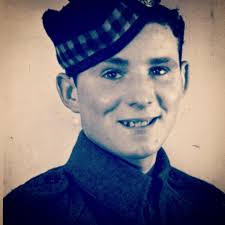
Dennis was destined to take up the family business until, in 1944, aged 19, he joined the Royal Scots Fusiliers. His elder brothers had already joined up, with one, Lewis, having tragically died that year, while another, Alfred, was languishing in a German POW camp after being captured at Dunkirk.
Dennis, being of Italian heritage, regularly received derogatory remarks, or even worse abuse, due to being suspected of holding allegiances to the old country, even despite his brother’s sacrifice in service of Britain. Therefore, Donnini wished to prove himself in battle and remove the slander. But how dearly he would pay.
The opportunity soon arose. After the Normandy landings in June 1944, the Allied armies had pushed right on to the Netherlands and were now poised for an invasion of Germany. Ordered to attack the village of Stein, close to the border, Donnini’s platoon advanced from their entrenched positions into open ground.
As they emerged, the rattle of a Spandau machine gun sent a hail of bullets into their ranks. Donnini was hit in the head. With blood gushing from the wound blurring his vision, he charged towards the enemy. Spying their position, he hurled a grenade into their midst, knocking out the machine gun.

The Germans fearing that they had been attacked by a larger force, retreated in disorder.
Donnini then led his platoon into a barn on the outskirts, providing covering fire as they sought shelter. One man was wounded and slumped to the ground. Dennis, once more disdaining the enemy bullets, leapt forward to drag the injured man to safety.
But he had tempted fate, and was wounded again. One more stray bullet ignited a grenade that hung on his belt, and he was killed, not so long after his 19th birthday.
The Germans were eventually overcome and the village was taken. Donnini’s bravery was recognised, and he was posthumously granted the VC some months later.