By Thomas Bainbridge
Few events stir the imagination so intensely as the terror and exhilaration of battle. The noblest may fall, the most obscure may rise. Reputations are lost and won, daring deeds are woven in the tapestry of history, all in the face of immense danger.
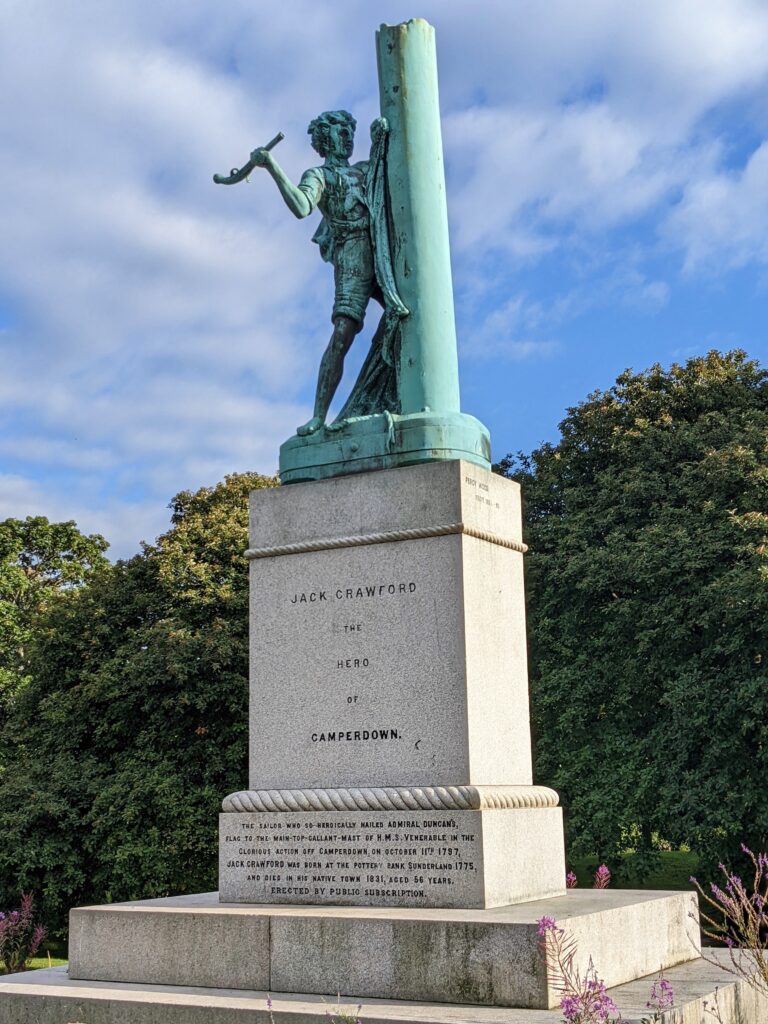
John Crawford (1775–1831) understood this better than most, for it was on him that the laurels of victory were bestowed when he hoisted the colours at Camperdown.
Keelman to Press Gang
Jack was of ‘the meaner sort’: the son of a keel-man, and reared in the same trade. From a young age he ferried coal monotonously to and fro’ along the Wear. This arduous work was undertaken in all weather, operating seventeen hours daily from one tide to the next. Each keel could transport 20 tons of coal which had to be hauled aboard and then unloaded during each trip, propelled along the banks of the river either by punting or pulling the barge by hand.
So strenuous was the job that keelmen were typically incapable of work after the age of 40. It was no wonder then, that Jack sought to find employment elsewhere. At South Shields he became apprenticed aboard the Peggy — a recruiting ship, the crew of which were tasked with impressing local sailors into the Navy. The members of this press-gang were dubbed ‘weary cutters’ (wretched thugs), and went into North Shields from their berth at Peggy’s Hole, raiding bars and gin shops to apprehend their unfortunate victims.
There is little doubt that Jack joined in the unfortunate business: forcibly removing men and boys from their homes and families into a life at sea lasting many weary years and often ending in death. In 1796 alone, over 250 sailors from North Shields were pressed into service on Naval vessels. In this same year Jack himself joined the Navy, though whether as a volunteer or himself receiving a just comeuppance, there is no record. Certainly, keel-men especially were desired for their strength and the wits fostered by their occupation.
Why Press Gangs Were Needed
As brutal as it was, there was a certain patriotic motive behind the activities of the weary cutters. Though overshadowed by the convulsions that would soon overtake Europe during the Napoleonic Wars, the initial threat of revolutionary France was amongst the greatest posed to Britain in her long history. The Dutch puppet state, the Batavian Republic, was to be the pawn in this heated rivalry, doing the bidding of its French masters by mustering its forces for an invasion of Ireland, from which together they could strike at England. As over a century later when Britain found herself alone against Germany, the Royal Navy stood barring the way. At innumerable ports, British ships lay in wait for any sign of movement from the opposing Dutch forces moored behind the Texel — a small island which provided a sheltered harbour on their northern coastline. The Navy needed all the men it could get, whether they were willing or not. Thus, from 1793 to 1797, the manpower of the Navy rose from 45,000 to 120,000.
Mutinies
Yet, this practice of impressment, low wages and stern discipline took their toll upon the morale of the British crews, who began to grumble. Some conspired to mutiny, news of which they hoped would reverberate throughout the entire service.
The first of these occurred at Spithead, when the crews of sixteen ships refused to follow orders and sent delegations to protest the conditions under which they laboured. After two weeks, during which the mutineers promised to end their strike if there was a threat of invasion, the negotiations ended amicably with the agreement of a Royal pardon and a pay rise.
At Great Yarmouth, the crew of HMS Venerable — Crawford among them — were also poised to mutiny, though they were dissuaded by the ferocious anger of Admiral Duncan. Another ship, HMS Adamant, attempted the same two weeks later, to which Duncan dangled the ringleader over the side, exclaiming “My lads, look at this fellow, he who dares to deprive me of command of the fleet.”
In the same month, another rising at Nore along the Thames was less tranquil, as its ringleader Richard Parker attempted to persuade crews to desert to French ports, for which he was later indicted with treason and hanged.
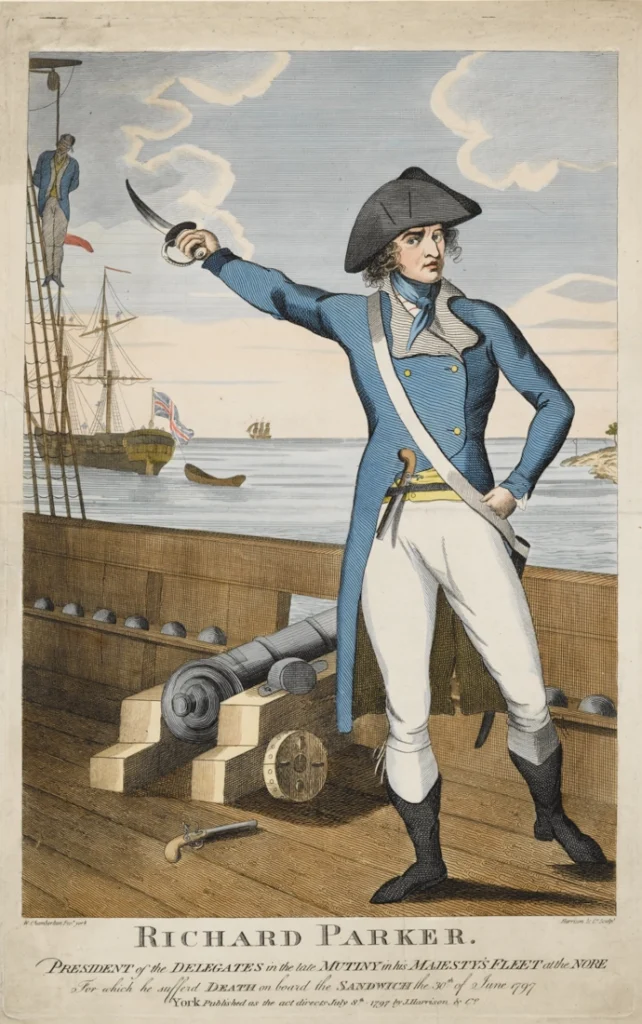
Battle of Camperdown
Despite these vicissitudes, all was forgotten as a greater foe literally appeared on the horizon
In October, the Dutch fleet under Admiral De Winter quitted the straits of the Texel and it was feared were en route to the English Channel, from which they might unite their strength to France at Brest. Such a force would greatly outnumber Britain’s fleet.
Upon being made aware, Admiral Duncan immediately put out to sea to confront De Winter. Seeing this, De Winter attempted to retreat in the face of the British fleet, but, dogged by the quicker British ships, was forced to form a defensive formation.
Watching from the small village of Camperduin, not more than a village and a clump of sand dunes, a crowd gathered in expectation of a great clash. The battle had begun…
The forces were well matched, with 16 British capital ships facing 15 Dutch. As was typical then of naval combat, De Winter’s ships formed a perfect line, sailing north-easterly. Not unlike Nelson’s gambit almost a decade later at Trafalgar, Duncan’s vague plan was to sever the line in order to isolate pockets of the enemy fleet.
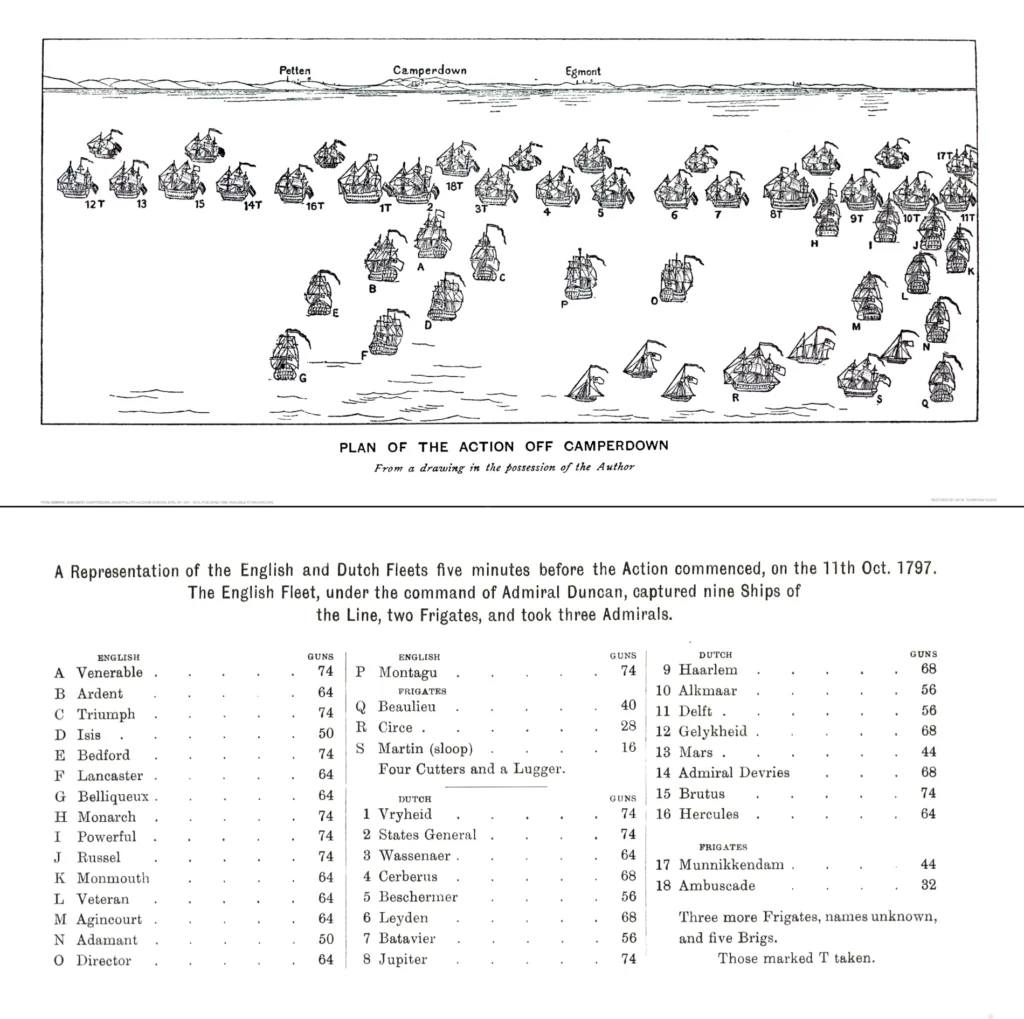
However, his signalled instructions were so confused that many captains were left unknowing as to what to do. One, John Inglis of HMS Belliqueux, simply threw away his signal book and ordered, “Up wi’ the hel’lem and gang into the middle o’t.”
The flagships of the respective fleets, HMS Venerable and the Dutch ship Vrijheid, engaged in mortal combat.
As the rest of the fleet slowly bore into action, the Venerable was also being pulverised by the combined fire of the Dutch: The Vrijheid, the Staaten General, the Admiral Tjerk Hiddes De Vries, and the Wassenaar all trained their guns on the lone vessel.
Amid the hail of splinters and grapeshot, the sails and colours were shorn to pieces. Through the fog of war, the day seemed lost. Had the Venerable capitulated? Had Duncan been killed? Had the colours been thrown down in surrender?
Peering through their telescopes, the Captains of the Triumph and Bedford looked with bated breath as they itched to join the fight. Finally, a touch of red, white and blue was glimpsed through the gun-smoke. The flag rose up the rigging of the Venerable. It was Crawford.
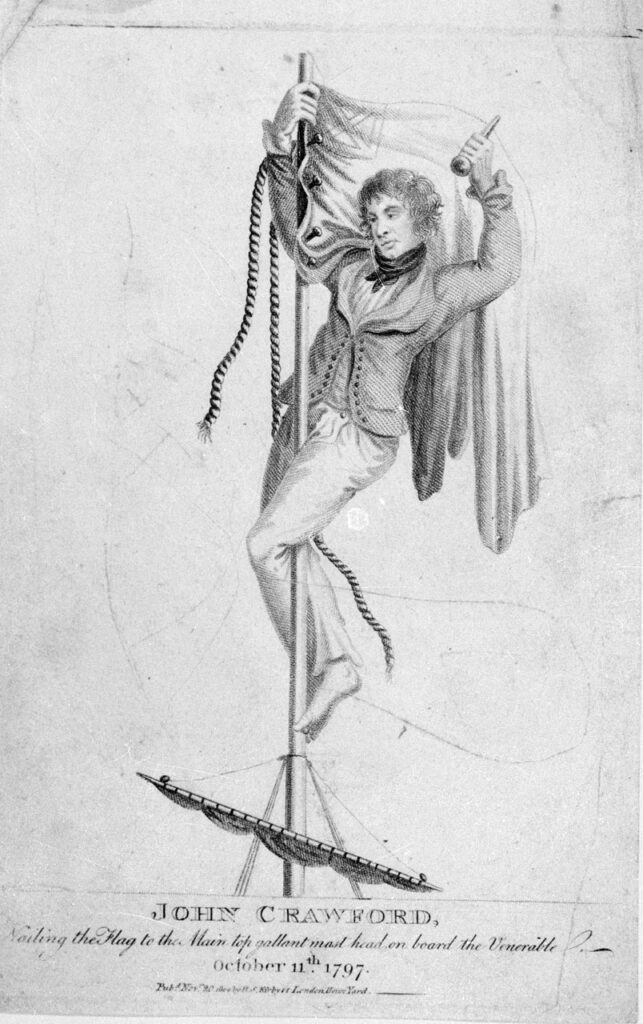
Whatever dissolute life he had led, now he proved his mettle. The brave hero hoisted it high above the mainsail, visible for all to see, defiant despite the raging battle below. He hammered the nails in with the butt of his pistol and with it dashed the hopes of the Dutch.
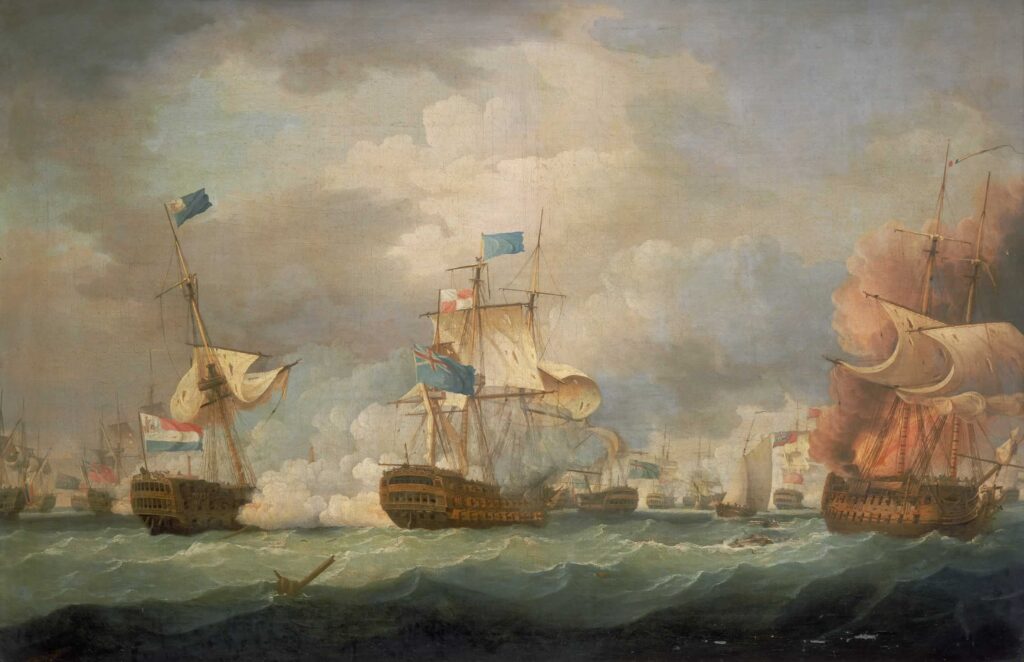
Soon the Dutch found themselves surrounded and outclassed. The men of the Royal Navy could fire three salvoes for every two of their own, and this quickly began to tell. The shattered Dutch ships began to strike their colours, while others were ablaze or floated aimlessly amidst the waves. Though De Winter demurred, he was out of options, and soon forced to surrender aboard the deck of the Venerable, with Crawford, partially the author of his defeat, looking down from the rigging. The battle was won.
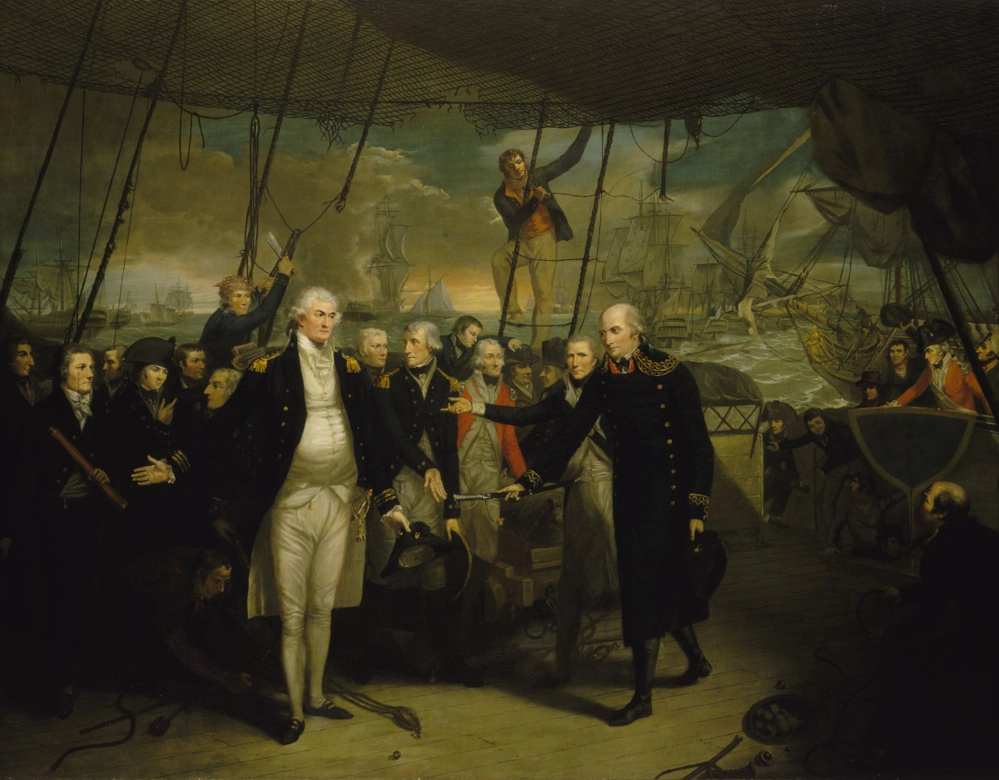
One historian wrote:
“This was one of the severest, and certainly the most decisive, engagements that ever were fought between the two nations, and produced an effect upon the maritime powers of Europe highly advantageous to the character and interests of the British empire. Had the event been different, the northern powers would not have hesitated to join France for the purpose of our subjugation. and to their blind revenge would have sacrificed their own existence. By the defeat of the Dutch fleet on the eastern coast, the designs of the French Directory were completely disconcerted on the western side of the kingdom.”
The losses were primarily sustained by the Dutch: 503 men killed, twice as many as the British, and over 3,000 of their sailors captured, alongside nine, albeit battered, ships.
Of the British, 200 men were killed, and the Venerable, after receiving raking fire, had to be dismantled and reconstructed. However, there was intense adulation at the news of the mammoth victory. Crawford was hailed a hero upon his return to his hometown: in March, 1798, the people of Sunderland presented him with a silver medal in honour of his efforts. Official recognition took a few years. In 1806, perhaps at the end of his naval career, Crawford was brought before George III and granted the healthy pension of £30 per annum.
Despite his national fame, he fell upon hard times as he used his pension to indulge in idle drunkenness, despite having a family to provide for. He continued to live in the East End of Sunderland until his final days when tragically he was amongst the first victims of the 1831 cholera epidemic. An ignoble end for a rogue hero. For many years, a plaque stood at the corner of his birthplace on Thornhill’s Bank (now Pottery Bank) on the Sunderland quayside. A poem recounted the heated events of that day, and the heroics of Jack Crawford:
We had battled all the morning, ’mid the never-ceasing hail
Of shot and shell and splinter, of cable-shred, and sail;
We had thrice received their onslaught, which we thrice had drive back,
And were waiting, calm and ready, for the last forlorn attack;
When the stainless flag of England, that has braved a thousand years,
Was shot clean from the masthead; and they gave three hearty cheers.
’Twas the purpose of a moment, and the bravest of our tars
Plunged headlong in the boiling surf, amid the broken spars;
He snatched the shot-torn colours, and wound them round his arm,
Then climbed upon the deck again, and stood there safe and calm
He paused but for a moment – for it was no time to stay –
Then leaped into the rigging that had yet survived the fray;
Higher yet he climbed and higher, till he gained a dizzy height,
And then turned and paused a moment to look down upon the fight.
Whistled wild the shots around him, as a curling, smoky wreath
Formed a cloudy shroud to hide him from the enemy beneath.
Beat his heart with proud elation as he firmly fixed his stand,
And again the colours floated as he held them in his hand.
Then with pistol deftly wielded, ’mid the battle’s ceaseless blast,
Fastened there the colours firmly, as he nailed them to the mast;
Then, as if to yield him glory, the smoke-clouds cleared away –
And we sent him up the loudest cheer that reached his ear that day,
And, with new-born zeal and courage, dashed more boldly to the fight,
Till the day of battle ended in the triumph of the night.