By Crasterfarian
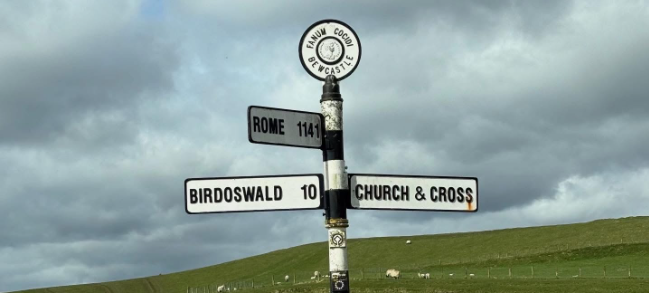
Now here’s a canny tale, one involving radgies, locals, their Red God, the onslaught of the Roman Empire, and how even the might of the Eagles was softened when Rome absorbed a local hunter god into its own religious beliefs.
You also have to remember, I have a very vivid and fertile imagination, but all my theories and stories are rooted in historical fact and, to me at least, make perfect sense.
Once I start writing what was meant to be a simple article and begin stringing all the pieces together, it normally changes direction, grows legs and expands considerably.
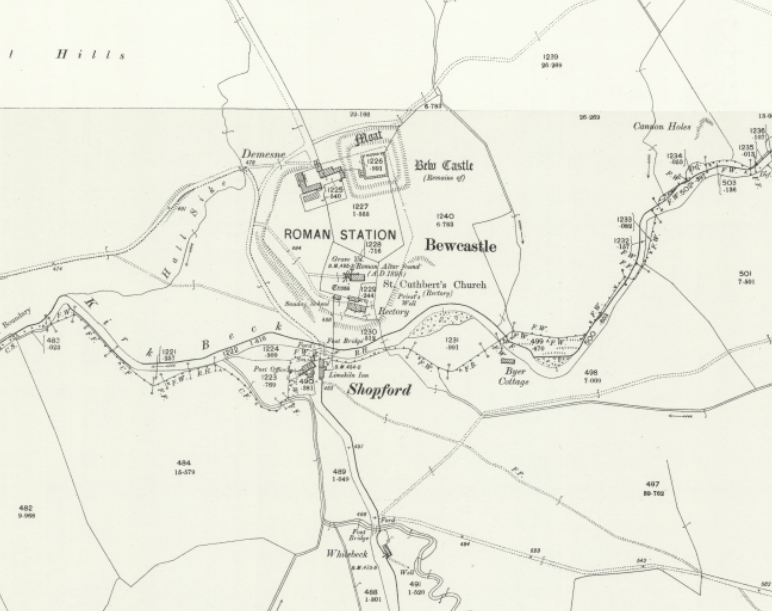
There is a place in Cumbria, quiet and almost forgotten, but nearly two thousand years ago Rome looked at this lonely hill and decided it mattered.
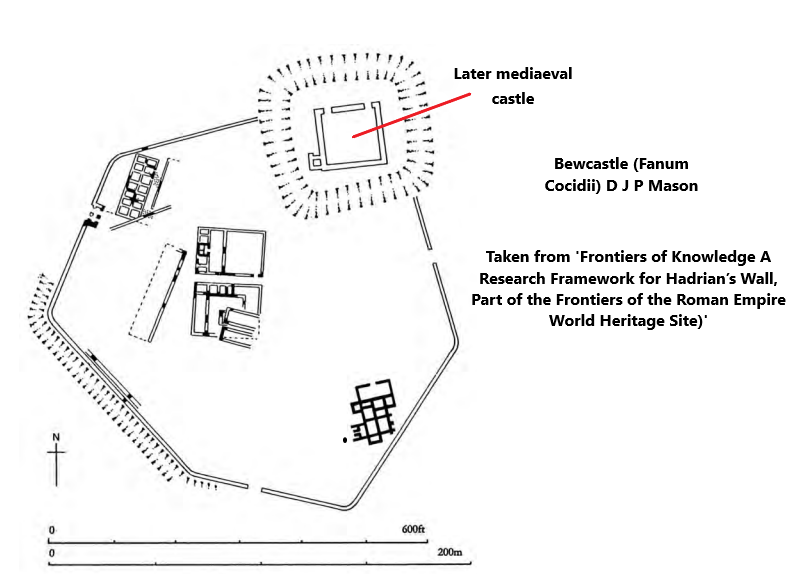
Bewcastle village sits within the remains of a Roman fort, with a later medieval castle tucked into its north-eastern corner.
The fort itself appears to occupy an even older settlement site, possibly with roots stretching back thousands of years, on a hill just north of Kirk Beck.
But this was not just another Roman fort.
It is unusual.
Instead of the familiar rectangular plan, its defences form a slightly abstract hexagon, apparently shaped around the contours of the earlier enclosure. Roman engineers normally preferred straight lines, symmetry and order, but even they seem to have accepted that here the landscape was calling the shots.
So why here?
Why the strange shape?
Part of the answer lies in the route.
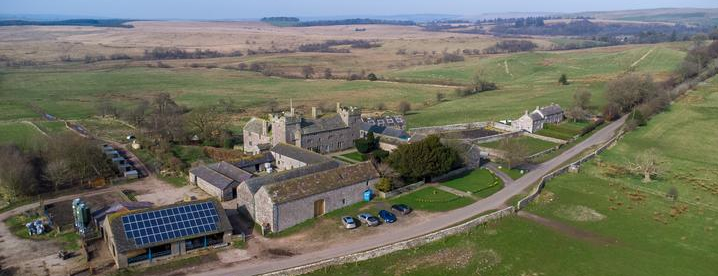
Have a drive up, and on the road north towards Bewcastle, you pass Askerton Castle, one of those buildings that makes the Border country feel very Game of Thrones. Its core dates from the early 1300s, with later towers and defensive additions built by the Dacres. Built in local sandstone, with its towers, courtyard and battlements, it is a stunning reminder that this route remained strategically important long after the Romans had gone.
Bewcastle stood north of Birdoswald, Roman Banna, on the route later formalised as the Roman road to the fort. It gave Rome a way through difficult border country and a position from which to watch movement, communicate with the frontier and project military power northwards.
The permanent fort at Bewcastle belongs to the early second century, but the landscape was certainly not empty before Rome arrived. People had travelled these valleys, ridges and uplands for generations. They knew the crossings, the high ground, the shelter and the natural routes through the country.
That is one reason I wonder whether Bewcastle may first have attracted Roman attention during Agricola’s northern campaigns around AD 80–81.
Remember, Banna at Birdoswald did not yet exist.
Any force moving north from the Stanegate fort of Magnis at Greenhead would have left the junction of the Maiden Way and Stanegate, crossed the River Irthing near the point where the Romans would later build their bridge for Hadrian’s Wall, climbed the steep escarpment onto the higher ground, then pushed on through rough and often boggy country.
It would have been roughly a day’s march, perhaps around 14 miles depending on the exact route, but certainly not an easy one. North of the established road system they may well have been following older native tracks, improving them or even forging a new route as they advanced.
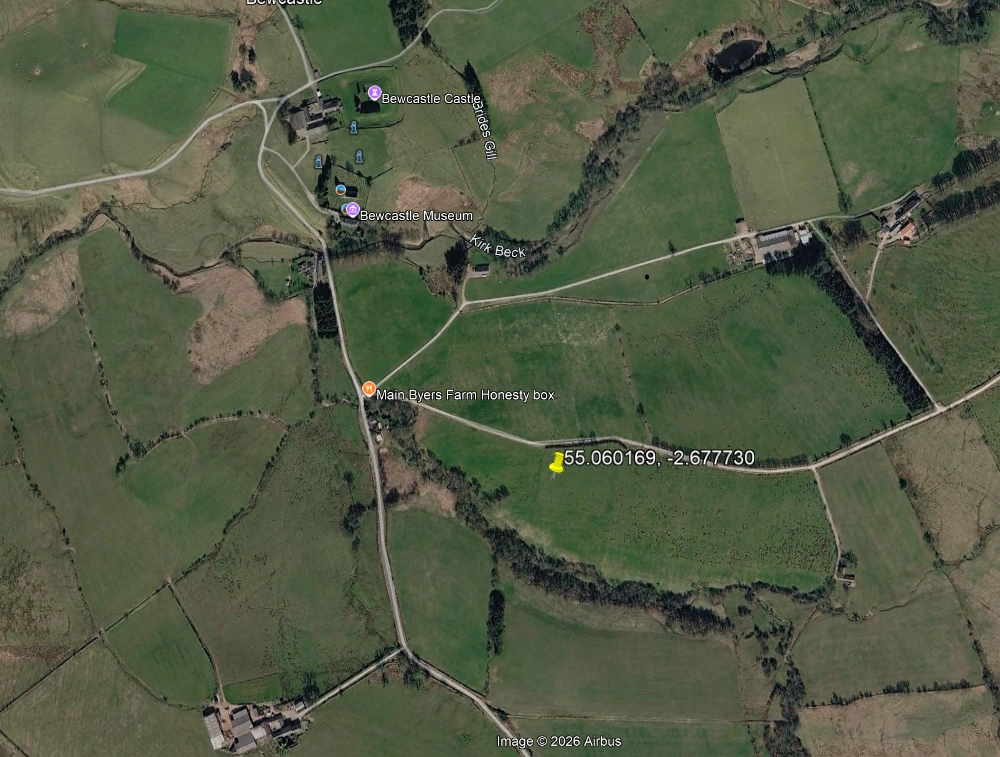
What makes the area even more interesting is the large temporary marching camp, visible albeit faintly, on the high ground above White Beck, barely a ballista throw from Bewcastle.
The site of the marching camp is marked by the yellow pin.
It is certainly large enough to have accommodated a substantial force, with a dependable water source immediately below.
That raises the hairs on my arms…
Perhaps the army halted there deliberately, short of the high ground at Bewcastle. If the hill ahead was already occupied or defended by the local population, it would have made perfect sense to stop and secure a camp before advancing.
But perhaps there was something else on that hill too.
The Romans were deeply superstitious.
Sacred ground mattered.
Strange local gods mattered.
If Cocidius was already associated with Bewcastle before the permanent fort was ever built, then perhaps the advancing army found more than warriors waiting for them.
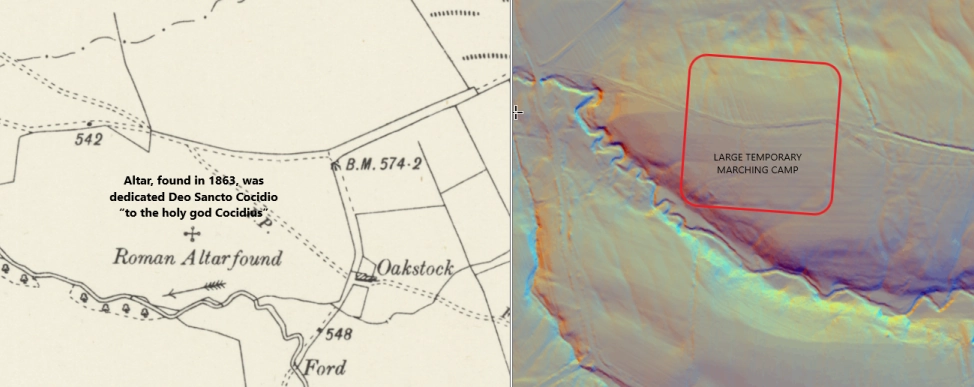
Even more intriguingly, the old Ordnance Survey map marks the discovery of a Roman altar almost exactly where the temporary marching camp lies above White Beck.
The altar, found in 1863, was dedicated: Deo Sancto Cocidio, “to the holy god Cocidius”, by a Roman centurion.
It cannot be assumed to belong to the earliest occupation of the site, but its position is remarkable. Here, on the approach to Bewcastle, beside the water source and within the landscape of a temporary Roman camp, Cocidius appears again — close to a place that may have been used by Roman troops before the later Hadrianic stone fort at Bewcastle was established.
Was there already a timber shrine on that hill? A wooden effigy of a god long since rotted away? Ritual fires burning on the ridge?
Did a local druid, priest or shaman come forward to confront the advancing Romans and make even the legionaries of Rome stop and think before they moved on?
That keeps the mystery without making the altar itself earlier than the Hadrianic fort.
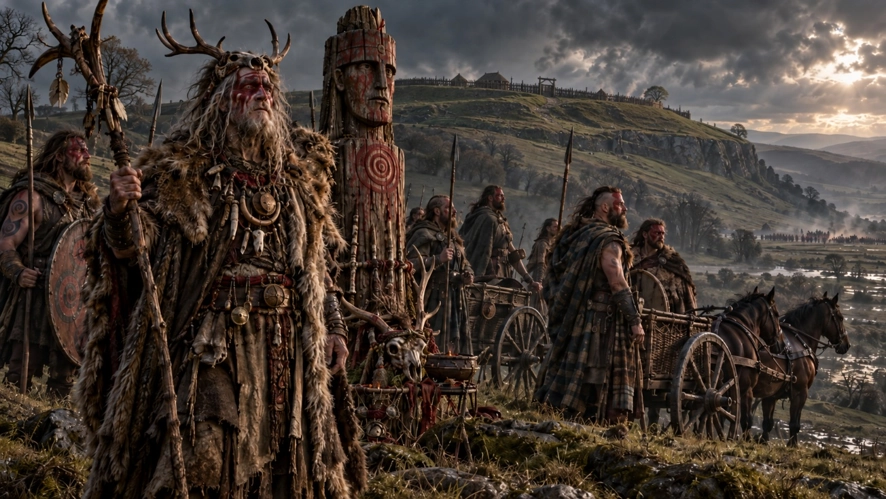
We can never know, but something may have made Agricola’s army stop and think.
I can imagine the scene…
Thousands of exhausted troops on the ridge above White Beck after a brutal day’s march, over ground that may not yet have carried a fully metalled Roman road.
Their temporary marching-camp defences thrown up around them.
The spot ticked the boxes: fresh water below, defensible high ground, and you can still see how the south-west corner of the camp drops towards the edge of the ridge above the beck.
And there, looming ahead, was Bewcastle.
I imagine warriors gathered on the north side of Kirk Beck, perhaps with an effigy, a shaman or priest and all the noise, menace and ritual that might have gone with defending a place important to them.
Agricola still had a much larger campaign ahead of him in Caledonia.
The northern tribes later named in Roman sources included the Caledonii, Vacomagi, Taexali, Venicones, Decantae, Lugi and Smertae, with others farther west and north.
He could hardly afford to waste men in a pointless local fight barely ten miles beyond the Stanegate if it could be avoided.
Maybe Agricola was simply being cautious.
Maybe it was a stand-off born from uncertainty.
Maybe he stopped to scout the ground, assess the people ahead and decide whether Bewcastle was worth the blood.
Or perhaps, just perhaps, Cocidius was already there.
If so, the story becomes even more intriguing.
Rome would later permanently occupy Bewcastle, the site becoming an outpost of Hadrian’s Wall.
By around AD 120 the route north was being formalised and metalled, linking the Maiden Way into the wider Roman road network that stretched deep into Caledonia and towards the old campaigning country of the Gask Ridge.
Roman soldiers at Bewcastle would themselves come to worship Cocidius, and the place became known as Fanum Cocidi “The Sanctuary of Cocidius”.
The god of the people who may once have faced them, eventually became a god of the men who conquered them.
As theories go, I think there is a strong argument for the events I have detailed above. However, there is no proof that Agricola himself stood above White Beck, nor that the later fort site was an Iron Age stronghold at that precise moment.
But the geography fits remarkably well, high ground, fresh water, a defensible camp, a natural day’s march from Magnis and the route north lying directly ahead.
That is why Bewcastle makes sense to me as more than just a later Hadrianic fort.
Perhaps Rome first stopped here because, for one reason or another, Bewcastle, its inhabitants and its deity stopped Rome.
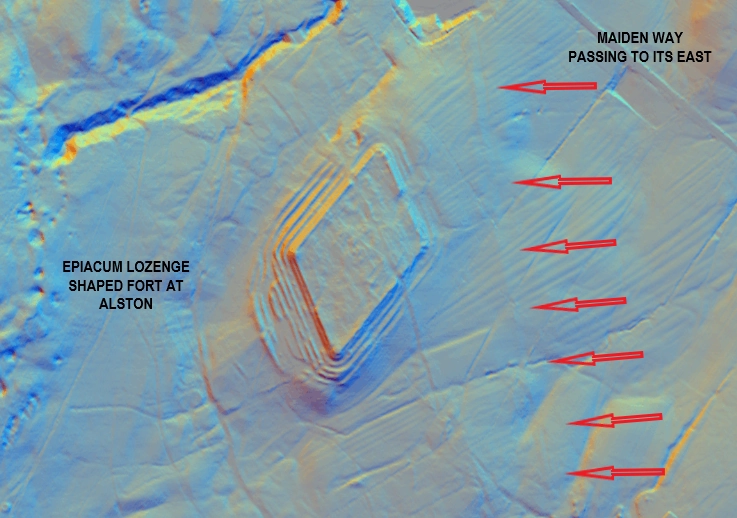
There is an interesting comparison further south at Whitley Castle, Roman Epiacum.
It too stood beside the Maiden Way, and it too was built in an unusual shape.
At Epiacum the fort forms a lozenge, adapted to the hill on which it stands.
In both places, the Roman engineers seem to have decided that the position mattered more than the rules.
I do sometimes wonder what later legates made of them.
“Eh, whee built this, man? It’s airl wonky.”
Unlike Epiacum, Bewcastle became an important religious centre as well as an outpost, and the influence of its deity seems to have spread far beyond the fort itself.
Excavations at Bewcastle found several dedications to Cocidius, including silver votive plaques and altars. One plaque shows Cocidius standing within a shrine, carrying a spear and shield.
Its inscription reads simply:
Deo Cocidio
[To the god Cocidius]
Cocidius was not a Roman god brought north from Italy. He was a native northern British deity.
Yet Roman soldiers adopted him.
On some inscriptions he appears as Mars Cocidius, suggesting that Roman soldiers recognised something of their own warrior god in him. Perhaps they thought Cocidius was Mars in another guise.
We shall never know.
Elsewhere he is linked with Silvanus, a god associated with woodland, hunting and the wild landscape.
Perhaps Cocidius was never just one thing.
Warrior.
Hunter.
Protector.
A god of the hills, forests and wild places.
The Romans often absorbed local gods rather than simply sweeping them aside.
They compared them with deities they already understood and folded them into Roman religious life.
But Cocidius kept his own name.
At Bewcastle he seems to have mattered enough for the place itself to be remembered as his sanctuary.
That raises the most interesting question of all.
Was there already a sacred place or shrine nearby?
Was the hill itself significant?
We simply do not know.
More intriguingly, Cocidius was not confined to Bewcastle.
A crude and heavily weathered carving found near Leeds has also been associated with the deity.
Far away to the north, high in Upper Coquetdale on the Otterburn ranges, another remarkable trace of him survives.
Near the North Yardhope marching camp, beside the Roman route running from Bremenium at High Rochester towards Alauna at Learchild at Whittingham on the Devil’s Causeway, a small rock-cut shrine survives in the hillside.

In a natural niche, altered by the hand of man, somebody carved the figure of an armed god directly into the stone. There is also a second niche and a shelf cut into the rock, which looks as though it may once have supported some kind of crude roof or shelter.
The figure carries a spear and a small round shield and has long been identified as Cocidius.
Remarkably, the shrine was only recognised archaeologically in 1980.
That always makes me wonder how many soaking-wet, freezing squaddies took shelter in that niche in the decades before its “discovery”, perhaps knocking up a brew during an exercise and staring at the strange figure in the rock, wondering what on earth it was.
For centuries, Cocidius had been sitting there in plain sight.
There may even be an echo of his name in the landscape. The River Coquet, and therefore Coquetdale, is thought to preserve an ancient Brittonic word associated with the colour red, while the name Cocidius has also been linked with a similar root.
That does not mean the valley was named after the god, but it is an intriguing coincidence: a northern deity whose name may have meant something like “The Red One”, and a valley whose ancient name may preserve the same idea, with a shrine to that god hidden high in the hills
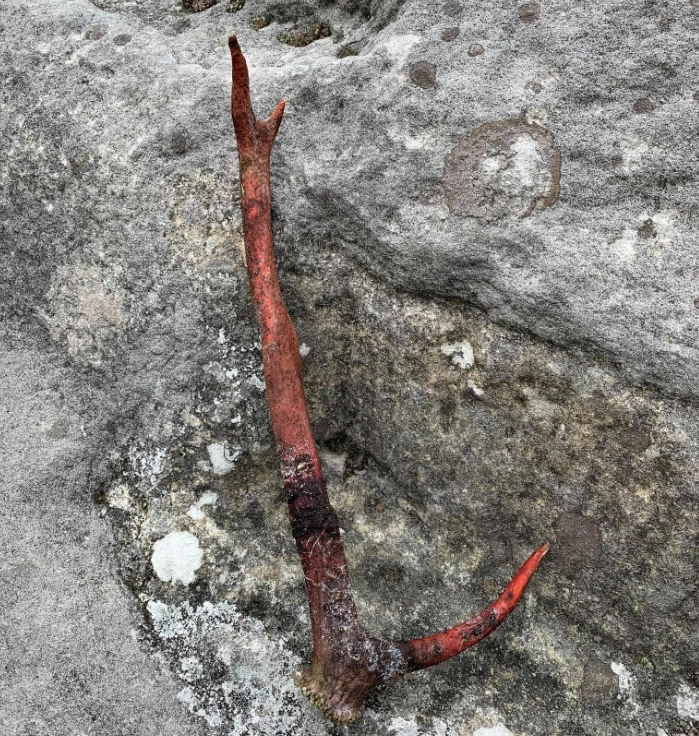
I have been fortunate enough to visit the Yardhope shrine myself. It’s an absolute nightmare to find, and you need permission from Range Control and a guide to access that area.
However, while I was there, I tripped over something poking out of the ground, right below the bas-relief — something that added another layer of mystery.
I carefully pulled it from the ground.
It was a full red-deer antler.
It had clearly been shaped, pierced and bound with cord.
I handed it to the MOD Range archaeologist, and I was later told that it had been dated to the early nineteenth century.
So, it was not Roman, which disappointed me a little.
But somehow that made it even more interesting.
Was the cult of Cocidius still alive and well in Upper Coquetdale?
Were rites still being practised, his name chanted and ancient Celtic words recited by acolytes almost 1,800 years later…?
Bloody hell, I hope so.
Why would somebody in the early 1800s take a worked red-deer antler to this remote place and bury it beneath a rock carving associated with a god linked with hunting, woodland and the wild landscape?
Being brought up in Craster, the weird and wonderful world I inhabited seems strange to many now. Some of the antics would leave jaws on the floor. We did, however, stop short of burning the local policeman in a wicker man…
Or did we…?
Never interrupt a lock-in, let alone twenty men boat-racing pints at 03:00 hrs.
I’m sure plenty of other rural villages had their own idiosyncrasies, strange habits and practices.
But it being buried beneath Cocidius felt strangely appropriate. I got shivers then, and I am now while writing this.
And that brings me back to Bewcastle.
The Romans came here because they wanted control of this fertile, mineral-rich land.
They built an extraordinary fort on an extraordinary hill and linked it into the wider military network of the north, but Rome did not simply erase everything that came before.
Sometimes things travel both ways.
The beliefs and practices of our forebears seeped into Roman life too.
The Roman, and very much Borg-like, approach of “Resistance is futile. You will be assimilated” may have been a double-edged gladius.
(I know they were double-edged before some smart arse corrects me.)
Incredibly ancient routes became Roman roads; they were not the first road builders here.
Strategically important hills became Roman forts.
And native gods became gods of Roman soldiers.
Perhaps when the first Roman soldiers climbed that strange hill, Cocidius was already there, patiently waiting for them to step into his fold.
With love from the Crasterfarian xx
Never miss an article. Enter your email or give our FB page a like
In PenBal articles, AI imagery is sometimes used where an appropriate historical photograph or illustration doesn’t exist.
Intriguing account…History this far back doesn’t usually interest me, but enjoyed this well researched and well written piece…with a homophone too!