
By Thomas Bainbridge
The British people had become accustomed to feeling safely ensconced within their island nation, assured in the security afforded by the Royal Navy. Even as the Great War burst upon Europe, it was thought that the Germans would never dare to cross the North Sea and raid the English coast.
However, in November, 1914, this bubble was popped when a German squadron descended on Great Yarmouth. Though largely inconsequential, the operation proved to the German Navy staff that such raids could be contemplated.
By December, Germany had suffered numerous setbacks. The Western Front was bogged down in stalemate as they had failed in their attempt to reach Paris, while their famed Admiral, Von Spee, had been sunk off the Falklands. They needed a simple victory to lord over the Allies, and what better than to strike home against the British mainland?
On the evening of the 14th December, British naval cryptographers based in Room 40 of the Admiralty intercepted German transmissions which indicated that an attack on the eastern coast was imminent, though they did not know exactly where or when it would occur. Preparations were made to intercept the enemy formation, but the entire coastline could not be guarded everywhere all at once.
Target Hartlepool
At Hartlepool, in the early morning of the 16th December, 1914, 8:10 AM, looming shapes were seen through the mist in the distance. Then the German cruisers broke through the fog and unleashed upon the small British flotilla that lay around the harbour, which promptly returned fire. Unable to match the German fusillade, those able to do so were forced to retire, while others were pinned in the harbour facing continual bombardment.
At the Headland, the small Heugh Battery of the fort commanded by Lieutenant Colonel Robertson entered the contest, holding one ship’s close attention, being repeatedly pummelled from only one hundred meters. The first to be killed in the exchange was Private Theophilus Jones, the first soldier of the war to die on British soil, followed by three more: Privates Liddle, Clark and Turner of the 18th Durham Light Infantry.
The battery was the only site of direct military action in Britain during the war and the first since 1796. The men that manned the guns were doing so in defence of the very streets in which they had been born and raised.
Harry Tyson, of Rowell Street, recalled the intensity of the fight, straining to reload the guns in a frenzy of activity, aided by that crucial bulwark of British pluck:
“Our cooks, Billy Sanderson and Arthur Hall… must have been making tea all the time we were in action. As soon as we stopped firing out came buckets of hot tea.”
Aided by this tonic, the guns repeatedly fired through the haze of the chill morning air. However, they were outmatched by the German warships, and the damage dealt out was minimal. Blucher was hit six times, killing nine of the crew, but the small calibre of the shore battery could not penetrate the heavy armoured hull.
Carnage in the Town
At the same time, the other two vessels had begun to indiscriminately bombard the town.
Over the course of half an hour a rain of shells struck homes and churches, as the populace ran for cover. Many children, preparing for school, found themselves caught in the fire. To imagine the horror of the scene, the cries for help, taxes the emotions of even the most stoic. One survivor, Mary Morris, remembered,
“There was a boy, he was only 14, he was going to the shop, he was blown to pieces.”
Some thought it was a German invasion, crying, “The Germans are on the Beach!”

Overall, 1,000 11-inch shells fell, weighing half a ton each. Many of these did not detonate, though they still had enough kinetic force to decimate streets.

The first fatality was Hilda Horseley, only 17, killed alongside her were the sisters Annie and Florence Kay, when a shell struck their home. The Dixon family nearby suffered horrendously with three children, George, Albert and Margaret being killed by a single blast. Another account from a shipyard worker recorded:
“In a few seconds a shell hit the offices and blew nearly all of it in the air. At the same time railway wagons were being blown sky high. A few yards further on I saw Barney Hodgson of Water Street, pinned up against the Swedish church wall bleeding very badly. I went to run towards him but he shouted, “Keep on running son, I’m done for.””
Meanwhile, the women of the telephone exchange continued to relay information on enemy movements, remaining in their place amid the intense cannonade.
All told, over 600 buildings were damaged. Still, these could be, and would be, reconstructed, but the real cost was counted in the number of lives lost. 114 were killed, among which were 37 children, displaying the sheer barbarity of the German attack.


One famous figure covered on PenBal, Jack Kirkpatrick, the Australian hero and native of South Shields, echoed the feelings of many:
“I see by the papers that the Germans have killed a lot of people in Hartlepool they were pretty close to Shields I hope that they dont get as near again for I would not like to see poor old Shields knocked about by the Germans but they will have to pay the piper for it all in the long run. I would like to have the pleasure of putting a bullet through damned Old Kaiser for he is the start of the lot.”
North Yorkshire Hammered
In Whitby, the attempted destruction of the Abbey of St. Hilda, in which the Great Synod was convened, mirrored the evisceration of Belgium’s great cultural sites earlier in the year. Scarborough also suffered: 17 were killed and scores wounded. The Grand Hotel was struck, while the 12th century Castle overlooking the Bay was badly damaged. A postman going about his rounds, Mr Beal, was killed, while a boyscout, 15 year old George Taylor, also fell victim while on his way to buy the newspaper.


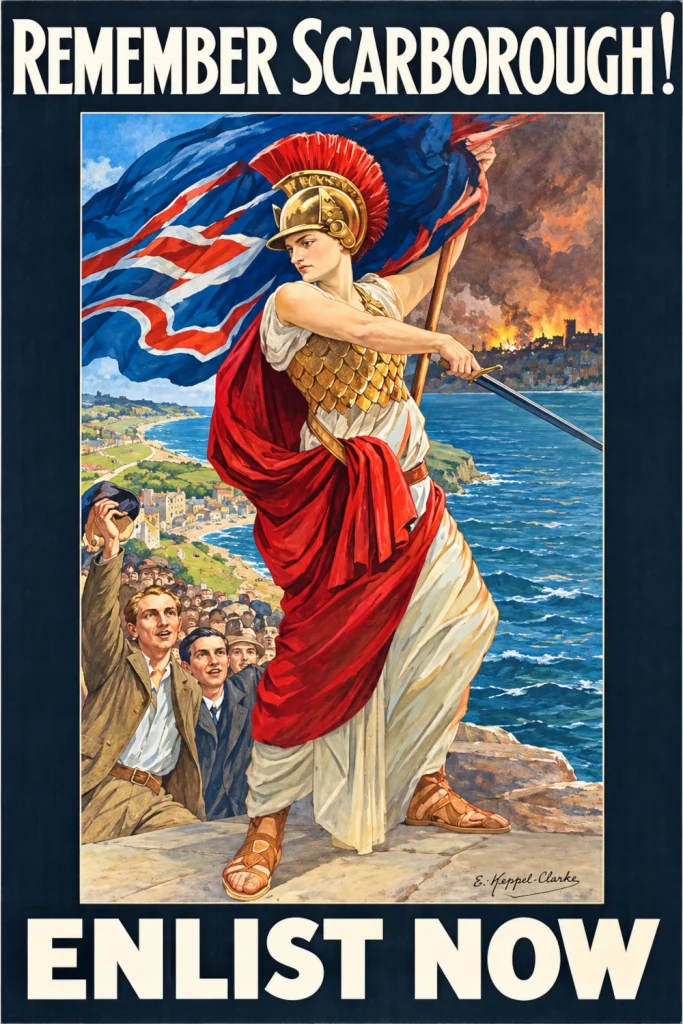
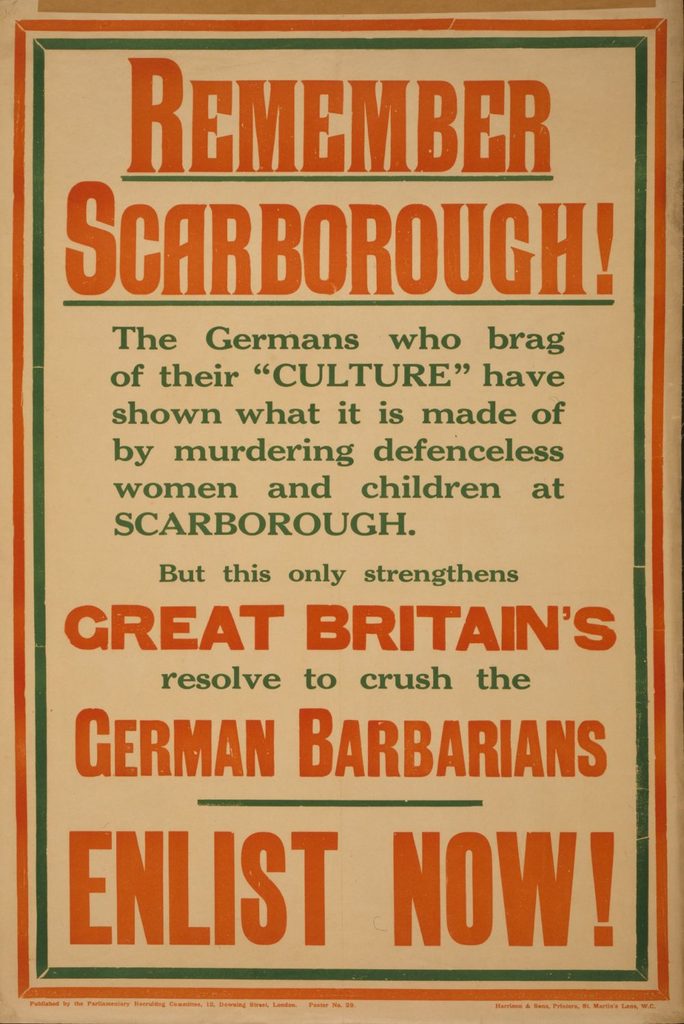
Many posters attest to the importance the raid had in the minds of the public. “Remember Scarborough!” was echoed on walls throughout the British Isles. Though the number of casualties in Hartlepool was far greater, the fact that the Germans had attacked a seaside resort seemed beyond the pale. The shipyards of Hartlepool could perhaps be construed as a military target, but hardly Whitby and Scarborough. Even the purported aims of the attack, to draw out a portion of the British Grand Fleet, could have been achieved without taking the lives of civilians. An American magazine of the period pointedly stated: “This is not warfare. It is Murder”.
Avenging the Act
There was public outcry against the Admiralty that the raiding party had not been swiftly sent to the bottom of the sea, but that instead they were able to escape from their vile mission intact. Still, the guilty ships would eventually receive their comeuppance. Blucher, in the vanguard of the raid, was sunk in the action of Dogger Bank in January, 1915. In a twist of irony, a German zeppelin attempted to bomb the British ships that had rushed to rescue the drowning crew. Forced to retreat after retrieving only 200, the remaining 700 men went to a watery grave.

The reality then, was that the slaughter along the North East coast was a cynical means to raise morale in Berlin for failures elsewhere. But if they thought that it might demoralise the ‘Englanders’, they were sorely mistaken.
Whatever devastation wrought by these events, whatever sorrow the people of Hartlepool felt, they would remain undaunted and were instead infused with resolve to see their town avenged. Within a few months, 20,000 men of the town had signed up to Kitchener’s army.
Among the most poignant reflections on the event:
“This account cannot be concluded without paying a tribute to the gallant behaviour of the civil population of the bombarded towns … Men, women and children following their daily tasks do not expect to be blown to pieces in the streets or to have the roofs of their houses come crashing in over their heads. Yet the inhabitants of the Hartlepools behaved like soldiers. There was no panic—no wild rush to safety. An hour after the firing ceased normal life was resumed just as if nothing had happened. This seems to show that these northern people still possess those sterling qualities which we associated with their ancestors.”

Never miss an article. Enter your email or give our FB page a like
