
By Thomas Bainbridge
It is a curious observation that the elegance and refinement of Georgian manners contrasted so heavily with the brutality of the criminal code. While dancing and witty conversation were practised at pleasant social gatherings, draconian punishments were meted out for the most minute infractions.
Misdemeanours were punished with death — most famously the theft of twelve pennies — and more serious crimes were punished by the most odious forms of medieval brutality. This set of circumstances remained long after the turn of the nineteenth century, and soon many clamoured for the reform of these archaic practices, but not before a few more victims fell prey to such excess:
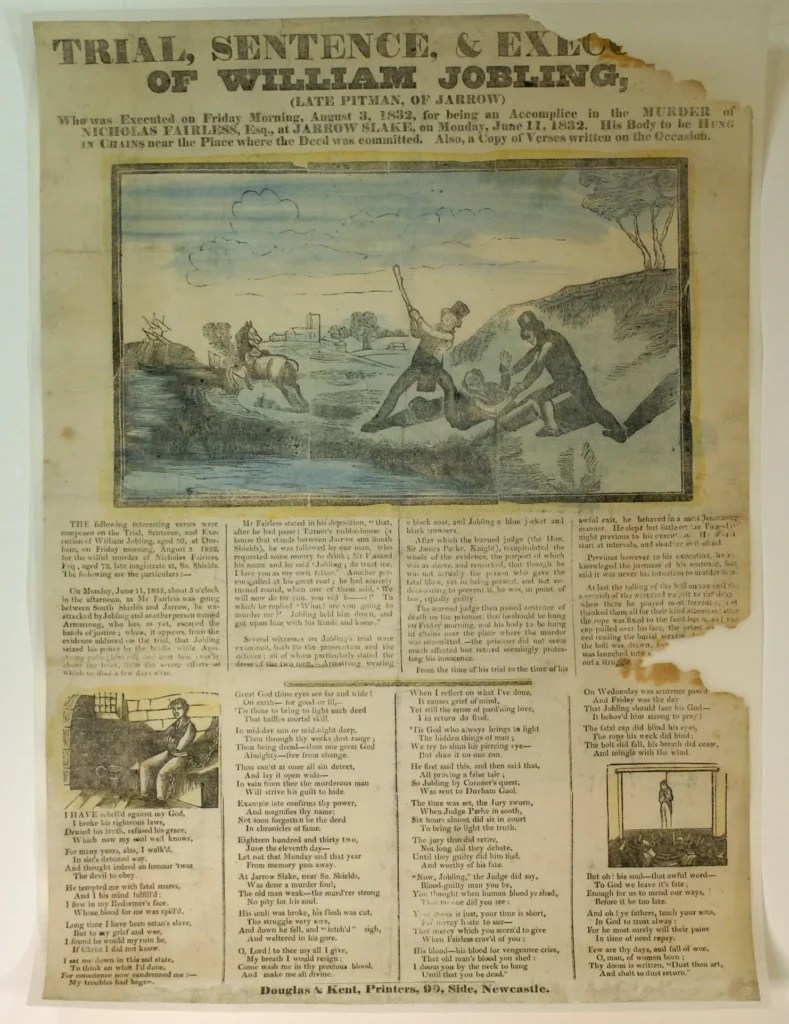
Gibbetting (the public displaying of the cadavers of executed criminals in iron cages) continued even until 1834, and one of the final to be thusly degraded was William Jobling.
Destitution and Danger
Jobling was a miner, born in Jarrow. From a young age he was exposed to the harsh existence that this line of work entailed: Toiling for hours in the near pitch-darkness; an aching back from the constant contortions required in the tight spaces; an exasperating cough from the inhalation of coaldust. Only recently had the dangers of firedamp been curbed by lamps of Stephenson and Davy. These odious conditions sparked The Great Strike in 1831, which succeeded in bringing the mine owners to heel, forcing them to make rapid improvements and increase pay. And yet in 1832, forty more men and boys were killed by yet another mining accident, and before long another strike was called. Eight thousand pitmen from across the northeast dropped their pickaxes and shovels, but soon, without their meagre wages, hunger ravaged their ranks.
Drunken Attack
William Jobling was one such victim. Having been out of work for over two months, by the 11th of June, 1832, the last of his money had run out, and he resorted to near begging. He lingered around the pubs in South Shields looking for favours from passers-by. On one occasion he had been successful and was thrown a few pitiable pennies in order to enjoy a pitcher of ale in Turner’s Public House.
Becoming drunker than usual due to his intense hunger, Jobling and his companion Ralph Armstrong began walking back home to Jarrow Slake when another opportunity presented itself: Nicholas Fairles, a local Justice of the Peace, rode towards them. Jobling, who knew the man, stopped him and asked for some coin. Fairles, seeing Jobling’s condition, refused. Whether it was planned or spontaneous, the scene erupted into violence. Armstrong crept up behind Fairles, pulled him from the horse and proceeded to give him a vicious beating.
According to eyewitness testimonies, Jobling had aided Armstrong by holding down the magistrate — though Jobling steadfastly refuted these claims. Armstrong had quickly escaped the scene and likely soon boarded a ship, never to be seen on these shores again. Following the ordeal, Fairles, bloodied and broken, was tended to in a nearby home. However, his wounds were too far gone, and he expired ten days later. Now assault and bodily harm were compounded by murder charges, and Jobling, well known in the area, was apprehended in South Shields and brought before Durham Assizes.

Convicted and Condemned
Jobling, by all accounts quiet and reserved, could only sit and listen to the exhortations around him. The testimonies provided by Mary Taylor and Margaret Hall seemed damning. The physical evidence was exhibited with gory interest — the cosh the assailant had used on Fairles was red with blood. The jury returned after fifteen minutes of deliberation, delivering a verdict of guilty, the sentence of Justice Parke was death.
Did Burke and Hare Influence the Outcome?
And yet, there remained further considerations about the punishment, informed by a notorious scandal of the period: The grisly murders of Burke and Hare in 1828.
This pair murdered their victims to sell their corpses. This led to an outcry for the regulation of anatomical dissection, resulting in the Anatomy Act of 1832, which was in the process of being passed during Jobling’s trial.
Previously only the cadavers of convicted criminals could be used for dissection, but now it was legal for any dead body to be dissected.
With this in mind, Judge Parke perhaps misinterpreted the Anatomy Act and assumed that gibbeting was the only option left, In this sense, William Jobling’s punishment could be seen as a legal hiccup. On the other hand, we might also discern more sinister motives in Parke‘s mind. Now that there was an ample supply of bodies for medical purposes, it was less necessary that Jobling’s be dissected, allowing him to choose the gibbet more easily.
Here, the context is crucial. The Judge believed that the rise of the unions had led to a degradation of morals amongst the miners, and that was partially the cause of Fairles’ death. If he thought the sentence was his only option, he certainly delivered it with relish. Indeed, Parke was said to have “hoped the sight of it would have a due effect on the prisoner’s companions” — fellow miners.

Barbaric Display
The sentence was carried out, and Jobling’s corpse was covered in pitch and hung from a gibbet hoisted over Jarrow Slake, after having been carried by cart through the streets of the town. The Slake was a commanding spot in clear view of the constant shipping that passed up and down the Tyne, and many houses including that of the cottage of his widow and children.

A Further Miscarriage of Justice?
Was William Jobling guilty of his crime? Was the desperation of his poverty an incentive to murder? Or was he merely a drunk in the wrong place at the wrong time? Certainly, his guilt or innocence was not fairly ascertained by the court.
He could not afford a lawyer and, being unknowledgeable in legal terminology and minutiae, could not have been expected to put up a good defence. In the words of Bob Dylan: “The trial was a pig circus; he never had a chance.”
It was Ralph Armstrong that struck the fatal blows. Though he had since fled, it was he that was the true culprit. Still, whether Jobling murdered Fairles, or was an accessory to the fact, it is relatively indisputable that he played some part in the crime — even if by simply failing to prevent it. But with the true killer absconded, an example had to be made.
And yet, did that merit the barbarity, humiliation and horror that the display of his corpse must have caused his bereaved family? In a supposedly enlightened age, how could that be seen as justice? Whether he was innocent or guilty, the cruel fate that befell Jobling, and more-so his loved ones, was not justice.
These ill proceedings soon met with outcry. It was a revolutionary era. Everyone from Land’s End to John O’Groats clamoured for reform. Certainly, by the turn of the nineteenth century, gibbeting was already seen as odious. Still, it remained on the statute book and could be employed when deemed necessary — as shown by Parke’s malicious judgment. And yet, Jobling was not the last. Another wretch, James Cook, would face the same end in Leicester in 1834, before the practice was finally stamped out of British law.

Black Middens
Jobling’s gibbeting caused such revulsion and resentment that his corpse vanished not long after it was displayed. The crime of taking a body in this way carried a heavy prison sentence, but it was rumoured that Jobling’s friends were so incensed by the humiliation of their innocent pal, that they buried William with some lasting dignity on the Black Middens, an isolated tidal wasteland nearby, where no one would find him.



As always informative and illuminating which I greatly enjoy reading. Keep up the great work which I’m sure there are many readers enjoy.
Thanks Stephen!
Fascinating.
Was there enough earth on yhe Middens for a burial?
Lots of rocks