By Thomas Bainbridge
Through the study of history, the fog of the past sometimes clears so we may catch a glimmer of distant events, but never so much so that the gloom dissipates entirely. Events are recorded in documents, and sometimes those documents are made long after the fact, so that none can claim to have actual knowledge of what transpired. Great cataclysms and deeds between warring powers are merely forgotten.
Anglo-Saxon Northumbria
The 6th century is a time of which there are sparse recollections, dimly denoted in poetry and scattered fragments.
It was during this period that the beginnings of Northumbria were formed from the kingdom of Bernicia, a wild and rugged region vaguely encompassing the lands between the Tweed and the Tyne.
The formidable array of Germanic tribes that migrated to Britain had formed numerous petty kingdoms both in the north and south of the island, ousting many of the native Britons and pushing others further inland into Scotland, Wales and Cumbria.
Yet many were not ready to meekly cower before the Anglo-Saxon invaders, and determined to retake their ancient birthright. Though these Celtic kingdoms had often fought amongst themselves, this new imposition united them to do battle against the common foe.
The conflict is recounted by the 9th century Welsh monk, Nennius, in Historia Brittonum :
“Hussa reigned seven years [the seventh king of Bernicia]. Against him fought four kings, Urien, and Ryderthen, and Guallauc, and Morcant. Theodoric [Hussa’s predecessor] fought bravely, together with his sons, against that Urien [Celtic king of Rheged].
But at that time sometimes the enemy and sometimes our countrymen were defeated, and he [Urien] shut them up three days and three nights in the island of Metcaut [Lindisfarne]; and whilst he was on an expedition he was murdered, at the instance of Morcant [the Celtic challenger to the throne of Bernicia], out of envy, because he possessed so much superiority over all the kings in military science.”
From this jumbled prose, a story can be reconstructed, though we should not pretend that it will be entirely factual. Still, it can at least fuel the imagination to better understand this murky period.
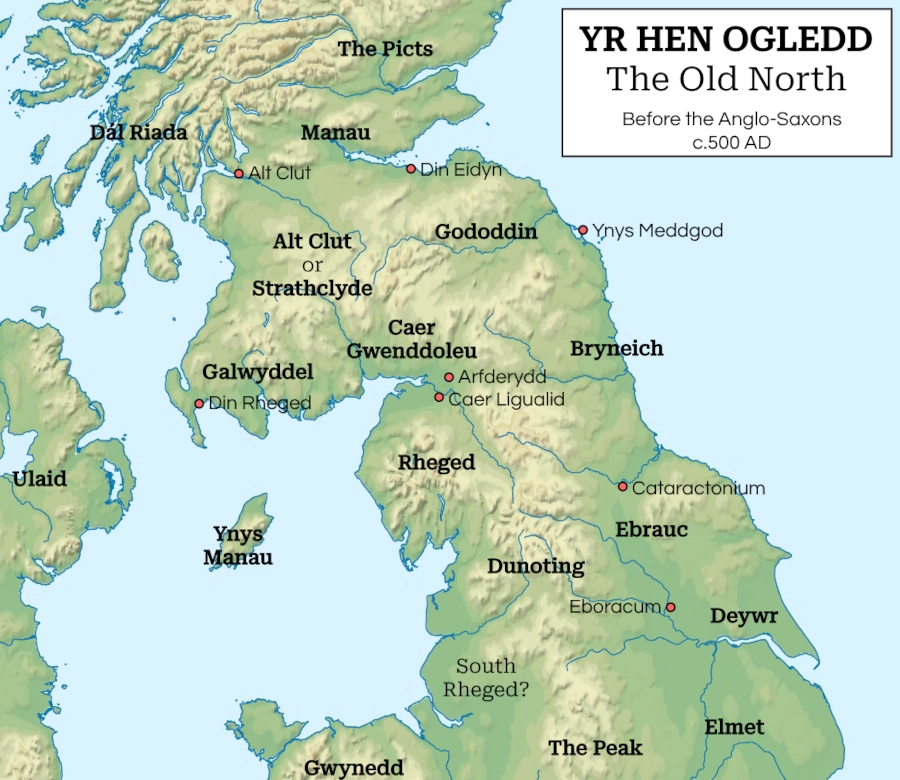
The four Celtic kings arrayed against Theodoric were:
- Urien of Rheged (Cumbria),
- Ryderthen of Strathclyde,
- Morcant of Bryneich (the Brythonic name for Bernicia). The last of the Votadini kings of Bernicia, formerly based at the stronghold of Bamburgh. By this time the Votadini were called the Goddodin.
- Guallauc of Elmet.
But it was Morcant, most of all, who had seen the homeland of his fathers invaded, their lands taken, the coasts overran by marauding Angles, and he wanted vengeance.
Is it possible to look upon the Angles more generously?
The Bernician kings were not evildoers bent upon destruction. They were the leaders of their own people who had come seeking finer pastures to sow crops and fairer waters to catch fish.
The medieval way of life was one of continual strife, and to survive often meant to take from others when one had the power to do so. The light of Christian conviction had not yet reached them, nor the laws on which all would one day be bound. A king was certainly little more than a warlord, but still with a measure of devotion to those he ruled over.
Britons Close In
The four Celtic kings, at the head of four armies, ranged themselves against Theodoric of Bernicia.
From north and south they converged upon this remote corner, their overwhelming forces ravaging the countryside, burning farmsteads and pillaging the helpless populace.
Theodoric, with what force he could muster, had garrisoned the citadel of Din Guardi (Bamburgh), the capital of Bernicia and once the seat of Morcant’s Votadini ancestors.
Of course, this was not the Norman castle of stone that was constructed five centuries hence, but little more than a makeshift wooden fort atop the inert black volcanic crag.

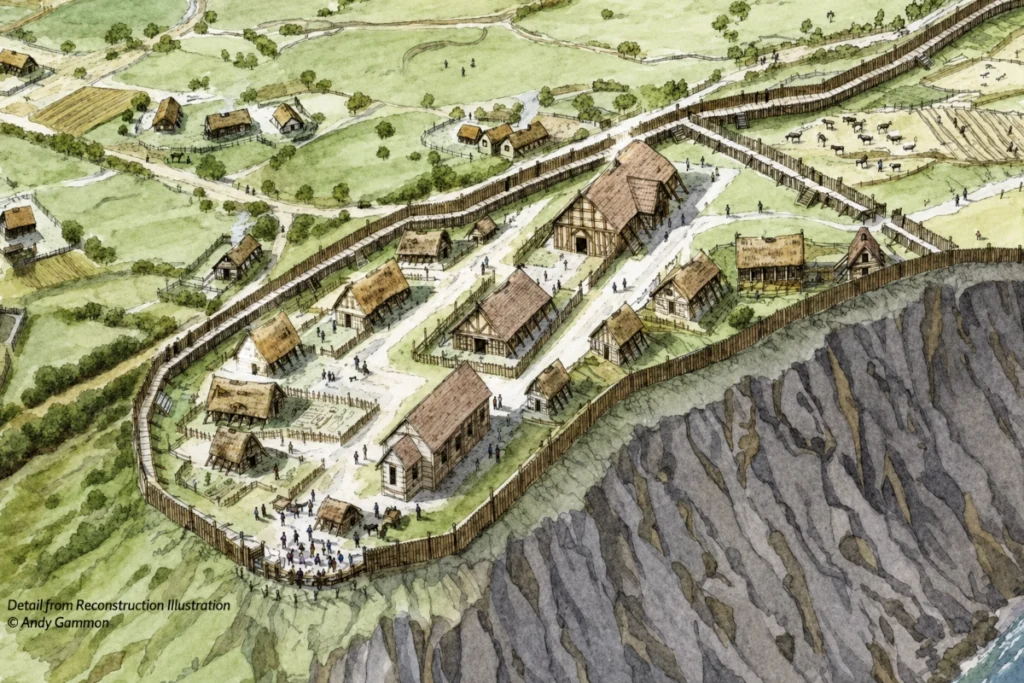
Theodoric was aware that he could not hold out so long against the great force that opposed him.
Only the barren and windswept island of Medcaut, before it became Lindisfarne, the famed outpost of Christian piety, offered a sanctuary from which to defy the British host. The natural moat created by the tides offered a defensible position with which to hold out against an army three times as large.
Still, the odds were stacked against Theodoric and the Angles.
Cracks in the Alliance
The Celtic forces laid siege to the isle, hoping to massacre their enemies or at least to starve them of victuals. But, while they intended to sap the strength of the Angles, the patience among their own ranks quickly dissipated. The British kings had never been friendly with one another. Their old rivalries were not so old, as they seethed beneath the surface of their alliance. All vied for power, and wondered what would occur upon the destruction of their immediate enemy. Treachery was never distant from their camp, and three days of boredom were all that were needed to renew the odium between them.
A disagreement naturally arose upon a question of strategy, and regarding which of the monarchs held ultimate command.
Urien assumed himself to be superior, as he was well renowned for his martial prowess and, being a white-haired old man, was the eldest of the kings.
Morcant quickly took offence at this, but meekly accepted the rebuke in public. Still, the insult stung, and the devious mind of Morcant turned to revenge. He charged his retainer, Llofan Llaf Difo, to murder the unfortunate Urien. We do not know how he was killed, but one possibility is that he was beheaded as he slept.
With such a bloody murder, the Celtic forces imploded in disarray. Men fought amongst each other as others attempted to flee the scene.
From Medcaut, the Angles must have looked on exultantly and with no small measure of bemusement at their turn of luck. The day was saved, the siege was broken, and Bernicia was momentarily delivered from the Celtic hordes.
An Earlier Win for the Britons
But through the tangled weeds of history we learn of another victory, this time for the Britons and relayed to us by the Welsh bard, Taliesin:
There was a great battle Saturday morning
From when the sun rose until it grew dark.
The fourfold hosts of Fflamddwyn invaded,
Goddau and Rheged gathered in arms,
Summoned from Argoed as far as Arfynydd —
They might not delay by as much as a day.
With a great blustering din, Fflamddwyn shouted,
‘Have these hostages come? Are they ready?’
To him then Owain, scourge of the eastlands,
‘They’ve not come, no! they’re not, nor shall they be ready.’
And a whelp of Coel would indeed be afflicted
Did he have to give any man as a hostage!
And Urien, lord of Erechwydd, shouted,
‘If they would meet us now for a treaty,
High on the hilltop let’s raise our ramparts,
Carry our faces over the shield rims,
Raise up your spears, men, over our heads,
And set upon Fflamddwyn in the midst of his hosts
And slaughter him, ay, and all that go with him!’
There was many a corpse beside Argoed Llwyfain;
From warriors ravens grew red
And with their leader a host attacked.
For a whole year I shall sing to their triumph.
Until I am old and ailing, in the dire necessity of death,
I shall not be in my element if I don’t praise Urien.The Battle Of Argoed Llwyfain
The tale describes the demise of the English King Fflamddwyn, which historians have identified as Theodoric of Bernicia.
Others have claimed that it was his brother, or possibly his father, Ida, the first Anglian king of Bernicia, who ruled at Bamburgh from 547 to 559.
The poem praises King Urien, which indicates it was somehow before the siege in which he was slain.
Regardless of the haziness surrounding the clash, it formed a pivotal part of the strife between the two races that lasted for generations.
Notes and Philology
- Nennius also provides descriptions of King Arthur as a fierce general, listing twelve of the battles in which he fought.
- Theodoric means ‘The People’s King’. His alter ego in the poem, Fflamddwyn, means ‘Flame Bearer’.
- Bryneich, which evolved into Bernicia, translates as ‘Land of Mountain Passes’.