
By Thomas Bainbridge
The sheltered, meandering course of the River Wear was naturally an ideal setting in which to fashion vessels for use on the open water. The earliest recorded shipyard along its banks was established by Thomas Menville in 1346, whereby he:
“occupied a certain place at Sunderland called Hendon, for the purpose of the building of ships, paying the Bishop an annual rent of two shillings.”
While this may have formed part of Edward III’s policy during the Hundred Years’ War to counter the superior French navy, another possibility is that shipbuilding simply emerged alongside other industries in the area.
From the 14th century, the salt trade grew in prominence. Great pans were filled with seawater and boiled for three days until all moisture had evaporated. The salt that was left behind required transportation, leading to the manufacture of small flat-bottomed river barges or keels.
In the 1600s, as mining developed, there grew a greater need for these vessels to shift the coal that was being excavated, especially as competition intensified with the Tyne. This economic rivalry became a crucial component within the English Civil War, fostering a divergence of loyalties between Newcastle and Sunderland. While the former received royal privileges, Sunderland was relatively neglected. Still, an industrious merchant class had begun to develop who saw the opportunities afforded by shipbuilding.
Empire Builders
It was around the mid-18th century that the rapidly expanding British Empire produced a boom in shipbuilding in the town that continued for the next 150 years.
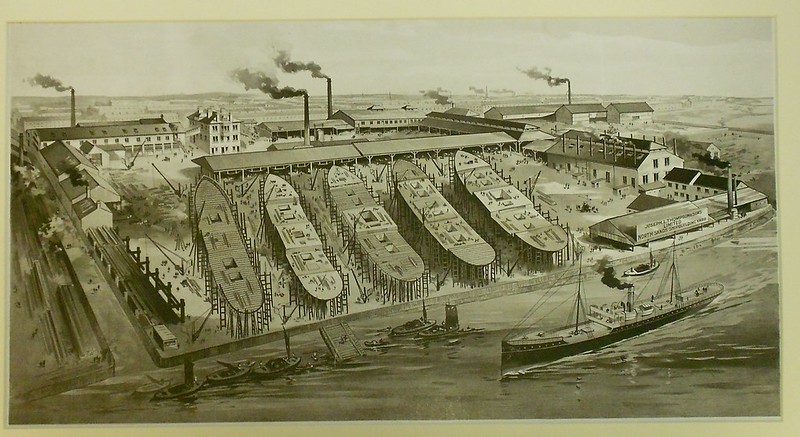
In 1815, 31 shipyards along the Wear produced over 600 vessels. The journalist and historian, William Brockie, wrote of the Wear in 1820:
“The banks of the river were studded with small wood shipbuilding yards as far as they flowed, exciting the wonder of strangers, when they passed at time of low water, as to how the builders could possibly manage to get their vessels launched.”
By 1834, Lloyd’s Register recorded that Sunderland was:
“the most important shipbuilding centre in the country, nearly equalling, as regards number and tonnage of ships built, all the other ports together.”
Famous shipwrights such as William Pile, born in Southwick, made continual advancements, including early efforts in utilising alternative materials such as iron and composite to construct hulls. Pile also introduced the clipper ship onto the Wear, launching his most famous creation, the City of Adelaide, in 1864, which went on to make over twenty return voyages to Australia.

South Docks
After 1850, much of Sunderland’s economic success, and its even greater subsequent expansion can be readily attributed to the genius of one man: John Murray.
As an engineer on the River Wear Commission, in the 1840s, he designed and pushed through many of the plans for the modernisation of the river, including the creation of a tidal basin on the south bank that allowed larger ships to enter and leave the harbour. This would be crucial in further opening Sunderland up to international trade. Resulting from this, the South Docks were opened in 1850 to jubilation as crowds gathered to watch the unveiling ceremony.

Within the next few decades over 65 shipyards vied in production along the river. Notably, Laing & Co., situated in Deptford, made pioneering leaps. First, they produced the Torrens which became the fastest ship between England and Australia, completing the journey in only 65 days, and on which the novelist Joseph Conrad was Chief Officer. Later Laing & Co. would be at the forefront of oil tanker construction.
Thus, as the Victorian age came to its end, Sunderland was internationally recognised for the quality and the technical advancement of its ships. Its industrial capability would prove crucial in the wars that were to come…
Powerhouse
During the First and Second World Wars, Sunderland’s shipyards were a boon to the national effort. In 1914 alone, the yards produced 750,000 tons of merchant shipping, which would help stem the loss of almost 9 million tons by the Allies throughout the War. Many naval ships were also constructed, of which William Doxford and Sons Ltd. alone produced 21 torpedo boat M-class destroyers.
Due to its industrial significance, the town drew the ire of the enemy guns. After the Battle of Jutland in the summer of 1916, airships carried out a bombing raid against Sunderland. Though the inaccuracy of these Zeppelins caused minimal damage to the shipyards, 22 people were killed and hundreds injured as the bombs fell wide of their target, instead raining down on the thickly clustered surrounding buildings.
After the armistice of 1918, shipyards began to close as they were swallowed up by other companies fighting for the increasingly cramped banks of the Wear. As with many industries, the employment of thousands relied on the whims and dictates of the market. During the ‘30s there were significant job losses, and it was only the renewal of war in 1939 that reinvigorated the shipyards once again. It was the Second World War that proved to be the culmination of the long strides that Sunderland had achieved in shipbuilding.
Dark Days
By June 1940, Europe had fallen. The German menace threatened Britain. Only the might of the Royal Navy, and the skill and daring of the RAF could keep the enemy at bay. It was crucial then to ensure the import of provisions and foodstuffs required for a beleaguered British population. From across the Atlantic, innumerable ships brought cargoes of wheat and munitions from the New World, though these were hampered at each juncture by the U-Boats that stalked below the ocean surface, waiting to strike and then slink once more into the murky depths. This contest — the effort to supply Britain in her hour of need — was dubbed ‘The Battle of the Atlantic’.
The German Admiral responsible for the campaign, Donitz, aptly dubbed it a ‘tonnage war’. The problem was a basic one: For Britain and her allies, it was about maximising the tonnage of supplies that could be transported to British shores. For Germany, it was about minimising this volume by destroying the ships that carried it. Still, the solution on either side was not immediately an obvious one.
Within the German Navy there was an early dispute as to whether surface raiding ‘pocket-battleships’ were more efficient than U-Boats. Only after the ill-fated scuttling of the Admiral Graf Spee off the coast of Uruguay, was the latter method chosen, and soon these submersibles wreaked havoc. In a single week, U-Boats sank 27 merchant ships. Time was of the essence. Among the British cabinet, there was disagreement over the convoy system that had been used in the First World War. Though this offered greater safety, it was feared it might drastically reduce the speed of shipping which had become so critical. However, before long, the British rebuff was readily conceived with the creation of a vast armada of lightweight vessels that could cross the Atlantic at regular intervals in large convoys, guarded by the Royal Navy.
Liberty Ships
But which design offered the most advantageous features to now be replicated en masse in order to undertake the task? The answer lay at J.L.Thompson and Sons, situated at North Sands, Monkwearmouth. It is no surprise that Sunderland should have held the key to the Atlantic problem and to British survival. Its long history of shipbuilding spanning centuries now availed itself of immense value.
Upon learning of the designs, Winston Churchill, then First Lord of the Admiralty, sent a delegation to America to make arrangements to immediately begin their mass production. In this group were Robert Thompson, Harry Hunter of the North East Marine Engineering Company, the surveyor William Bennet and another engineer, John Heck. Taking the design of the Sunderland-built Dorington Court as their basis, the American and Canadian shipyards set to work on the immense task of producing their great quota of ships. Upon seeing a photograph of the vessel, President Roosevelt dubbed it an ‘ugly duckling’. However, its offspring were soon proclaimed ‘Liberty’ ships, and became a vital cog in the mechanism by which the war was won. A congressional committee found that “the design is the best that can be devised for an emergency product to be quickly, cheaply and simply built.” Though some time elapsed before the first of these were launched, by the end of the War, 2,710 had been manufactured in the United States, with hundreds more issuing from Canadian ports.
While American shipyards, with enormous industrial weight behind them, would obviously collectively outproduce those in Britain, in terms of man hours, a Sunderland yard produced a merchant ship over 50% faster.

More strikingly, as many men were engaged in the armed forces or on arduous convoy missions in the Atlantic, over 700 women were enlisted to take over numerous manual roles, contributing immensely to the war effort by welding, riveting, painting, and operating cranes.
As in the First World War, air raids resumed, though with far greater intensity, undertaken by long-range strategic bombers. While the shipyards were the primary target, the Luftwaffe rained hell upon the town in an attempt to shatter its morale and disrupt production.
One staggering statistic relates that 90% of all buildings were damaged, while 273 civilians were killed during the course of the conflict, though this only acted to strengthen the resolve of its population. By the end of the war, Sunderland shipyards had produced a total of 246 ships, being 27% of all British output. The shipyard at North Sands alone produced 76 of these.
During the War, 54% of the gross tonnage of British merchant vessels was lost, which equated to over 11 million tons. But the efforts of the shipyards had done much to offset these losses and ensure the steady flow of supplies to Britain, and with it Victory.

Ironically, the damage accrued by German and Japanese shipbuilding facilities allowed for their rapid modernisation in the ‘50s and ‘60s. By 1964, Japan was already building half of the world’s ships. Still, in this time there were some monumental achievements. In 1963, the oil tanker Borgsten was launched by Thompsons, then the largest vessel ever built in Britain.

However, by the ‘70s it was clear that the British industry was in a slump. Though shipbuilding was nationalised in 1977, this was undone during the rule of Margaret Thatcher, whereupon the industry continued to dwindle. In 1983, Don Dixon, MP for Jarrow, remembering so clearly the role that shipbuilding had played in the War, perfectly eulogised the industry’s peril and the loss that that the UK would incur upon its demise:
“The Minister talks about retraining people from the shipbuilding industry, but we live in an island in a world in which seven-eighths of the surface is covered by water. We rely on 98 per cent. of our trade—by weight—being carried by ships. What is the point of retraining shipyard workers? We require a shipbuilding industry, just as we require a shipping industry. There is no point in retraining shipbuilding workers so that they can produce plastic knobs. We shall require ships in the future, and shipbuilders to build and maintain them. We should be retaining them, not retraining them.”
Despite this staunch defence, nothing was done. Finally, an EEC directive in 1987 set a cap on the value of subsidies permitted for a member state’s shipbuilding industry. The following year, the Pallion Yard, the final shipyard in Sunderland, was closed, ending an ancient practice that remains part of the skeleton of the city today.

I’m so happy about this wonderful publication.
Thank You.
👍
Interesting article, it amazes me how quickly such an integral and historic industry can be reduced to nil.
I have an hour long PowerPoint presentation on shipbuilding in Sunderland.
You could record yourself giving the talk and share it on Youtube.