
By Crasterfarian

I can remember this story being passed down by Mammy Joan, and later retold owa a pint in that ethereal little bar in the Jolly Fisherman, our own little Nexus from the 70s and 80s that we’d all dearly love to find our way back to.
The Jolly Fisherman as was, a place where reality had no meaning, especially at closing time, the fug of a million tabs and the smell of rum and whisky filled the air, and just like Tolian Soran in Star Trek: Generations, desperate to return to his Nexus, some of us might even be willing to destroy a star to get back there for on more night…

Those happy days, in that happy place, where wisdom, craic and sheer unbelievable stories abounded, tales so extraordinary that people today would scarcely believe half of them.
Nuw hey, afore ye start, I’m not as auld as this story, so I don’t remember the actual event first hand. In fact, at the time of the incident, I wasn’t even a twinkle in auld PMA Snr’s peepers.
My older sister would be born in the September, the following month, so the timing of writing this now is canny, as it was almost 68 years ago to the day. That’s by pure coincidence mind, as I gan through some of these auld images and rack my sieve-like brain for snippets from the past.
BUT… this one has got a bit of everything.
A shipwreck. The Cold War. A brand-new Polish fishing vessel. Talk of asylum. Russian officials and far too many radio aerials.
And, naturally, a possible spy story.
Anyone who knows the coast between Craster and Dunstanburgh will know Nova Scotia and Cushat Stiel. It’s the little inlet here, just before you make the final climb up to Dunstanburgh Castle.
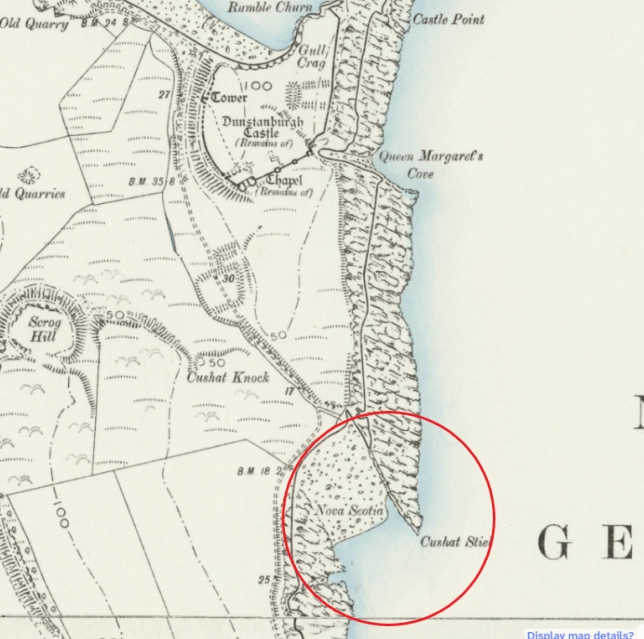
On 28 August 1958, the Polish fishing vessel GDY-226 came ashore there. She was virtually brand new, just out the boatyard… Brand spanking new…
Polish records identify her as a B-25 type “superkuter”, built for the state fishing concern, Arka of Gdynia.
She had only recently entered service and one Polish vessel history records that she was lost on her first voyage. It wouldn’t be the first, nor the last time that a maiden had been scuppered on the Cushat Steil…
She’s nee Titanic mind, but she and her crew were to cause a Titanic stink and a lot of nervous officials…
She was around 25 metres long and 82 tons, so she was sizeable for her time.
The documented version of events is straightforward enough.
On 28 August 1958, in fog, GDY-226 ran aground at Nova Scotia and became a total loss.
And then we get to the REALLY interesting bit.
For years there has been another version of the story doing the rounds locally. Call it gossip, folklore, village craic, whatever you like, but it was a hot topic. Craster was like any fishing village, craic was king and this was red-hot info.
Remember, late 50s, this was at the height of the Cold War and the story goes that she had been deliberately driven onto the rocks by her skipper.
Why?
Apparently, the skipper and crew wanted to claim asylum in Britain. Nowt wrong there, lots of Eastern Bloc defectors were doing the same. Nee Berlin Wall to get shot climbing owa here, just beach her at the Cushat…
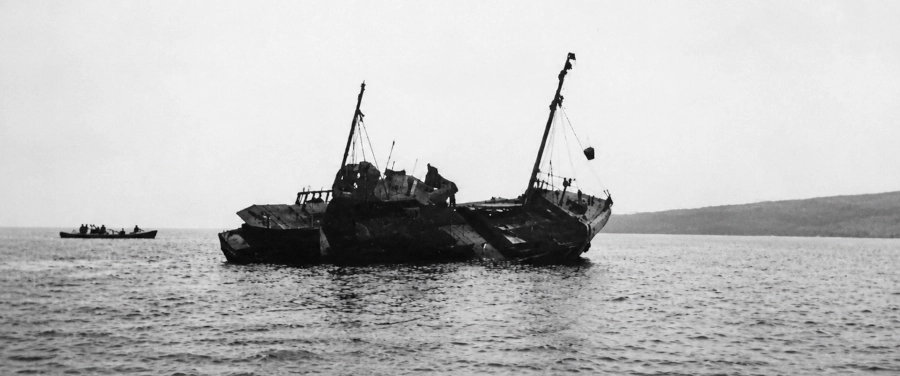
Now that would already make a canny tale.
But people also remembered something unusual about the vessel herself. She was said to have carried an abnormal number of radio aerials. Which obviously raises a question:
Was she REALLY just fishing? Or was she listening to a bit more than the shipping forecast or the BBC Home Service…
Then the story gets stranger again.
According to the local account, shortly after the men reached shore, they were collected, put into cars, and driven away by people said to be connected to the Russian Embassy, not me fitha’s Embassy Filters mind, but the real Russians, furry hats the lot, poison brolly tips, the works, black cars and black ops.

After that they more or less disappear from the story, and I’m damned if I can find any pictures of them to add to my story…
And while I’m on about pictures, would it have killed anyone back in the day to scribble on the back what they showed, who was in them, the date, and where they were taken?
No, it wouldn’t. Anyway…
You can certainly see how the legend of the Russian spy trawler at Craster came about.
Records confirm that GDY-226 was wrecked on 28 August 1958, and later accounts describe her as having run aground in fog.
There is another interesting name connected with the story.
Edward Kreft was a skipper associated with the Polish state fishing company, Arka, during this period.
His name has been linked with the Craster story, but so far I have found nothing solid enough to prove that he was skipper of GDY-226 when she came ashore.
So that part must remain unconfirmed too.
And the same applies to the spying.
There is currently no documentary proof that GDY-226 was a spy vessel, that she was deliberately wrecked, or that Soviet officials spirited her crew away.

It does seem a bit far-fetched to me, a James Bond-style chase along the coast, a black sedan being pursued by an Aston Martin…
But this was the Cold War, and the local recollection of all those aerials, asylum and embassy cars clearly came from somewhere.
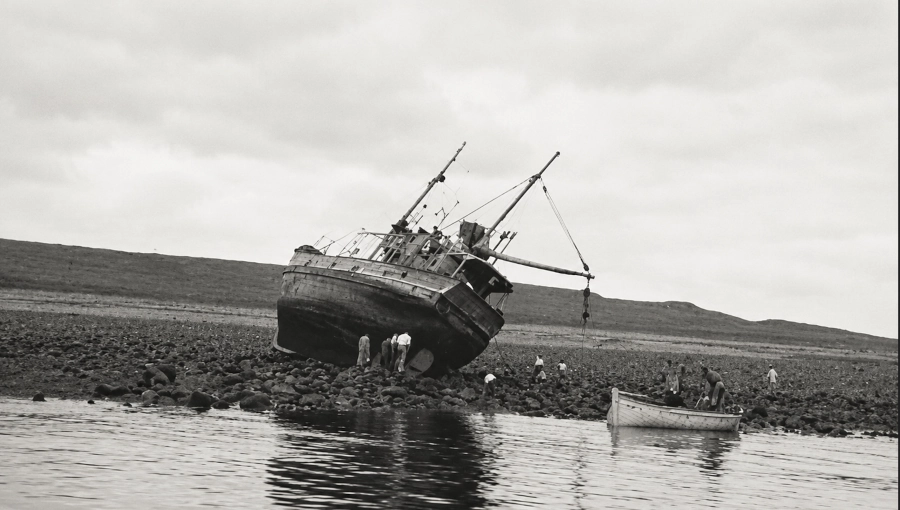
Maybe GDY-226 was simply a brand-new Polish fishing boat caught out in thick North Sea fog and driven onto one of the nastiest bits of rock on our coast.
Maybe the aerials were just modern radio equipment. She was only a few months old, so the perception of the kit she had may have seemed extreme.
Maybe the story grew legs over the following decades.
Maybe the crew had heard of the mystical little bar in the Jolly and were hoping to enter their own Nexus, never to leave add spend eternity listening to the tales in there…
What? A story being exaggerated at Craster…? Never in the world.
Or maybe there really was a little bit more going on aboard her than fishing.
We may never know.
What we do know is that on 28 August 1958, GDY-226 ended her very short life on the rocks beneath Dunstanburgh Castle.
A few rusting remnants amongst the boulders are now about all that remain, and there’s less of them every year.
I can remember in the mid-70s that the portion of the hull that remained was still arch-shaped, maybe 6 ft by 8 ft, still planked, and it made a thrumming sound as you ran over it at low tide.
There must have been a bigger section covered by the rocks that stopped it being carried away by the tides and storms, as that little beach takes a proper howking sometimes off a south-easterly.
I did also, end up owning a wooden net-knitting needle said to be from the trawler, I treasured it, I even knitted creave covers with it until a puppy named Bracken, at 19 Heugh Wynd, decided it was a treat and ate it…
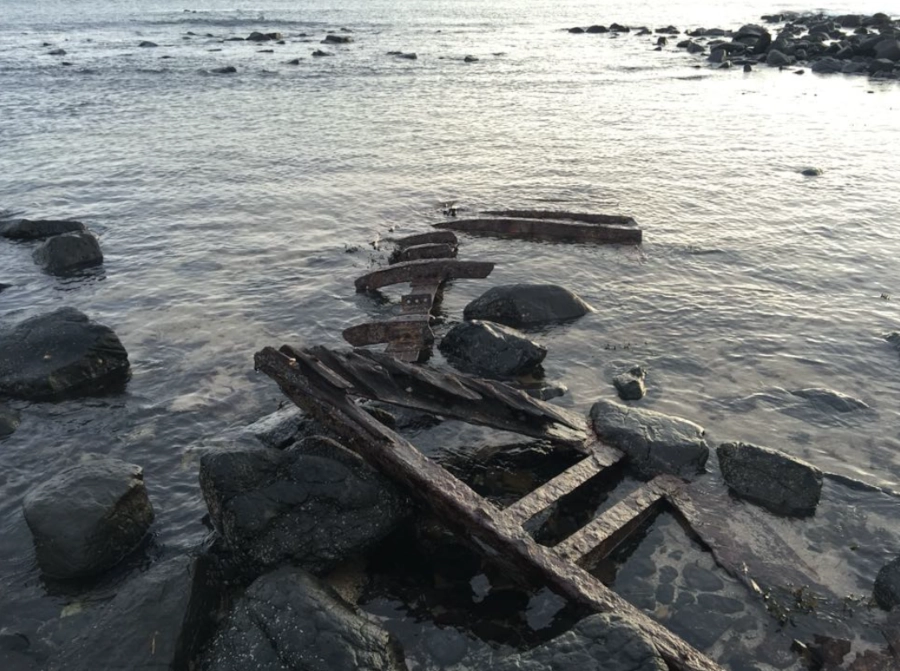
Thousands of people walk past that spot every year without knowing that they are passing the remains of a vessel wrapped up in one of the strangest little Cold War stories on the Craster coast.
Fishing accident, attempted defection, spy vessel or all of the above… Or is it a mixture of fact, folklore and village gossip?
Nee idea.
But it makes a bloody good story, and I bet it fuelled a canny few pints in the Jolly and the pints then fuelled the story.
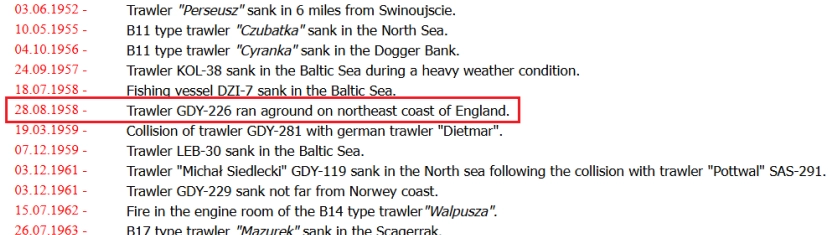
The wreck of GDY-226 in 1958 is documented.
The stories concerning deliberate grounding, asylum, unusual aerials and Russian Embassy officials survive as local recollection and should be treated as such rather than proven fact.
However…
There may even be moving footage connected to the wreck.
The British Film Institute archive holds historic film of the Northumberland coast, and I’m still trying to establish whether footage of a stranded Polish fishing vessel beneath Dunstanburgh is actually GDY-226.
If it is, that would be something special: actual film of her lying there after the wreck rather than just photographs and paperwork.
I can’t prove that identification yet though, so it stays firmly in the “still digging” pile.
With Love from the Crasterfarian XX

Never miss an article. Enter your email or give our FB page a like
Journal cutting from the time: https://x.com/TyneSnapper/status/2090441267410841999