
By Thomas Bainbridge
Even to those that live in the North East, Whitburn is a somewhat obscure spot.
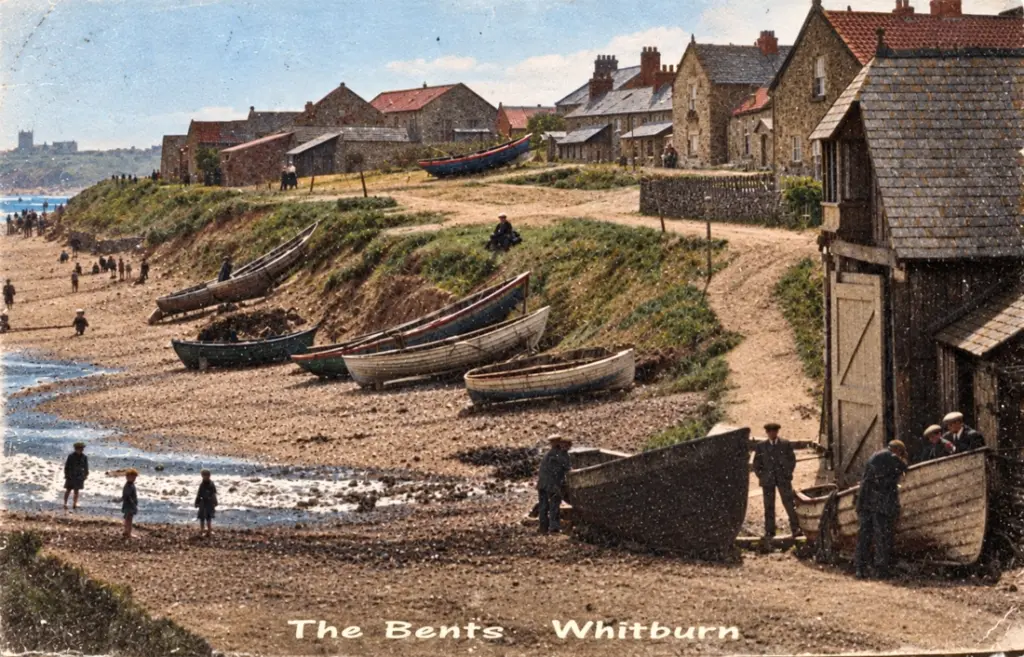
Situated to the north of Sunderland, further south than most Geordies would prefer to tread, the antiquarian Robert Surtees (1779-1834) aptly described it as:
“a small pleasant village on the coast, near a fine sandy bay with a cheerful prospect to the South, extending beyond Sunderland and Hartlepool, to the high cliffs on the Yorkshire coast.”
The name is recorded in the Boldon Book of 1183 as Whitberne, if not named after a nearby river, possibly deriving from a ‘white barn’ that had once been in the vicinity. Surtees continued:
“the village has a much warmer and more sheltered appearance than most of the hamlets on the bare Eastern coast.”
Certainly, many trees have been planted to protect it from northern winds, offering plenty of shaded spots in the heat of summer.
Throughout the village are many ornate buildings, erected at various times, displaying a variety of architectural styles.

Photo: Andrew Curtis
Whitburn House, though seemingly a prime example of the Tudor fashion, was in fact built in 1867 by the Coal magnate, Thomas Barnes.


It is the parish church, however, which lays claim to being the oldest structure, originally built in the 13th century. It is a stereotypical English church, a looming Gothic presence imbued with the mystique of religious reverence.

Like many quaint villages, Whitburn has its fair share of secrets…
Centre of Dissent
Whitburn became a place of espionage during the reign of Henry VIII.
In 1536, resulting from the Dissolution of the Monasteries, there was great disaffection within the northern counties. In Durham especially, the traditionally Catholic population were roused against the Crown, and flocked to the banner of St. Cuthbert to oppose Henry’s religious reforms.
In Whitburn, the priest of the parish church, ironically then known as St Andrews, Robert Hodge, whipped his congregation into a frenzy, declaring that they would rather welcome James V of Scotland than continue under the yoke of the Tudors. Unbeknownst to him, James Crane, a spy in the pay of Thomas Cromwell, was in the crowd. He informed on Hodge who was soon arraigned by the authorities and confessed to sedition. The zealous clergyman was then executed and gibbeted in Newcastle as an example to others.
Alice in Sunderland
The seemingly innocuous village was also in fact the inspiration for one of the great gems of English literature, being a holiday retreat for Charles Dodgson, better known by his alias, Lewis Carroll.

Dodgson had extensive connections to the region. His sister in Sunderland was the wife of Rev. Charles Collingwood, while his cousin Margaret Wilcox lived at Highcroft House in Whitburn. He often made trips to visit them, and together they endlessly wandered the coastline in between. On one such ramble he met Frederika Liddell, the cousin of Alice Liddell, who would later become the basis of his protagonist.
Whtburn became an important setting for Dodgson while he formed his multi-various ideas. For instance, one of the buildings in the village called the Red House, with its ornate and quirky brickwork, was said to have inspired many of the whimsical elements within Adventures in Wonderland. Supposedly, it was the many white rabbits in the area which inspired the beginning of the story.
The place also had a more definite influence. It was during one of his northern sojourns that Dodgson developed the nautical element that would become so prominent in his stories. The eerie poem The Walrus and the Carpenter, recited by Tweedledum and Tweedledee to Alice, was written in Whitburn, in which the characters persuade a group of oysters to follow them to their demise, as they eat their unfortunate prey. The poem would become the basis for the Beatles’ psychedelic anthem, I Am the Walrus.

The second piece of verse composed by Dodgson during his time in Whitburn was the nonsense poem, Jabberwocky, written in mock Old English. This too, depicting the slaying of a vile creature, was said to be inspired by the locality, being derived from the legend of the Lambton Worm:

’Twas brillig, and the slithy toves
Did gyre and gimble in the wabe;
All mimsy were the borogoves,
And the mome raths outgrabe.“Beware the Jabberwock, my son!
The jaws that bite, the claws that catch!
Beware the Jubjub bird, and shun
The frumious Bandersnatch!”He took his vorpal sword in hand:
Long time the manxome foe he sought—
So rested he by the Tumtum tree,
And stood awhile in thought.And as in uffish thought he stood,
The Jabberwock, with eyes of flame,
Came whiffling through the tulgey wood,
And burbled as it came!One, two! One, two! And through and through
The vorpal blade went snicker-snack!
He left it dead, and with its head
He went galumphing back.“And hast thou slain the Jabberwock?
Come to my arms, my beamish boy!
O frabjous day! Callooh! Callay!”
He chortled in his joy.’Twas brillig, and the slithy toves
Did gyre and gimble in the wabe;
All mimsy were the borogoves,
And the mome raths outgrabe.

Ghostly Goings-On
Every village has a pub which has been the site of innumerable memories, many lost to time. Whitburn boasts the Jolly Sailor which for three hundred years has acted as a waypoint for weary travellers and weather-beaten fishermen. Naturally there are numerous tales told of paranormal activity within its walls.
The most prominent tale is of the Green Lady, who stalks its corridors in search of a coachman who spurned her advances. After the rejection, she took her own life in despair, still wearing the finely embroidered dress she had painstakingly fashioned to whoo her would-be boo. The flashes of her apparel can be discerned only briefly through the window as she coquettishly rushes across the room, only to be replaced by her barely audible sobs as she realises she is forever alone.
Another story exists of an ominous grey-clad presence inhabiting one of the rooms. One account claims that the room suddenly went cold and the door slammed shut. Whether a ghost or the result of the northern climate, one cannot be sure. Perhaps it is the apparition of the executed Father Hodge, having returned to his parish to rail against the Reformation.