By Crasterfarian
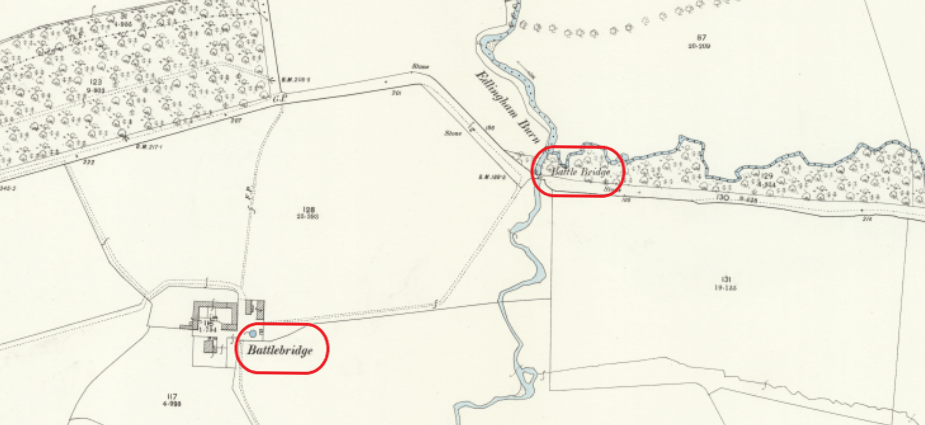
I’ve lost count of how many times I’ve driven or been driven along this road.
Even as a bairn, sat beside PMA Snr as he plied his trade as a master plumber, servicing Agas, sorting frozen pipes and doing leadwork on the farms and in the big houses of Northumberland, the name of this bridge intrigued me.
There was always a pub involved too, mind. A nip and a half for him, and a packet of crisps and a glass bottle of Coke for me, sat quietly in a corner while he chatted away to the barman.
I actually remember asking him one day, “Dad, why is this bridge called Battle Bridge?”
His reply, in typical droll style, “Whey son, there was a battle here.”
Oh, there you go then, question answered.
But it wasn’t.
Time has rolled on, probably getting on for 50 years now, and I passed it again last week on my way back from Ad Gefrin after collecting some whisky, and I thought, “Ye kna what, I’m gonna hev a bloody look mesel.”
It turns out to be true, Dad. There was a battle here, at a bridge, maybe not this bridge, but certainly some bridge that crossed the Edlingham Burn, a tributary of the River Aln.
A little bit of digging online and an AI forage into archaeological reports and historical documents revealed a forgotten battlefield in the heart of Whittingham Vale.
The place sits in the parish of Edlingham, not far from Lemmington Hall, Bolton Mill and the remains of the deserted medieval village of Abberwick.
But what battle? Who was fighting, and when?
As it happens, there is a rather interesting piece of Northumbrian history attached to this otherwise unremarkable little place.
The Battle of AD 875
According to Northumberland’s Historic Environment Record, Battle Bridge is traditionally associated with a conflict between the Anglo-Saxons and the Danes around AD 875.
Aye, the bloody Vikings, on the rampage near Alnwick.
The account describes a band of Danes advancing inland from the coast along the River Aln, eventually encountering the Saxons of Whittingham Vale.
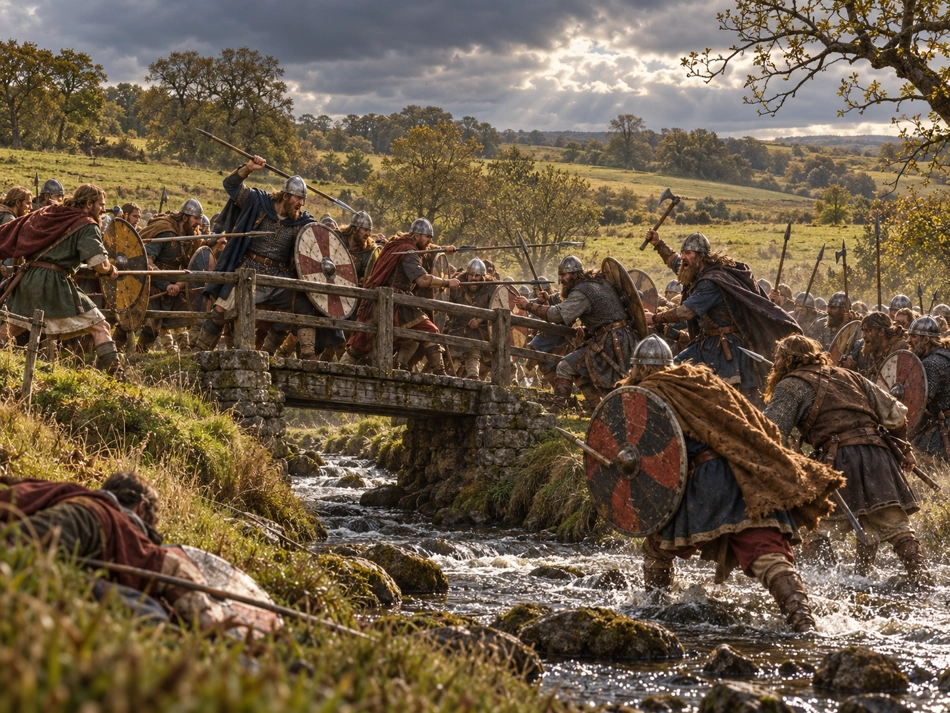
According to the records, the Saxons were defeated, butchered in their own back yard.
That’s the tradition, anyway.
The story was recorded by the nineteenth-century antiquarian W.W. Tomlinson in his Comprehensive Guide to Northumberland of 1888, which is cited in the archaeological record. It also appears in later Ordnance Survey records.
However, and this is important, there is no confirmed archaeological evidence establishing that a battle actually took place here.
Being realistic, though, how much would be left of a battle that’s over 1,200 years old, at a bridge that was rebuilt, by a stream that will have changed course, over land that has long since been farmed, ploughed and churned up with hooves and cartwheels?
You need to imagine that these things happened, as the story must have come from somewhere.
The county record itself acknowledges that the identification rests upon local tradition and place-name evidence, but in the same breath, the Blaydon Races was in a song, and no one doubts that, so why not this? What reason would people have to make a story up about this spot, especially with so much documentary evidence?
So, we have an old story, a curious placename and a suggested date…
What of the Brave Men of Whittingham?
In my earlier article, The Fyrd and the -ingham Settlements, I looked at three Northumbrian villages whose names reach back into the early Anglo-Saxon period.
Ellingham, Eglingham and Edlingham.

These were not simply isolated farmsteads. They grew in the landscape along old Roman roads, like at Edlingham on the Devil’s Causeway, its old collapsed Roman bridge probably eventually pulled apart to build the first stone churches.
Their names point towards the organisation of early Anglo-Saxon communities and estates, established long before the Norman Conquest.
The -ingham element is generally associated with an Old English personal name, although the precise formation and meaning of individual names can be more complicated than the traditional explanation of a homestead belonging to a man’s followers.
And there’s another village we ought to consider. Whittingham, on the River Aln, belongs to that same group of early Old English placenames.
Historian Brian K. Roberts, in his research into Northumberland’s early settlements, identifies Whittingham alongside Ellingham, Eglingham, Edlingham and Chillingham as places potentially associated with the division of larger royal estates.
He also notes that Whittingham, Edlingham and Eglingham were among the lands recorded as granted to the Community of St Cuthbert by King Ceolwulf before his abdication in AD 737.
It establishes that these places belonged to an organised landscape of royal estates and religious landholdings, possibly handed down from the Golden Age of Northumbria and Oswald and Oswiu.
These weren’t names suddenly appearing on a medieval map.
They had a history stretching back into the kingdom of Bernicia.
The Danes Come North
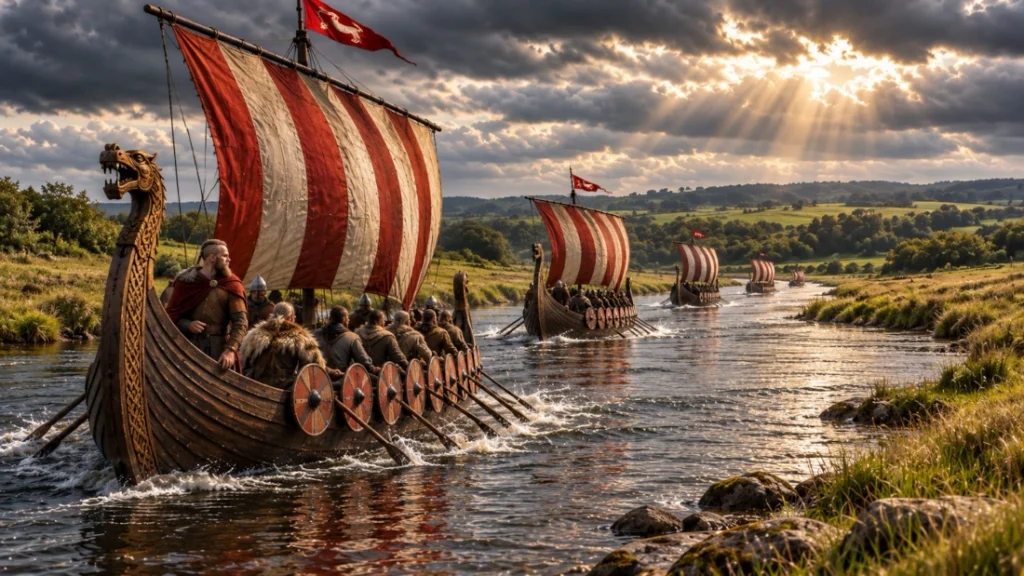
The date traditionally associated with Battle Bridge is AD 875.
The Anglo-Saxon Chronicle records that in AD 875 the Viking leader Halfdan took part of the Great Heathen Army north into Northumbria, where it established winter quarters beside the River Tyne.
The Chronicle also records attacks against the Picts and the Strathclyde Britons.
In the following year, AD 876, Halfdan divided Northumbrian land amongst his followers.
So Danish military activity in Northumbria around AD 875 is historical fact.
I’m joining the dots on the landscape and tying events, dates and historical references together here with The Fyrd and the Old Settlements, but it’s my story, so there you go.
In my earlier article, I suggested that these -ingham communities would have formed part of the wider network of estates capable of supplying food, resources and fighting men to the Bernician kings.
The fyrd, the system through which fighting men could be called upon for military service, depended upon the organisation of land and people.
It is within this wider history that the Battle Bridge tradition becomes interesting.
By AD 875, the settlements of Whittingham, Edlingham and Eglingham were already centuries-old established settlements, with their people living in extended family groups, and churches, blacksmiths’ shops and farms all occupying those lands.
Were local men called upon to defend their lands?
It’s a perfectly reasonable question. Did a local reeve call the fyrd, and did they march to meet the onslaught of Danish steel and aggression?
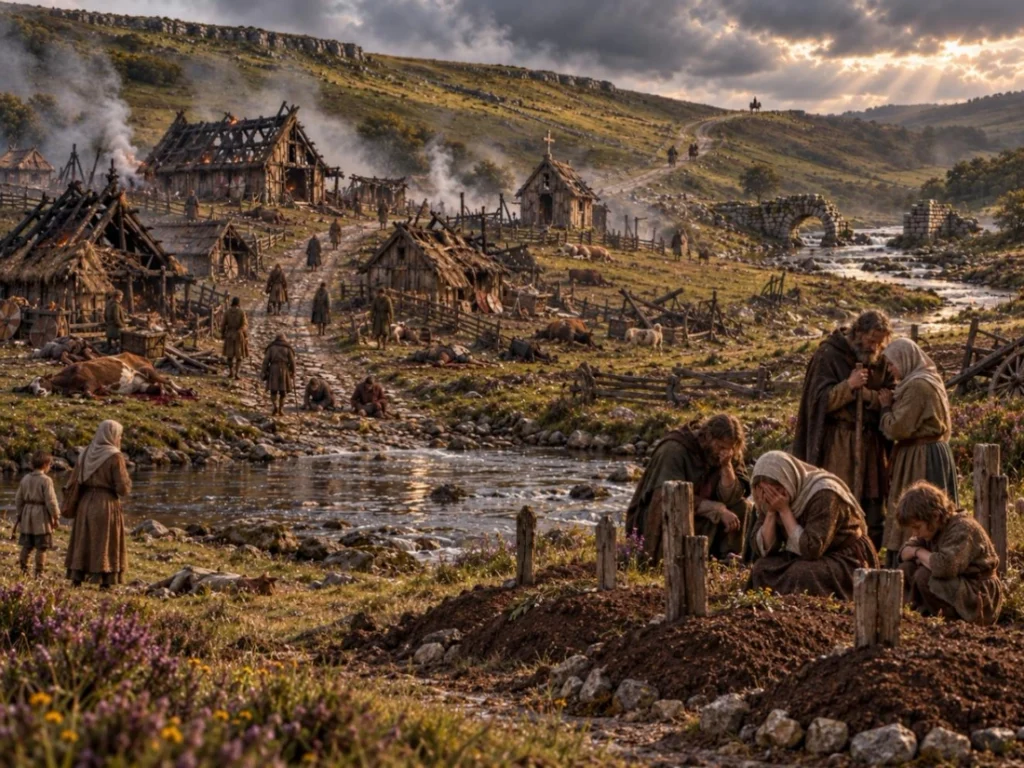
Were they butchered, their families fleeing up to the rocks at Caller Crag while the village was pillaged returning only to bury their dead menfolk after the invaders had ebbed away back to their ships
But we have no evidence identifying the men supposedly defeated at Battle Bridge, how they were organised or whether the encounter happened at all.
For all the appeal of the story, we must leave those questions unanswered.
The Clue is in the Name
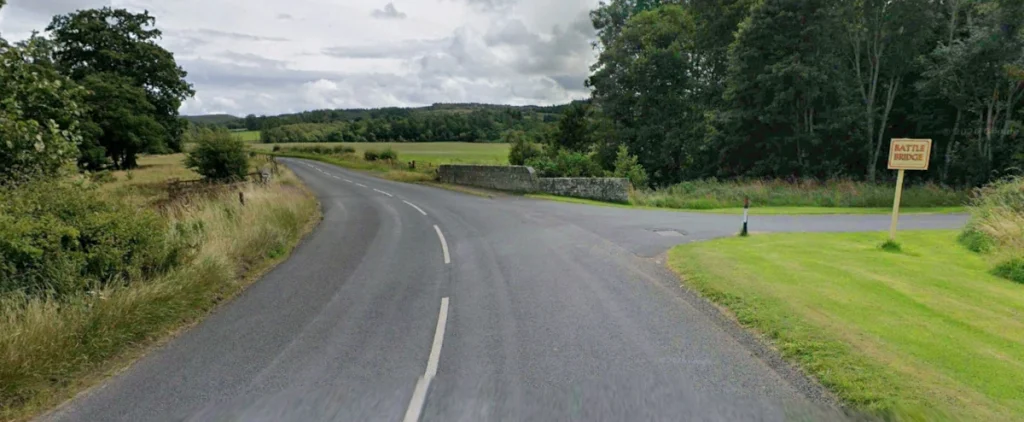
I’ve said before that Northumberland is full of history hiding in plain sight.
We travel these roads, cross the burns and pass the farms without giving much thought to the people who came before us. Well, I certainly do, but many people fly past, caught up in their own lives. But a place like Battle Bridge is a good example of somewhere even the most uninterested person must lift their head and say, “Howld ern here.”
The name is real. The outline of the events is recorded, and the historical circumstances in which the supposed battle was fought are documented.
The names Ellingham, Eglingham, Edlingham and Whittingham belong to an older Northumbria, one of royal estates, farming communities, inherited roads and changing allegiances. Battle Bridge adds an intriguing question about what may have happened to those communities during the Viking period.
Did the men of Whittingham make their stand here, defending what they had worked so hard for, or die trying, protecting their families and livestock from the invader?
We simply don’t know, but as usual, I’m taking a guess, and as always, you’ve been welcome on my little journey into this quiet, beautiful corner of Northumberland and peeked through the pages of history to see what may have happened here 1,151 years ago.
But I still reckon a name like Battle Bridge deserves a second look, don’t you? Howay man, Vikings and early Northumbrians scrapping, balls out to the death on a tiny tributary possibly crossed there by an as un-yet discovered Roman road and early bridge…. What’s not to love?
The countryside around Alnwick has a habit of giving up little fragments of its history when you least expect it.
It’s good to pick at those threads of a tale and imagine…
And that’s half the fascination of studying the history beneath our feet.
With Love from the Crasterfarian XX
Never miss an article. Enter your email or give our FB page a like
