
By Crasterfarian
I’ve written a couple of pieces lately on the Golden Age of Northumbria, and I’m trying to stitch it all together into a series of stories, as much for myself as anything. I find if I write it airl doon, it gans in.
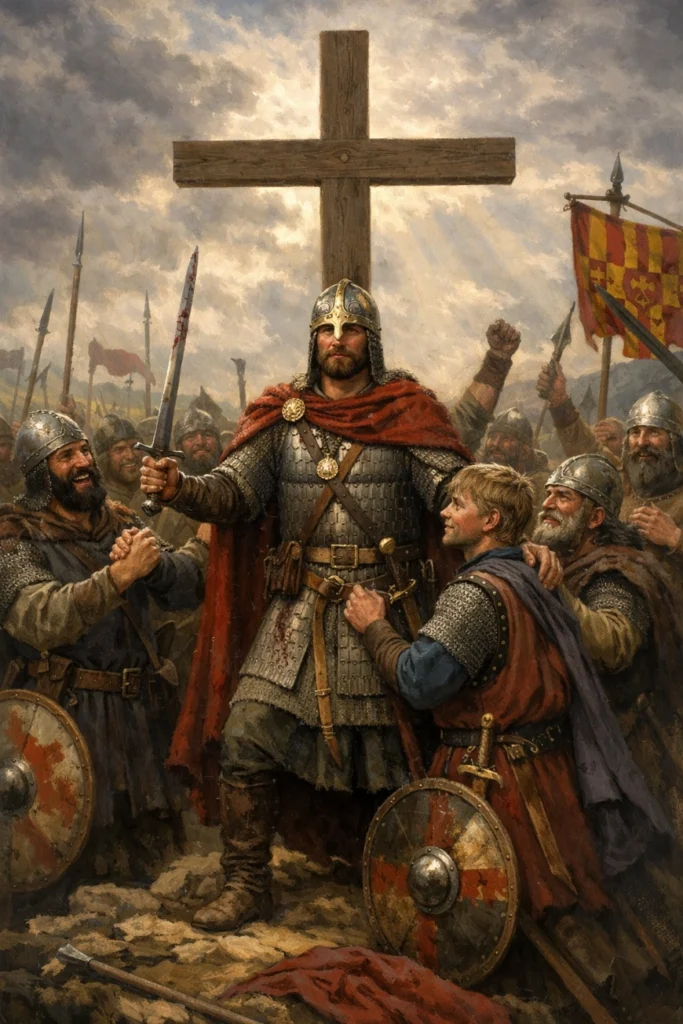
We all know of the victorious day at Heavenfield, where Oswald defeated Cadwallon under the Cross of Christ raised before the battle, and how that event was venerated.
The events at Heavenfield were used as a righteous tale of good over evil, new gods over the old.
The stories were beaten like a blacksmith’s hammer to drive home Christianity as being the one true God, and how, in his worship, the newly converted would bask in his glory and protection. Bede revelled in this story in his letters and writings sent to Rome and the Pope in the early 8th century.
What a lot of these stories leave out is the demise of Oswald, his eventual death at Maserfield, the massacre and rout of the Bernician fyrd, and the glorious victory of Penda of Mercia over the righteous Christians by the pagan gods Woden and Thor.
The story of how this occurred is slightly complex.
From Exile to King
King Æthelfrith of Bernicia ruled with his wife Acha of Deira, who was the sister of Edwin of Deira.
They had three sons.
After his death in 616 AD at the hands of Rædwald of East Anglia, the forces of Edwin, present at the battle, drove Eanfrith, Oswald and Oswiu into exile beyond Bernicia.
Bede tells us they were baptised and instructed among the “Scots,” meaning the Gaelic kingdom of Dál Riata. Later tradition strongly associates Oswald with Iona Abbey, the monastery founded by Columba.
Whatever the exact details, exile shaped him.
He did not return merely as a warlord reclaiming land. He returned as a Christian prince formed outside the political chaos of Northumbria. That would shape everything that followed.
A Kingdom in Pieces
When Oswald returned in 634 to take his rightful place as King after the murder of his brother Eanfrith, he did not return to a stable throne.
He came back to a land broken by war, the fyrd was decimated after the defeat and rout at the Battle of Elmet, the threat of invasion from the south was ever present, and the real danger of the genocide of the Christian people of Bernicia at the hands of Cadwallon ap Cadfan.
His father, Æthelfrith, had once forged Bernicia and Deira into a single powerful kingdom, his aim to become Bretwalda (Overlord) of all Albion. But Æthelfrith fell in battle, and Edwin, the exiled king, seized the crown and united the kingdoms under his rule.
Then Edwin himself fell at the Battle of Hatfield Chase, Elmet, in 633, defeated by Cadwallon ap Cadfan of Gwynedd and his ally Penda of Mercia.
Northumbria fractured almost immediately.
Oswald’s brother, Eanfrith, came out of exile and briefly took Bernicia. According to Bede, he attempted to negotiate with Cadwallon. It ended badly. Eanfrith was murdered by Cadwallon after being lured into a meeting with only twelve warriors.
Heavenfield: The Cross Before the Sword
In 634, Oswald faced Cadwallon near a place Bede calls Denisesburna, later identified with Heavenfield near Hadrian’s Wall. I’ve written two separate theories on the battle, as Bede’s interpretation, written 100 years later, is open to much interpretation.
Bede’s account is dramatic and specific.
Oswald ordered a wooden cross to be made. He held it upright himself while his men fixed it into the ground. Then he knelt and prayed, urging his army to do the same.
This was not subtle.
This was Bede’s attempt to tie the victory to religion, indoctrination, and the moulding of the people to follow the one true God.
We all know the story, and my thoughts on the battle being like Thermopylae and the 300 Spartans against Xerxes.
The army that followed him was smaller than Cadwallon’s. Yet the battle ended in decisive victory. Cadwallon was killed. Northumbria was reclaimed.
Heavenfield became more than a battlefield. It became a founding myth with a King who prayed before he fought and won.
King of All the North
Bede later claims that Oswald held “imperium” over all Britain, English, Britons, Picts and Scots alike.
That may be an exaggeration, but it tells us something real: Oswald was dominant.
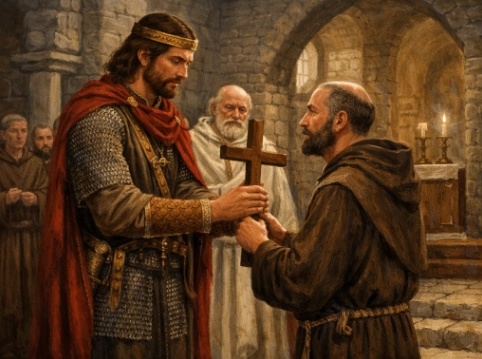
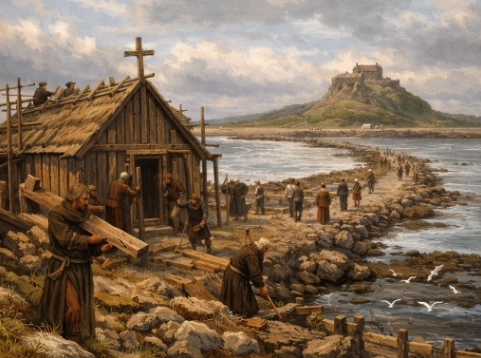
During his reign, and to bolster Christianity among the people of Bernicia, he invited a missionary bishop from Iona.
The first, a man named Corman, failed, for being too harsh and rigid in preaching to the Northumbrians, so he returned to Iona and was replaced by Aidan. Oswald granted him “Lindisfarena”, or Lindisfarne as we know it, as his base.
Bede records that Oswald sometimes acted as interpreter when Aidan preached, translating from Irish or Latin into English.
The preaching of the gospels by this instrument of God on earth, combined with his healing “powers” of basic medical knowledge, cemented Christianity into the land and its people. Heavenfield gave him a crown. Lindisfarne gave him the religion behind the victory, and a base to call the house of God within reach of Bebbanburg (Bamburgh).
The Quiet Middle Years
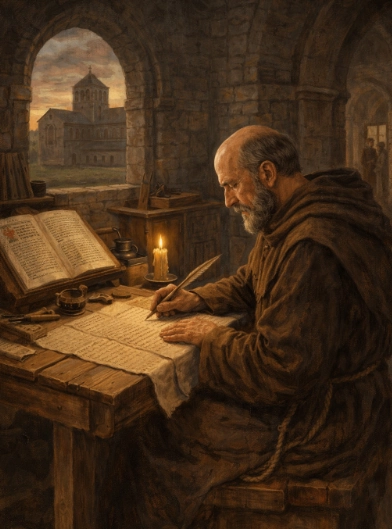
The years between Heavenfield and the military disaster at Maserfield are curiously quiet in the sources. Maybe nothing happened, or perhaps Bede simply didn’t have any information other than the highlights: bullet points, passed down to him.
Howay man, there was always something gannin on in the quiet valleys, coastline and wide-open tracts of land between the muckle Cheviot and the sea.
Huge open stretches of fertile land, once taxed for grain by the Romans, crisscrossed by their roads, must have produced some craic. You should try living in some of the villages nowadays, the gossip is always on the lips of the locals… But seemingly there was nothing noteworthy for Bede, so alternate theories of that time abound, especially in my head.
We know Oswald ruled for eight years. We know Northumbria expanded its influence both north and south. There is evidence of campaigns into British territories, possibly including the siege of Din Eidyn (Edinburgh) in 638.
However, Bede does not dwell on these wars. He used stories that were almost 100 years old at the time of writing as a hammer to beat the people into Christianity, and if it wasn’t for some corroboratory evidence in places like the Anglo-Saxon Chronicle and the Annals of Ulster, he could have been making some of it up. And I’m pretty sure, to further his own religious agenda, he did.
“WHAT?” I hear you say. Bede contrived some aspects of the stories to forward his own agenda. You know what, I think he did. It’s been going on for centuries and is still happening today.
A Man of the People and God
Oswald of Northumbria was portrayed by Bede as the saviour of the Bernician people. He delivered them from genocide and brought a measure of stability and peace.
He brought Christianity into the mix, along with the comfort blanket of “eternal life” at the side of God for those who converted to the one true faith.
Convenient, maybe. Probably, almost certainly.
Religion has always been used as a method of control for the masses, and Bede may well have massaged the facts to fit that narrative.
However, being less cynical, Oswald did convert large numbers and cast a new light of a single faith into what we call the Dark Ages.
What we can say is this: Oswald was not a passive ruler. He was active, powerful, and fully engaged in the shifting balance of power across northern Britain.
That was all about to change though, and his luck and piety that seemed to have got him thus far were about to run out… badly. Life’s great banana skin that affects all us mere mortals at times, was about to drop at his feet.
Maserfield: The Fall
The Battlefield at Maserfield
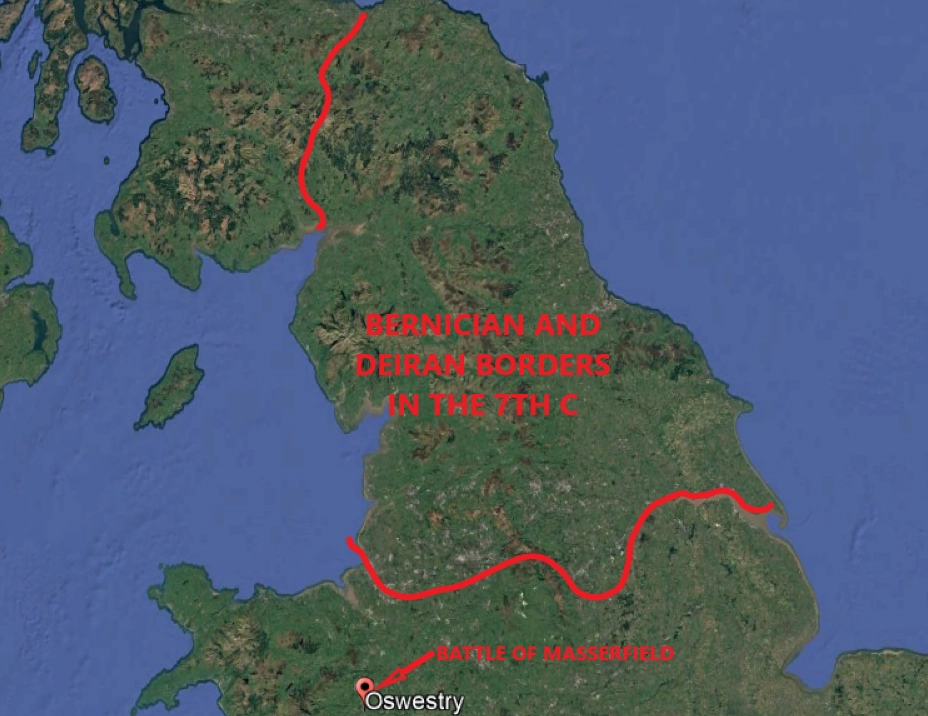
On 5 August 642, Oswald met Penda of Mercia at a place called Maserfield. Tradition often identifies this with Oswestry in Shropshire, an area whose early name, Oswaldestreow, means “Oswald’s Tree”.
The Welsh name, Croesoswallt, means “Oswald’s Cross”.
If that location is correct, Oswald was fighting far from his northern heartlands, taking the fight to his enemies, a theory I agree with based on his life and attitude of taking pagans to task.
This was not a defensive stand like Heavenfield.
It was a foolish and ambitious southern campaign where he would bite off far more than he could chew.
Penda may have also been joined by the men of Powys and Gwynedd, those sons, comrades and survivors of Heavenfield, out for revenge for their fallen and the death of their King, Cadwallon.
Had he convinced himself that God was on his side and that he was invincible?
Maybe. But the truth was, he was outnumbered, and the men of Bernicia were butchered on the battlefield.
The shield wall collapsed, and the men were routed, just as Cadwallon had been at Heavenfield.
Poetic justice, or just their wyrd.
The result was disaster.
Oswald was killed.
Bede tells us (aye, reet) that as he fell, he prayed and uttered these last words:
“Lord, have mercy on their souls.”
After his death and the rout of the fyrd (warband) came the humiliation.
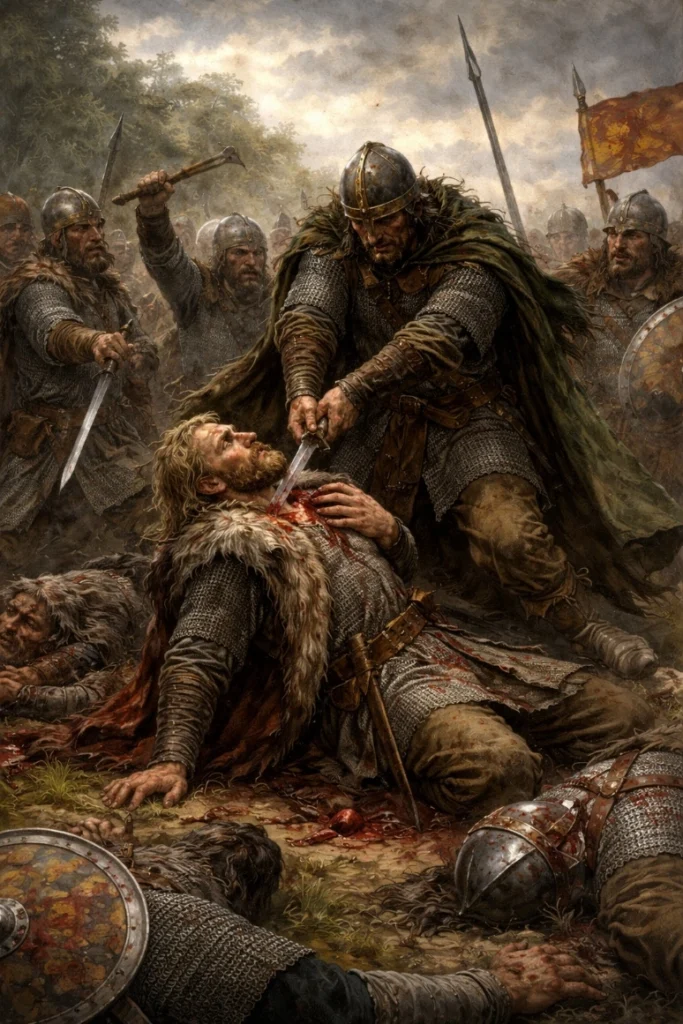
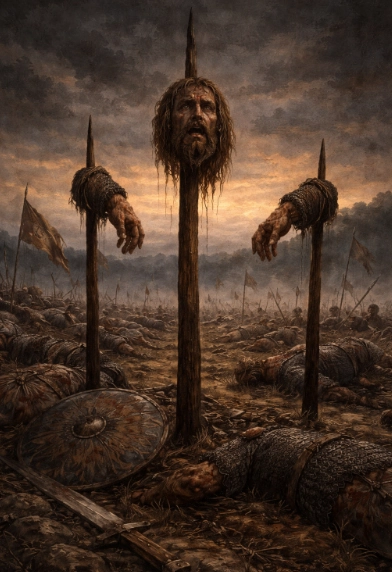
Penda ordered Oswald’s head and arms cut off and displayed on stakes.
The King of Northumbria, who had once raised a cross before a battle, was now raised as a trophy.
His body was butchered like a guffy (swine) and laid bare for all to see. Not only was this a disaster for Bernicia, but for the machinations and progression of Christianity.
The sacred ash tree was used as anchors to keep him staked to the earth on which he had died. Ash hafts were used like spear shafts, inexorably linking them to Woden, the Anglo-Saxon version of Odin, the All Father.
The champion of God on earth had fallen at the hands of a pagan.
The ash hafts pinning him, the ravens devouring him in a myth-like scene.
Bede records miracles associated with the place of Oswald’s death, perhaps to soften the blow and make it seem like some divine plan.
The Miracles of the Land
Later tradition deepens the story.
One tale tells of a raven carrying one of Oswald’s severed arms to an ash tree. A spring bursts from the ground beneath it. The place becomes a site of healing.
An ash tree.
A raven.
A severed limb.
A well.
All hugely symbolic.
In a landscape long shaped by sacred trees and wells, the symbolism runs deep. The pagan act of dismemberment became the seed of a Christian cult.
Cross and Irony
At Heavenfield, the cross stood firm and victory followed.
At Maserfield, prayer remained, but victory did not.
Did the cross fail?
Bede would say no.
In his telling, defeat did not undo Oswald, it transformed him.
The warrior king became a martyr. His severed limbs became relics. His death site became holy ground, positive from the negative.
Heavenfield made Oswald King.
Maserfield made him immortal.
But we can only guess at the wrath of Penda and his horde after the battle.
Once the rout had ended and the Northumbrian dead had been stripped of their wealth, little is known, other than the fact that Oswiu had survived.
Had he even been at the battle? Was it a strategic ploy to miss it, knowing Oswald’s death would make him King? Or was he simply too late to the fray, arriving and seeing from a distance that defeat was unavoidable, and leaving before engaging Penda’s fyrd?
A new king would be needed though, be it by fate or design. One brother of the sons of King Æthelfrith remained, and his time had come to step up and take his rightful place on the throne of Bernicia.
Oswiu King
The stories will continue
Have a great Easter
With Love from the Crasterfarian XX