
By Thomas Bainbridge
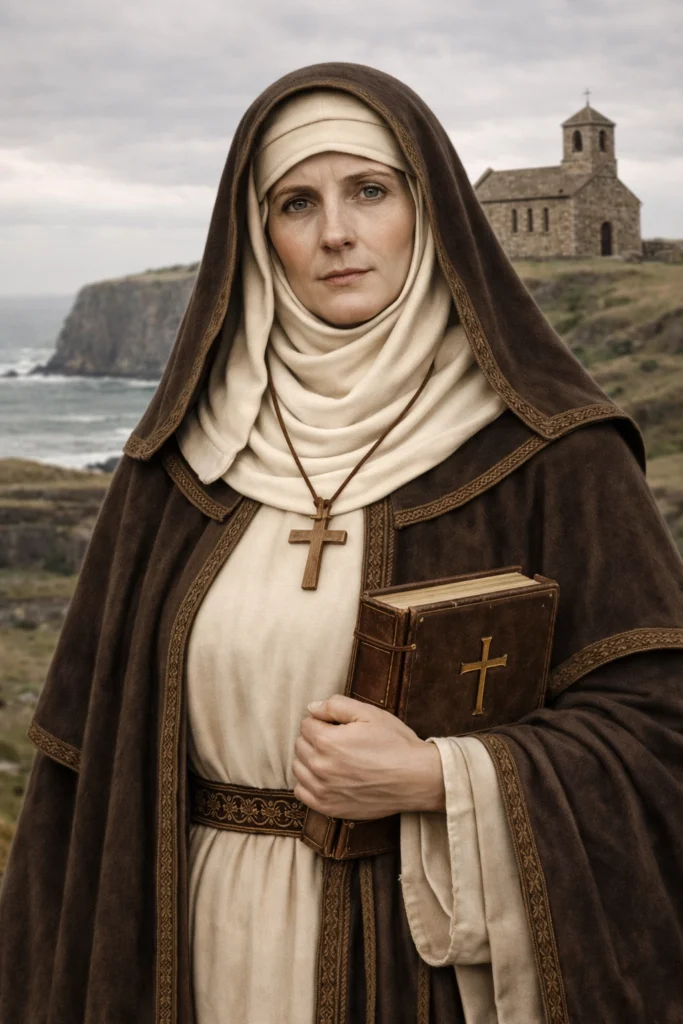
Saint Hilda (614 – 680) was a Derian Princess, connected through blood to the great dynasties of Anglo-Saxon Britan:
- Granddaughter of King Aelli of Deira (d. 588)
- Grandniece to King Edwin of Northumbria (c. 586 – 633), credited with establishing the first church at Tynemouth
- Niece to King Oswy (c. 612 – 670), successor of King Oswald
She grew up amid the struggles between these warring families over the kingdoms of the island.
Her mother, Breguswith, had dreamt of a light that would fill the entire world, and the child that she would bear to Hereric in 614 was a girl who, in an age dominated by brutal internecine strife, would act as a moderating influence, sowing peace and concord.

And yet, it was not till she was thirteen that Hilda was baptised.
Edwin, in whose household she was raised after the death of her father and mother, had married the Christian princess, Aethelburg of Kent. Arriving in the foreign land, Aethelburg was accompanied by the Roman monk, Paulinus (later Saint Paulinus), assistant to Augustine of Canterbury. By his earnest efforts, Paulinus persuaded Edwin to adopt his new wife’s religion. Thus, in 627, the King and his entire court were baptised in the waters of the River Ouse at York, including the young Hilda.
The details of Hilda’s early life remain obscure.
Perhaps agitated by these turbulent times, she sought a more contemplative life, away from violence and intrigues.
Despite the luxury afforded by her royal connection, she took monastic vows, choosing instead austerity and devotion. Initially intending to travel to the famous convent of Chelles in Francia to meet her sister, she was offered a place by the great Bishop of Northumbria, Aidan, to dwell, according to Bede, in the district north of the Wear, and there to learn the rudiments of her new vocation.
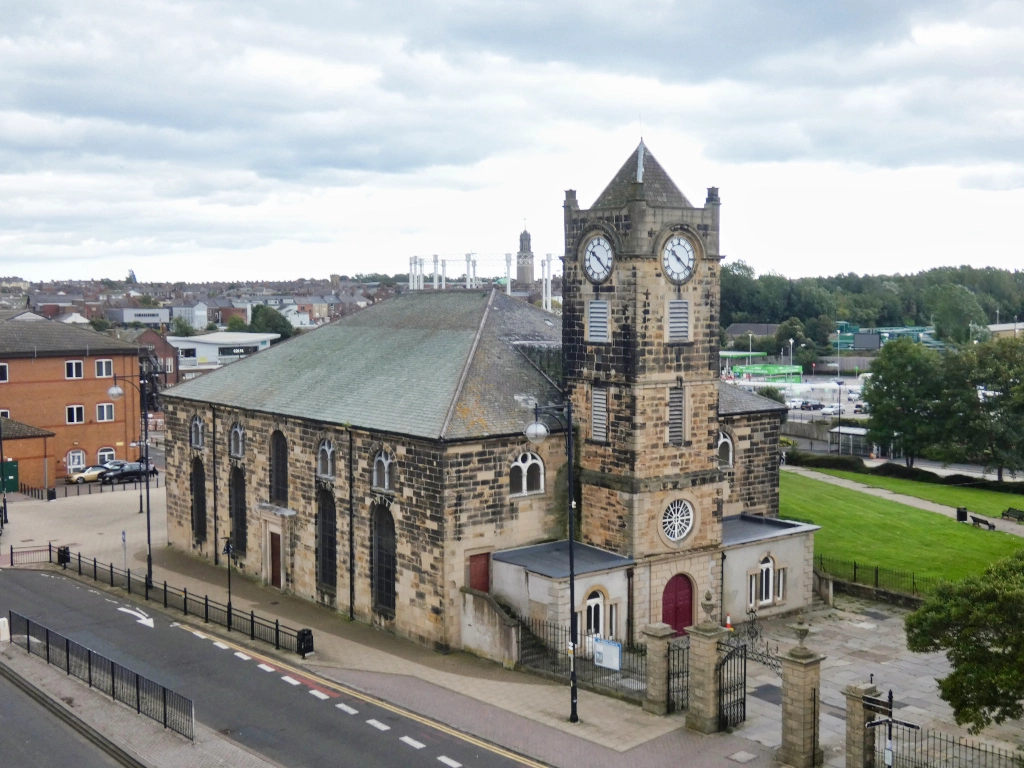
In a famous 1898 essay in Archaeolgia Aeliana XIX, pp. 47-75, the Rev. H.E. Savage navigated the vague wording of Bede’s Latin to dispell theories based on the writings of John Leland that her early place of learning had been at either Monkwearmouth or Souter Point. Instead, he laid out a clear and detailed argument (also referencing Leland’s knowledge gleaned from local monks at the time of the Dissolution) for the location of her first religious house being the site of St Hilda’s Church in South Shields, established by Aidan in 647.
Bede also recounts a story about the building of the church, observed by Saint Cuthbert from the opposite bank at Tynemouth:
This church was ultimately put under Hilda’s charge and perhaps this promotion occurred just a short time after its founding.
The purpose of Hilda’s tutelage here was to learn the traditions of the Celtic Church from which Aidan had hailed and which was centred on the island complex of Iona. Even though Celtic Church doctrine contradicted the early Roman form of Christianity into which she had been converted, she accepted it readily.
Ministry
According to Bede, Hilda was exemplary in cultivating her talents. Such was her promise that the following year, Hilda was sent to Hartlepool as Abbess, overseeing the administration and education of the convent on the Headland.
However, ailing with sickness, her mentor, Aidan, died in 651, leaving the kernel of his teachings implanted in the mind of the Princess.

Then in 657, in recognition of her piety, Hilda was granted a tract of land at a small bay at the river Esk, called Streanaeshalch (meaning Beacon Bay, now Whitby), in which to form a new religious house comprising a convent and monastery, over which she was to be the Abbess.
Here too, she met with eminent success. In her time as Abbess, she tutored five who would go on to become bishops: Bosa, Aelta, Oftfor, John, and Wilfrid — the latter two as Bishops of Hexham and York. The scholarship of the Abbey was also impressive, in which the poet Caedmon composed some of the most exalted verse within the Anglo-Saxon language.
Thus, Hilda became one of the foremost figures of her age, having attained the highest position of any woman perhaps in all Christendom. As Abbess, she commanded as much power as many bishops and was granted just much respect. She was renowned for her wisdom and thegns and even Kings supplicated to her for guidance.
The greatest instance of Hilda’s influence was the decision to hold a synod at her Abbey, to settle one of the most significant debates of the era then raging between the proponents of the Celtic and Roman tradition.
Specifically, the dispute arose regarding the dating of Easter. Though Hilda maintained her Celtic faith on this question, it was thought that her presence and oversight would soften some of the tempers of those present. Violence was not an uncommon consequence of such events, even though we may now scoff at their seeming banality. Though Hilda initially disagreed with the Roman manner of calculation, she accepted it wholeheartedly upon the conclusion of the synod.
The final years of her life were spent in the grip of an unrelenting disease and she died on the 17th of November 680. Hilda had done so much in her 66 years, with the crowning achievement being the resolution of the schism that threatened to shatter the English Church. By convening the Synod at her Abbey in Whitby, Hilda’s place in history is assured. She did as much as anyone to foster Christianity in this country.
Further Reading: