
By Crasterfarian
“Oh, I’d love to see something like that.”
That’s what you hear when you post a stunning relic of any description from around the world.
People sit at home thinking they can never get to see some of these wonders. But howld ern……
Most people assume you’d need to travel to Pompeii or Herculaneum to see Roman water systems and public fountains still surviving in stone.
The one pictured below is one of the many such public fountains in Herculaneum.

Yet tucked away quietly in Northumberland, right on our doorstep, reused as a flowerbed, sits something remarkably similar.Not only that, but you can literally reach out your hand and touch it from your car window.

The structure in the photograph above is the re-sited and re-used remains of a Roman public water cistern from the Roman town of Corstopitum at modern-day Corbridge.
Water was channelled into a holding tank by an aqueduct and distributed throughout the settlement nearly 2,000 years ago, serving one of the most important Roman supply towns in northern Britain.
Corstopitum stood at the end of Dere Street towards the end of the 1st century AD and acted as a staging post and, ultimately, a secure springboard for the construction of the Stanegate, an early militarised demarcation line across the country, the campaigns by Agricola into the north during the AD 80s, and the eventual construction of Hadrian’s Wall in AD 122.
If legend is to be believed, it is also the location through which the fabled, and “missing in action” Legio IX Hispana marched through in the early 2nd century before they disappeared from history be it by slaughter in battle or removed from the record because of disgrace
A Roman emperor himself, perhaps Hadrian or later Septimius Severus, may even have let his horse slake its thirst from this very cistern while overseeing refurbishment of the Wall during the late 2nd century.

Even more fascinating is the famous Corbridge Lion, now displayed in the site museum, which is well worth a visit. You can wander the deserted streets of a Roman town and imagine life there 2,000 years ago.
The lion once formed part of a decorative Roman fountainhead, with water issuing from its mouth into a trough or basin below.
It is another reminder that Roman Britain was not simply forts and marching soldiers, but a sophisticated civilisation bringing engineering, art and urban infrastructure to the very edge of the empire.

H2Owners
The Romans were absolute masters of hydro engineering.

Across the Empire they designed aqueducts like the one above at Segovia in Spain that featured pressurised pipe systems, baths, drains, fountains, sewers and complex water management networks using nothing more than gravity, siphons, mathematics and an extraordinary understanding of gradients and flow.
Even here in the far north of Britannia they were harnessing springs and moving water across difficult terrain with remarkable precision.
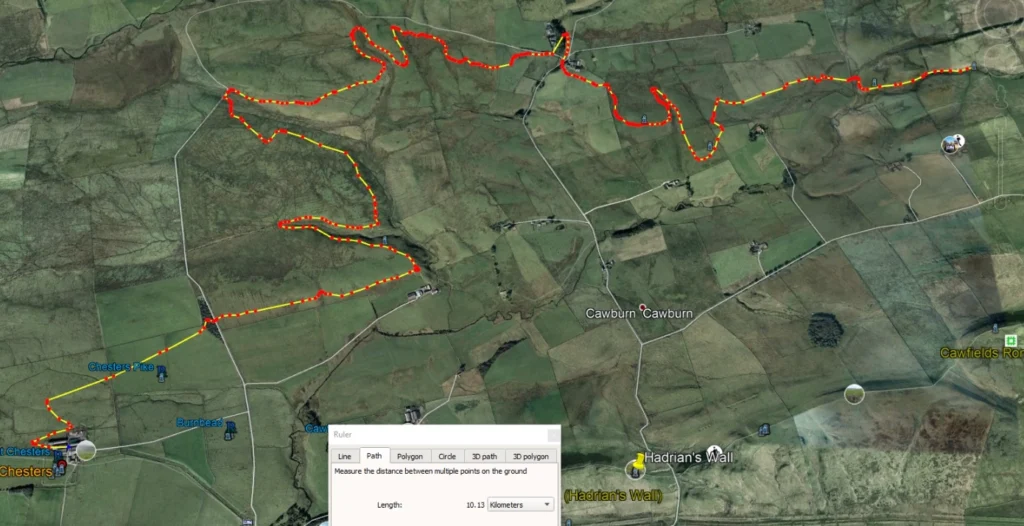
The aqueduct at Aesica fort (Great Chesters), which harnessed water from the Caw Burn and its snake-like 10km meanderings to supply the fort, is a fine example of determined water engineering in some of the harshest terrain imaginable.
History in the Walls
What fascinates me most is that Rome never truly vanished from Britain.
Its grandeur did not simply disappear with the legions. Yes, it was abandoned, but it was absorbed into the very fabric of our towns, churches, castles, farmhouses and field walls. Roman stone was reused generation after generation, built into the foundations of the medieval and modern world around us.
In many ways, the genesis of our own architecture still rests upon Roman engineering and design, quite literally built upon the stones that once inspired it.
The tombstone to Flavinus, now on display in Hexham Abbey, was found during renovation work. It had been inverted and laid flat as a flagstone and could so easily have been destroyed.
It now sits in pride of place within the Abbey, one religion intertwined with another: two vastly differing belief systems now united forever.
Look closely across Northumberland and you can still see Rome hiding in plain sight.

Chollerton Church
Within the hallowed and consecrated ground of the Church of St Giles at Chollerton, the columns on the right-hand side of the aisle, which have stood in silent witness to countless weddings, christenings and funerals, were taken from the Roman fort at Cilurnum (Chesters) on Hadrian’s Wall, a mere mile or two away.
Stones that once stood within a Roman cavalry fort, supporting the portico of the headquarters building, as the tribune barked out his daily orders, now quietly support a Christian church roof centuries later.

Along with the columns in the church there is another relic of the Empire.
In a corner sits an inverted Roman altar, re-purposed as a font. Countless children have been brought into the fold of Christianity in this setting.
Once again, the pagan was repurposed for the later ‘better’ religion.
I have often wondered to which of the numerous Roman gods and deities this altar was dedicated.
Or whether it too had been repurposed from one Roman religion into another instrument of offering, as Rome’s religious beliefs ebbed and flowed with the tides of superstition and fervour that swept the Empire during its long existence.

The Ground Beneath Our Feet
As I have mentioned in many of my pieces, we walk among the skeletons of history in Northumberland.
Empires may have fallen, but their bones still hold up parts of our world.
What fascinates me is how easily people walk past these things without realising what they are looking at.
Open ya peepers, man! Have a deek aboot, form your own theories, research and dig around your own history. It’s all out there.
We tend to think of Roman Britain as just walls and milecastles, yet the Romans brought aqueducts, drains, cisterns, fountains and complex water management systems with them.
That’s the beauty of this county.
Hidden amongst fields, villages and quiet corners are fragments of an ancient world that still lives alongside us today.

I was in the new beer garden to the rear of Alnwick Working Men’s Club recently after it had opened and noticed some impressive stonework forming the boundary between it and the neighbouring property.
These stones were not simply blocks cut for that purpose and I’d hang my very moth-eaten hat on the fact they were repurposed from the original town walls and Clayport Tower, which once acted as the western gate into medieval Alnwick.
It’s all there waiting to be discovered.
Go on…… you know you want to.
With love from the Crasterfarian XX

Another repurposed Roman altar a few miles from St Giles, Chollerton: https://x.com/northerncurio/status/1845869898532114844