By Crasterfarian
Old photographs have a habit of making you stop and think.
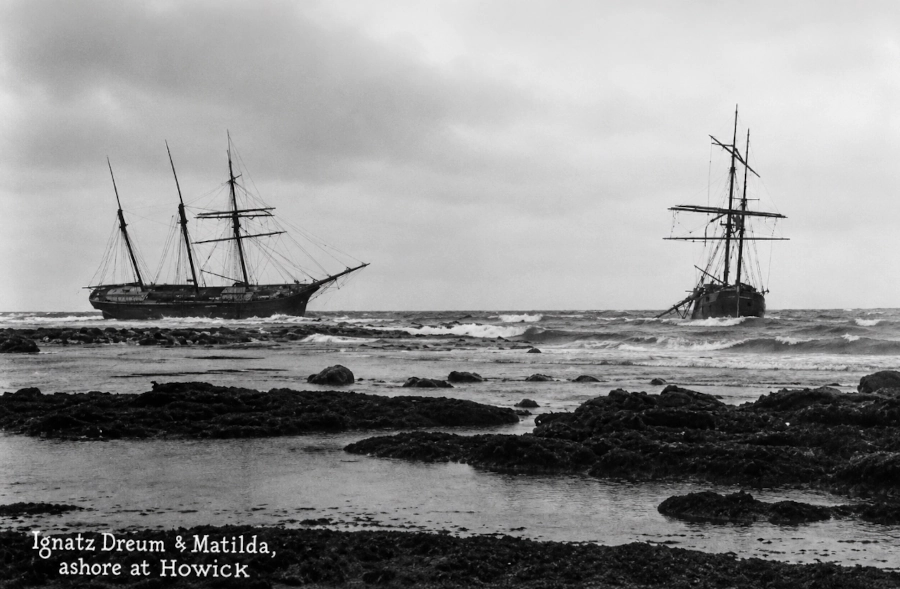
I saw these two stunning images on the Craster FB group, posted by Chris Cockburn some time ago, and never really thought anything more of them.
Then, recently, someone from outside the area questioned me when I mentioned a place called ‘Liverpool Hole’ on the way to Dunstanburgh Castle.
“Why is that inlet called Liverpool Hole when it’s so far from Liverpool?”
And, infuriatingly, I didn’t know the answer, but it got me thinking and doing some digging.
It turns out that Liverpool Hole was named after a shipwreck, possibly in the late 1700s/early 1800s, off the end of Little Carr.
The people who scrambled ashore from the wreck said the ship had hailed from Liverpool. Its name has seemingly been lost, but I am trying to find it. Then I remembered seeing the images of two wrecked schooners and wondered if one of the images was of the lost ‘Ship from Liverpool’.
Was I right? Sadly, no. Mainly as photography was not invented when the ship from Liverpool supposedly went aground, so you’ll have to wait a bit longer for the Liverpool Hole story.
Howick’s 1913 Wrecking Spree
The pictures got me thinking about the story behind them…
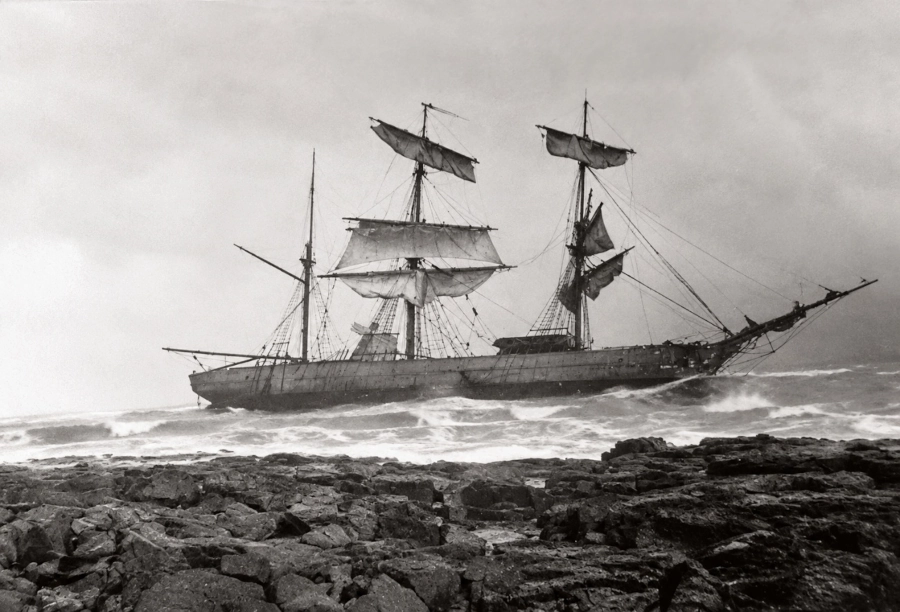
It turns out the image of the lone ship was taken at a different angle to the one of the two ships, but they were of the same incident at Howick Haven in early 1913.
These two remarkable images show the aftermath of not one but two shipwrecks: the wooden sailing vessels lying stranded amongst the rocks within sight of one another.
They were the Matilda and the Ignatz Breum, and they were wrecked only two days apart.
January 1913 had brought some truly atrocious weather to the Northumberland coast.
High winds were accompanied by heavy seas and substantial snowfall, with later accounts describing somewhere between ten and fourteen inches of snow falling over just two days. For the sailing vessels still trading along Britain’s east coast, conditions must have been horrendous.
The first casualty at Howick was Matilda, which is the single ship in the image above. In the first image she has dropped her sails, or had them torn from her masts, and has heaved to on her starboard side, whereas in the next image, the ship had just been wrecked.
An Unhappy New Year
On 10 January 1913, Matilda was driven ashore onto the rocky shallows at Howick.
She was carrying pit props from Sweden, timber destined for use underground in Britain’s coal mines.
Little seems known of the fate of her crew or how they were rescued.
Then, incredibly, two days later another sailing ship found herself in almost the same predicament.
On 12 January, the Ignatz Breum was caught in a strong south-south-easterly gale and very heavy sea and driven onto the same rocks.
The contemporary RNLI record from the lifeboat station at Boulmer describes her as the schooner Ignatz Breum, of Thurso.
She had been carrying wood pulp from Norway to England, probably destined for the paper-making industry.
Both ships would eventually be lost completely to the ravages of the North Sea and the rocks of Howick. For her crew, however, there was hope.
Six Men on the Shore

This is perhaps my favourite part of the story, because behind photographs of wrecked ships there are invariably stories of ordinary people who dropped everything and went to their aid.
This was in the days before the social media trend of being seen to be helping and taking pictures of the event for likes and attention. This was honest, hard-working people dropping all to help those in distress.
It’s a coastal thing, a timeless, honourable act by anyone linked to the sea.
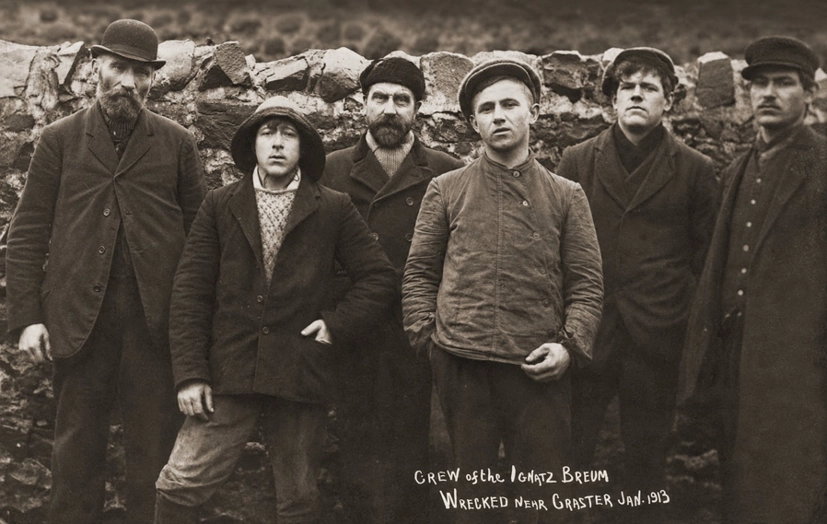
With Ignatz Breum being battered by the heavy sea, six local men went to the assistance of her six-man crew.
A rope was thrown from the wreck and communication established between the ship and the shore. What followed must have been nothing short of astonishing.
Using the rope, the six rescuers managed to drag each of the six sailors through the breaking surf and onto the shore, saving the entire crew.
It wasn’t without danger to themselves.
The official RNLI record specifically notes that the rescuers incurred risk during the operation.
Their bravery was subsequently recognised by the Institution, which awarded £3 to the six men for saving the crew. In 1913 that would have bought many a pint or a rum in the local pubs.
Names Lost to Time
Sadly, the record I’ve found so far doesn’t name those six rescuers.
That’s a shame because, more than a century later, those are the names I’d really like to put back into the story and give them the recognition they deserve. Their descendants probably still live in the area, and I could almost certainly take a stab at one family name being involved…
I am now wondering if the efforts of the people of Howick, who dramatically saved the crew of the Ignatz Breum through sheer determination, strength and unimaginable bravery against a heavy sea, may have hurried along plans for, or improvements to, the breeches buoy and rocket apparatus at Craster.
Little more than eleven weeks later, that very type of equipment would be taken to Howick during the desperate attempts to rescue the crew of the Tadorne.
I have no evidence yet to connect the two events, but given the timing, it’s an intriguing thought and one I’ll continue to investigate. Either way, they are incredible photographs. The image showing the two vessels together is particularly special.
On one side sits the Matilda, wrecked on the 10th.
Only a short distance away lies the Ignatz Breum, wrecked on the 12th.
Two ships. Two days. Same story. The same stretch of rocks.
Both carrying timber products, pit props aboard the Matilda and wood pulp aboard the Ignatz Breum.
One later account rather wonderfully speculates about just how much timber and other material must subsequently have washed ashore and been gathered by the locals. It lacks the same enchanting story of Whisky Galore, but never look a gift horse…
I suspect there wouldn’t have been much left lying around for long!
But the story also illustrates something easily forgotten today.
Even in 1913, when steamships had long since transformed maritime transport, their wooden forebears were still plying their trade across the North Sea, reliant largely upon wind and tide, harbours only safely met by the immense skill of their crews.
And Howick wasn’t finished yet…
The wrecks of the Matilda and Ignatz Breum were only the beginning of a terrible year at Howick.
Barely eleven weeks later, during the early morning of 29 March 1913, the French steam trawler Tadorne ran onto the rocks near Howick Haven in dense fog.
You can read about her loss in my other article, ‘The Wreck of the Tadorne’.
The Changeable Coast
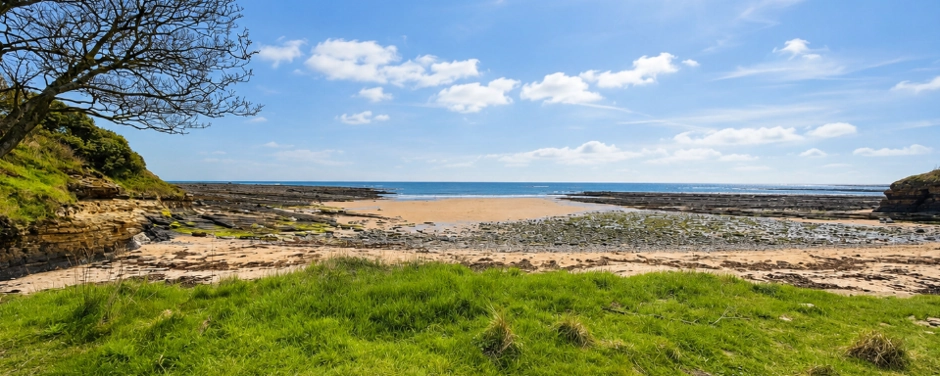
When you walk the coastal path on days like I’ve pictured above, it’s difficult to grasp the ferocity of the North Sea in mid-winter.
Rain and snow trying to tear the very skin from your face, having to lean into the wind to stay upright, the sea and noise of the tempest so loud it would drown out a scream.
But these times too shall pass, like all hardship, and be replaced by the breathtaking beauty of this area.
So next time you walk between Boulmer and Craster, think of the Matilda, the Ignatz Breum, the Tadorne and the brave folks in all the coastal villages, and how, within the space of less than three months in early 1913, this little stretch of coastline at Howick had seen three vessels wrecked upon its rocks.
The ships have long since disappeared, but thankfully somebody had a camera and the balls to help those in peril.
And because they did, more than a century later we can still look out across those familiar Howick rocks and put a story back to the scene.
With Love from the Crasterfarian XX
Never miss an article. Enter your email or give our FB page a like
Another ‘right rivetin’ read from Peter, well researched and easy to read.
Cheers David, there’s more to come, I’m researching some of the other wrecks that are now almost out of living memory so watch this space