By Thomas Bainbridge
The first Viking raid on Northumbria must have been the most harrowing experience for those that dwelled in the region, for the peasants placidly tending to their crops, or monks habituated to a life of scholarship and devotion, then to espy on the horizon a squadron of eerie vessels ploughing through the waves, piloted by axe-wielding warriors sowing destruction.
Terror
Such events were naturally seen in apocalyptic terms, as we might now view an alien invasion. The Anglo-Saxon Chronicle records of 793, the year of the first appearance of the Vikings:
“In this year fierce, foreboding omens came over the land of the Northumbrians, and the wretched people shook; there were excessive whirlwinds, lightning, and fiery dragons were seen flying in the sky. These signs were followed by great famine, and a little after those, that same year on 6th ides of January [sic: June], the ravaging of wretched heathen men destroyed God’s church at Lindisfarne.”
Alcuin, the renowned Northumbrian monk, wrote:
“Never before has such terror appeared in Britain as we have now suffered from a pagan race… The heathens poured out the blood of saints around the altar, and trampled on the bodies of saints in the temple of God, like dung in the streets.”
Following Summer
A year after the attack on Lindisfarne, in 794, Vikings raided Donaemuth, that is, the settlement at the mouth of the Don at Jarrow. Jarrow Slake, the tidal mudflats at the confluence of the Tyne and the Don, was a large functioning harbour at this time, established by King Ecgfrith at the time of the founding of St Paul’s church and monastery over a century prior. As well as this, it seems that the Don was wider and deeper than it appears today. According to the 19th century antiquary, Rev. Savage, who established the site of St Hilda’s early church nearby,:
“The Don was in ancient times considerable enough for ships to pass up it.”
Having been founded in 681 after a gift of 40 hides (120 acres) of land by Ecgfrith, Jarrow grew to become one of the richest and most renown centres of learning in Europe, containing the largest library north of the Alps.
The ferocious raids of the Norse invaders here are still evidenced by scattered remnants. Though their precise origin has been relegated to folklore, forgotten by academia, they still offer up curious information for the willing enquirer…
Escape at Donmouth
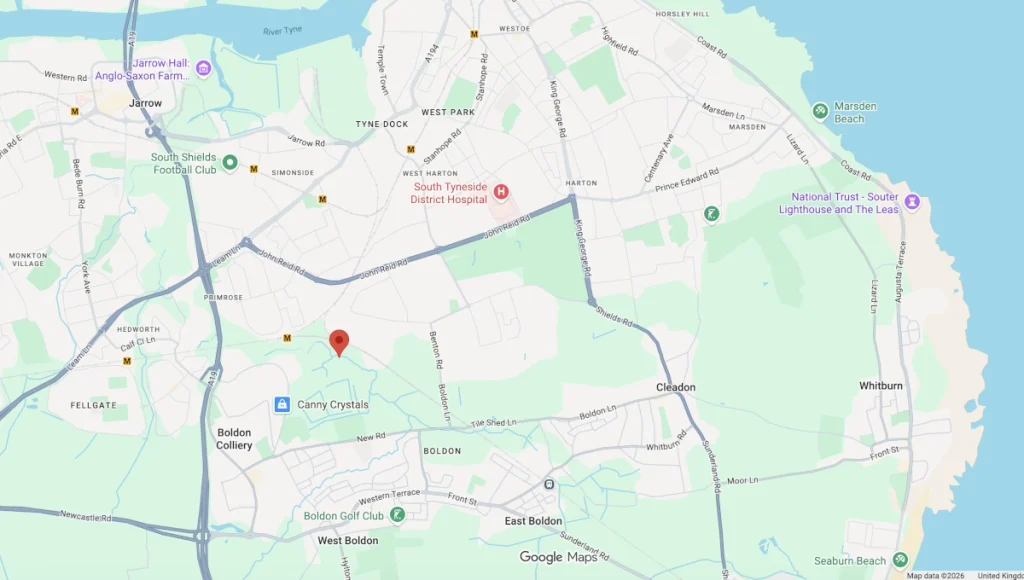
One tale is that of a Viking ship buried for centuries beneath the silt of the Don, by Brockley Whins. The ship was presumed to be amongst the raiding vessels that had attacked St. Paul’s at Jarrow in 794.
Travelling along the Northumberland coast, Norse longships had entered the Tyne and set upon the monastery, burning it to the ground, pillaging its riches and murdering the monks.
But, the spirit of Cuthbert, the patron of his ailing people, interceded and the raiders were met with reversal:
“One of their leaders was killed there, and also some of their ships were broken to bits by stormy weather, and many of the men were drowned there. Some reached the shore alive and were immediately killed at the mouth of the river.”
Symeon of Durham
Ran Aground
However, as the story goes, the crew of one of the ships, attempting to escape, perhaps to take shelter from the storm, followed a course up the Don. As the riverbanks tightened, still they bore onwards in flight. Before long, the hull, though sleek, lodged against the bed of the river, and the vessel veered with a crunch against the bank.
Though the Norsemen heaved with their combined might, breaking their oars trying to free it, they were forced to abandon the craft. Now, finding their numbers diminished in a foreign land, and surrounded by the Northumbrians against whom their predations had drawn cries for vengeance, the Norsemen’s only hope was to flee on foot. But their whereabouts was soon discovered and the local populace took up arms to massacre the invaders, or else impress them into slavery, which they themselves might have suffered at the hands of the foe.
The Vikings, having died a piteous death, were not granted entry to the hall of Valhalla, but left to wander this remote corner in search of their way home. The ship, partially sunken, was left to its fate and slowly submerged further as the years passed, covered over by centuries of dirt, forgotten until unearthed a millennium later.
Savage recounted in Archaeologia Aeliana (1898):
“For in June 1894, when a deep drain was being laid near Brockley Whins, by the bed of the Don, the workmen came upon the unmistakeable framework of an ancient ship, apparently of Scandinavian origin, at a depth of some eight feet below the present surface.”
It was not disturbed, but remains in its slumber to this day and is recorded in the Historic Environment Record (4910).
Of course, there are those in academic and professional circles who dispute the tale, and instead claim that the discovery at the Don was nothing more than timber revetments left over from a medieval bridge or mill.
But, that explanation is not so concrete. The theory of a longship is still a reasonable one that accords with our knowledge of historical events, and until more evidence comes to light, there does not seem cause to discount it.
Mill Dam Creek Ship Discovered
There is another site which bears the stamp of the Viking invasion of Tyneside, and not so distant from the Don, at South Shields.
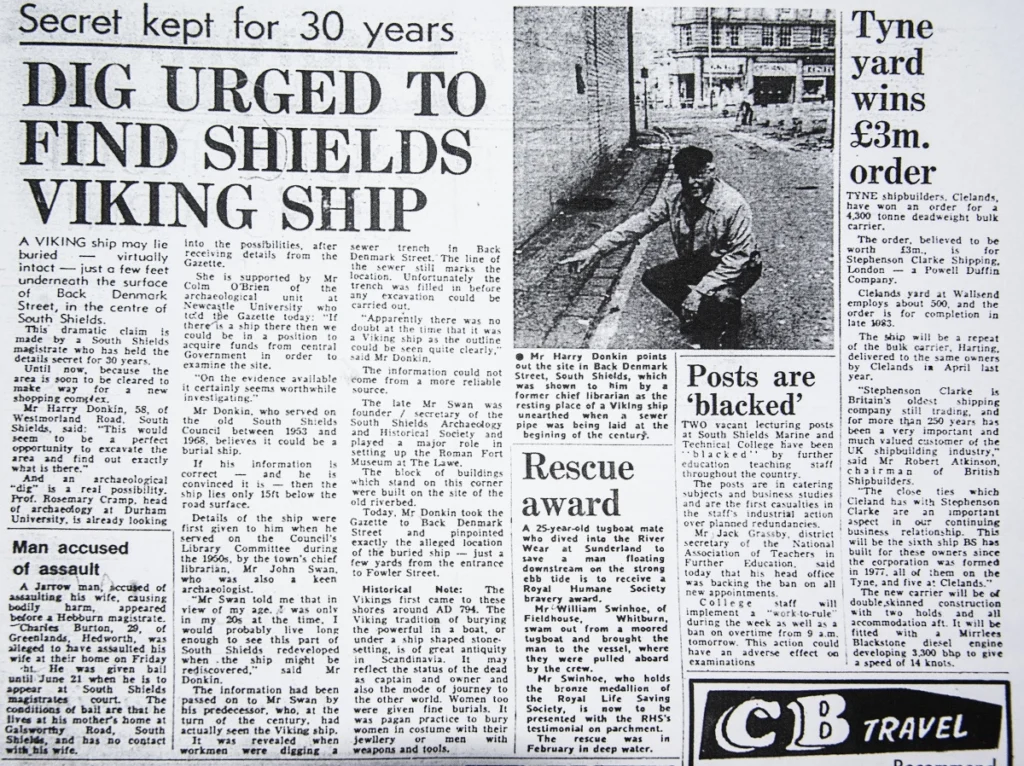
Story of the South Shields Longboat Here:
Insight into the Origin of the South Shields Longboat:

Never miss an article. Enter your email or give our FB page a like