By Crasterfarian
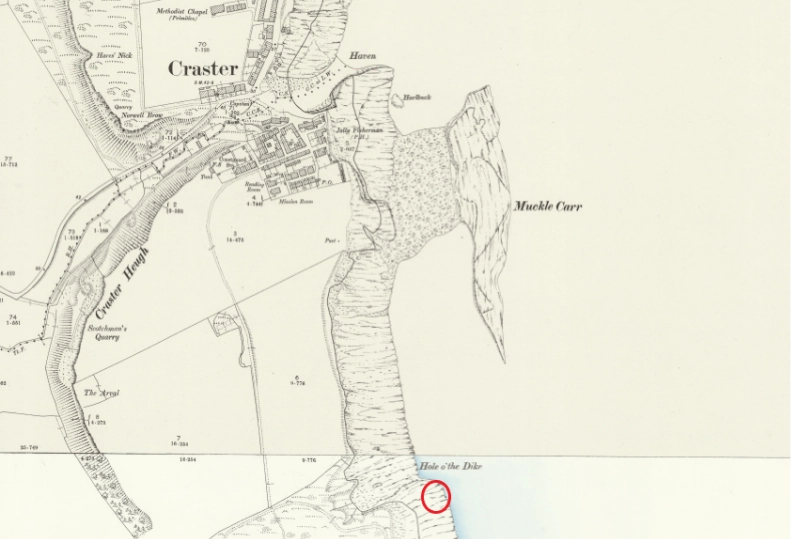
I’ve been doing a bit more digging into the shipwrecks along the coastline south of Craster, particularly around the Hole o’ the Dike, and uncovered two fascinating stories involving a German steamship and a Norwegian cargo vessel, separated by almost exactly 21 years.
Both vessels came to grief on the same treacherous stretch of Northumberland coastline, where the unforgiving whinstone ledges have claimed countless ships over the centuries.
Unlike the Matilda and Ignatz Breum, which were wrecked just two days apart in January 1913 at Howick, these two unfortunate vessels took a little longer to meet their fate.
Nevertheless, both ended their days on the very same stretch of rocky shoreline, victims of a coastline that has shown little mercy to mariners over the centuries.

The German Steamship Worms — 16 December 1907
Worms was a relatively modern ship, having been built just two years earlier, in 1905, by Eiderwerft AG at Tönning in Schleswig-Holstein. Originally named Carl Horn, she measured 1,032 gross registered tons and had been operated by H. C. Horn before passing through another German shipping company. In 1907, she was acquired by the Argo shipping company and renamed Worms. Unfortunately, she wouldn’t carry that name for very long.
On 14 December 1907, she departed Hamburg bound for Grangemouth on the Firth of Forth. Two days later, while making her way north along the Northumberland coast, she encountered heavy seas and a strong south-westerly wind.
According to accounts of the incident, the crew suddenly became aware of breaking water and land directly ahead.
The engines were immediately ordered full astern in an attempt to arrest her forward movement, but it was too late.
Worms struck the rocks south of Craster.
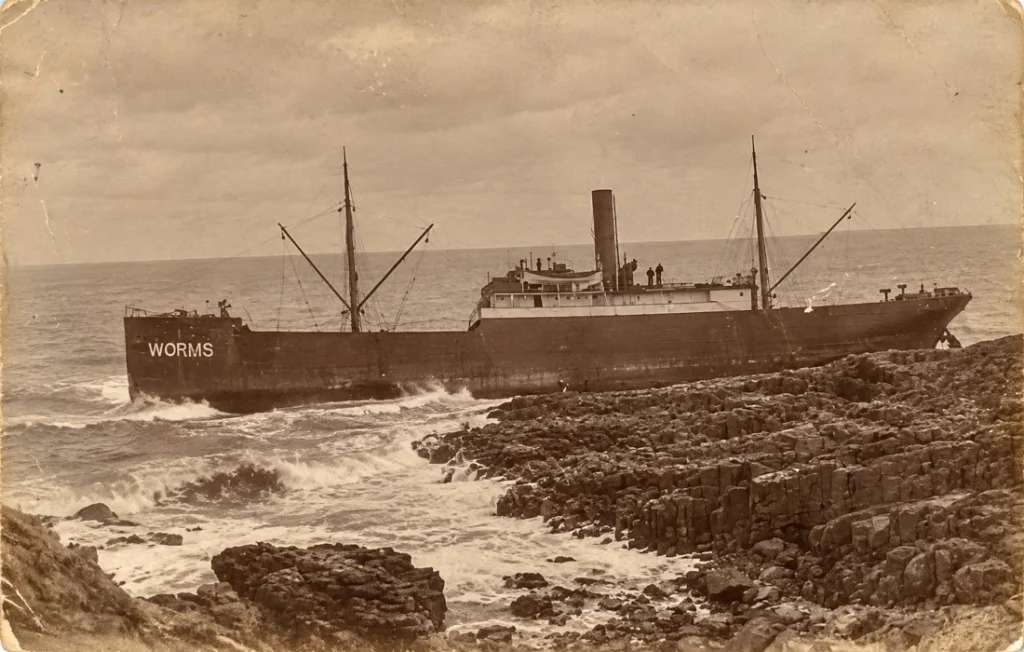
Remarkably, she initially managed to free herself, but the heavy seas drove her back onto the rocky shoreline.
Repeated pounding against the unforgiving whinstone eventually broke the vessel’s back, effectively snapping the structural strength of her hull.
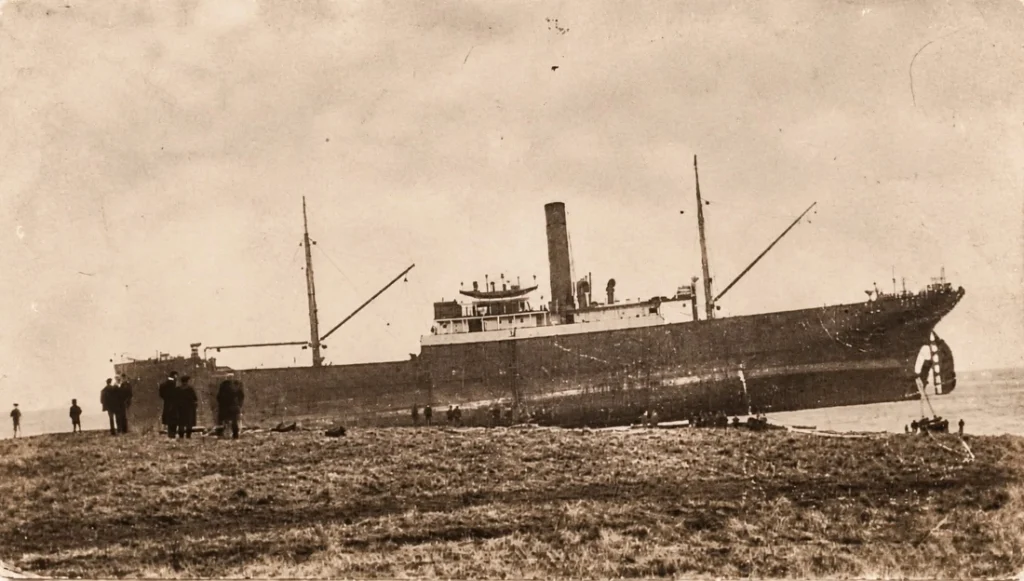
The photographs of the wreck show the severity of the damage. One particularly striking image shows the ship with her hull badly fractured.
Thankfully, contemporary German newspaper reports indicate that all her crew survived. Exactly how they escaped remains something of a mystery.
In one photograph, a ladder appears to be positioned against the damaged vessel. Could the crew have used it to climb down onto the rocks, perhaps taking advantage of a falling tide?
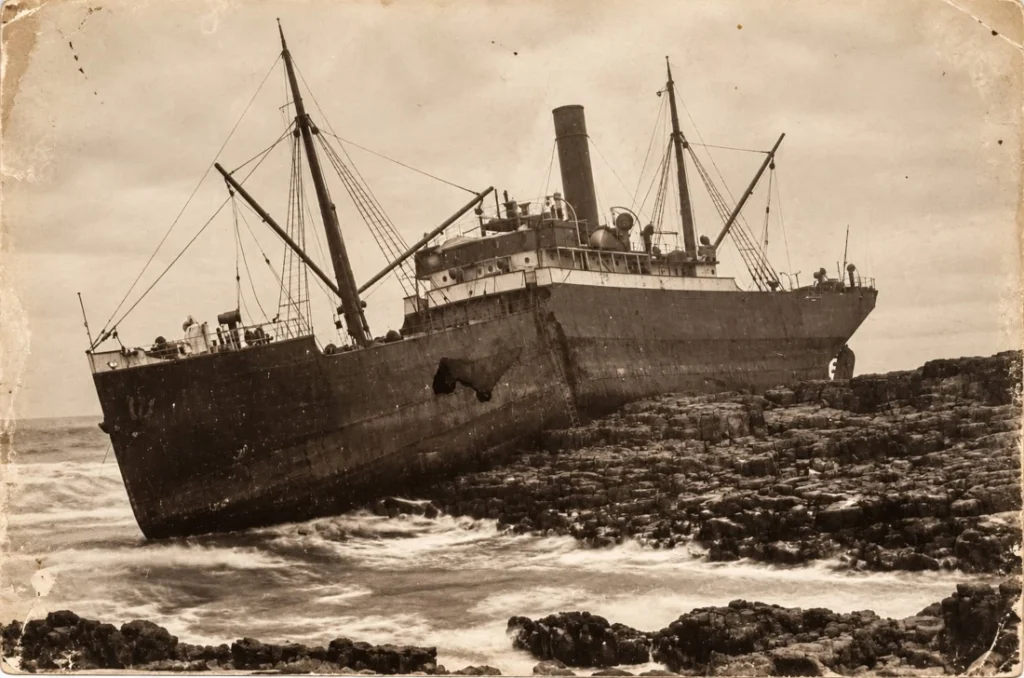
It’s certainly possible, although I’ve yet to find a contemporary account confirming the method of their evacuation.
With her back broken, Worms was beyond economic repair and declared a total loss.
Given the value of her machinery, fittings and metalwork, I suspect she was subsequently stripped for scrap, although I’ve not yet established precisely how or when this was carried out.
For a ship barely two years old, it was a remarkably short career.
Haarfagre — 11 December 1928
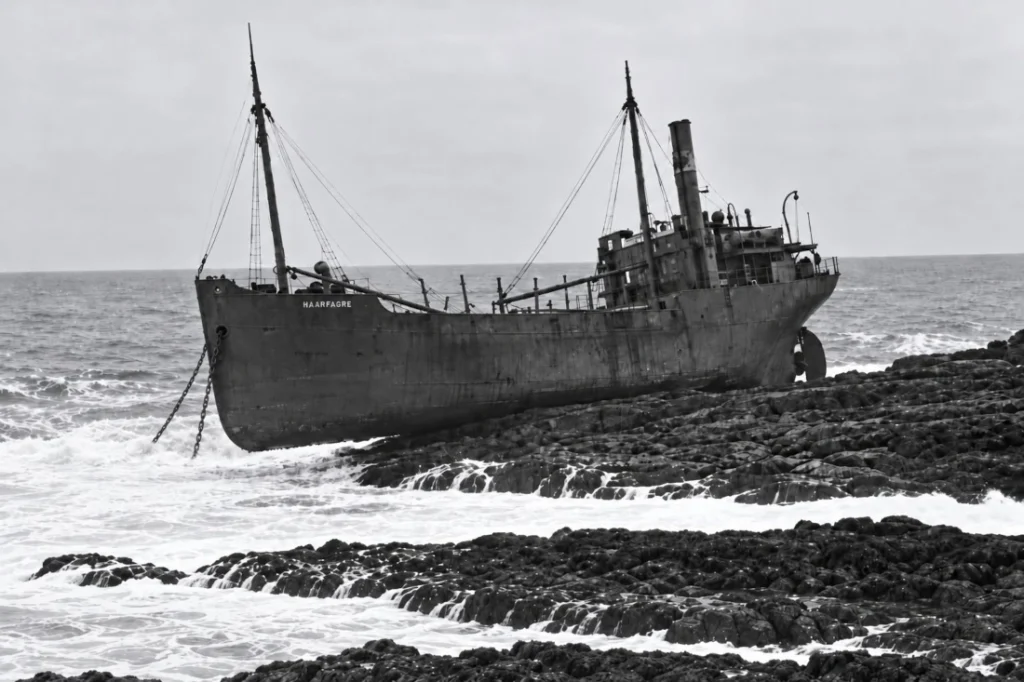
Almost exactly 21 years later, another vessel was to meet a similar fate along this same stretch of coastline.
On 11 December 1928, the Norwegian steamship Haarfagre ran aground approximately half a nautical mile south of Craster.
She was a considerably smaller vessel than Worms, measuring around 155 feet in length and 28 feet across the beam, with a gross tonnage of approximately 518 tons.
Built in 1909 by Nylands Værksted in Kristiania, now Oslo, she had originally been named Stadion.
And here’s an interesting detail.
Craster wasn’t the first place where this unfortunate vessel had ended up in trouble.
On 4 September 1916, while still named Stadion, she capsized and sank in Alexandra Dock at Hull during loading operations.
She was initially condemned, but was subsequently purchased back from her insurers, raised, repaired and returned to service.
Not many ships get a second chance after being condemned.
In 1922, she became Nordborg, before passing to the Norwegian shipping company A/S Havlide and being renamed Haarfagre in the early 1920s.
By December 1928, she was engaged in the coastal timber trade between Norway and Britain.
Norwegian shipping records differ slightly on the details of her final voyage. One account gives her departure point as Skien, bound for Middlesbrough with a cargo of pit props, while another records Larvik to Middlesbrough carrying timber.
In either case, she was transporting timber to the north-east of England, where such cargoes were important to industry, particularly the coalfields.
But she would never reach her destination.
On 11 December, Haarfagre grounded on the rocks south of Craster, around the Hole o’ the Dike.
The vessel became stranded on the exposed whinstone, with sections of her hull projecting over the rocks and water.
And unlike many other wrecks of the period, we have moving pictures of her stranded on the shoreline.
British Pathé filmed the wreck for a newsreel entitled Again the Sea Takes Toll!
The footage shows the ship sitting on the rocks, with waves washing around her hull. At one point, two men can be seen examining the underside of the stranded vessel.
It’s a fascinating glimpse into an event that would undoubtedly have attracted considerable attention locally.
Unfortunately, the surviving footage is rather badly corrupted in places, and the opening sequence appears to have been reversed, making the vessel look as though she’s north of Craster rather than south.
What happened to the crew?
This is another aspect of the story that I’d like to investigate further…
One published account records that eleven of the vessel’s thirteen crew members were taken off following the grounding.
But what happened to the remaining two?
Were they left aboard temporarily to assist with salvage operations, or were they evacuated later?
I haven’t yet found a reliable account explaining their circumstances, so it would be wrong to assume they were lost.
If anyone has newspaper cuttings or family stories relating to the wreck, I’d be particularly interested to hear about them.
What became of Haarfagre?
Despite attempts to save the vessel, she was eventually condemned in 1929.
Given her position on the rocky foreshore, refloating her would have presented considerable difficulties.
The combination of exposed rocks, tidal movement and repeated wave action would have made the task hazardous, particularly if her hull had already suffered serious structural damage.
I suspect that, once she had been declared a total loss, anything of value would have been recovered and the remaining vessel gradually dismantled.
However, I haven’t found documentary evidence establishing exactly how the salvage was carried out, or whether any substantial remains were simply left to the sea.
What is certain is that her remarkable career, which had already included one sinking and recovery, finally ended on the Northumberland coast.
A Remarkable Coincidence, another Haarfagre.
While researching the wreck, I came across something rather unusual.
The Norwegian shipping company A/S Havlide subsequently acquired another steamship and gave her the same name.
This second Haarfagre was a much larger vessel, built in 1918 by Pusey & Jones at Wilmington, Delaware, in the United States.
Originally completed as Aurora, she was approximately 299 feet long and measured 2,460 gross registered tons.
Following several changes of ownership and name, she was acquired by A/S Havlide in 1932 and renamed Haarfagre.
Then, during the Second World War, she was requisitioned for German-controlled service. And would you believe it?
On 19 March 1941, this second Haarfagre also ran aground! Fortunately, unlike her predecessor at Craster, she survived the incident.
She continued operating after the War and eventually passed into Finnish ownership, becoming Helmi L and later Kar-Erik. Her long career finally ended in August 1960, when she arrived at Ghent in Belgium to be broken up for scrap. So there we have it.
Two different vessels, operated at different times by the same Norwegian shipping company, bearing the same name. The first ended her career wrecked on the rocks south of Craster in December 1928.
The second ran aground in March 1941, just over twelve years later, but lived to sail another nineteen years. Two ships, one name, and both victims of grounding accidents. What are the chances?
A Coastline Full of Stories
The stretch of coastline between Craster and Howick is littered with maritime history, much of which is slowly disappearing from living memory.
Photographs, newspaper reports, shipping registers and even old newsreel footage help us piece together what happened, but there’s still plenty that remains unanswered.
When you walk these rocky shores today, it’s difficult to imagine the sight of a steamship sitting helplessly on the whinstone, with her crew facing an uncertain future and the sea breaking against her hull.
Yet these were real events involving real men, some of whom would have travelled hundreds of miles from home only to find themselves stranded on our little stretch of Northumberland coastline.
And that’s what makes researching these old wrecks so fascinating.
There’s nearly always another story waiting to be uncovered.
With Love form the Crasterfarian XX