
By Thomas Bainbridge
The legend of the Lambton Worm has been an inspiration to more than one great Victorian literary figure. In a recent article I discussed the influence that it had on Lewis Carroll in writing Jabberwocky. The tale also stimulated Bram Stoker, of Dracula fame, to write his 1911 novel, The Lair of the White Worm, though Stoker transposes the story to Derbyshire.
Through his character, Sir Nathaniel De Salis, he explains:
“In the dawn of the language, the word ‘worm’ had a somewhat different meaning from that in use to-day. It was an adaptation of the Anglo-Saxon ‘wyrm,’ meaning a dragon or snake; or from the Gothic ‘waurms,’ a serpent; or the Icelandic ‘ormur,’ or the German ‘wurm.’ We gather that it conveyed originally an idea of size and power, not as now in the diminutive of both these meanings.”

The tale goes:
One Sunday morning, wayward young Jack, heir of the Lambton family, the most prominent in the region, with lands encompassing large tracts of County Durham, spurned mass in order to fish on the banks of the Wear.
He felt an immense tug on his line, only to bring up a wriggling slimy little white worm. Disgusted, he threw it down the nearest well and forgot all about it as he went on to lead a life of frivolity.
After some years, Jack, realising the errors of his ways, took his penance by going off to fight in the Holy Land.
Devilish Serpent
All the while, the worm slowly grew in its dank seclusion, until it emerged and coiled itself around a nearby hill, continuing to expand to monstrous proportions. It wreaked havoc on the local populace, eating livestock and even drinking milk from the udders of the cows.
John’s father was forced to provide a tribute to the beast in order to stave off its predations, but its appetite grew as each day passed, and famine began to grip the land.
Sir John returned to the scene after seven years, and saw the desolation that had overtaken the fair green hills of his home.
Many gallant knights had already tried in vain to vanquish the behemoth, but Lambton was undeterred. He took counsel from a local Sybil (wise woman). She designed the armour that he was to wear in combat against the leviathan: studded with spear-points to turn its strength against it, and bade him stand at the Worm’s lair — being a rock in the middle of the Wear.
She further prophesied that if Lambton failed to kill the first creature he came across should he be victorious against the worm, a curse would be placed upon seven generations of his family: that they would not die quietly in old age, but be smote down in agony.
And so, Jack stood in wait for the appearance of the monster…
Slain in Combat
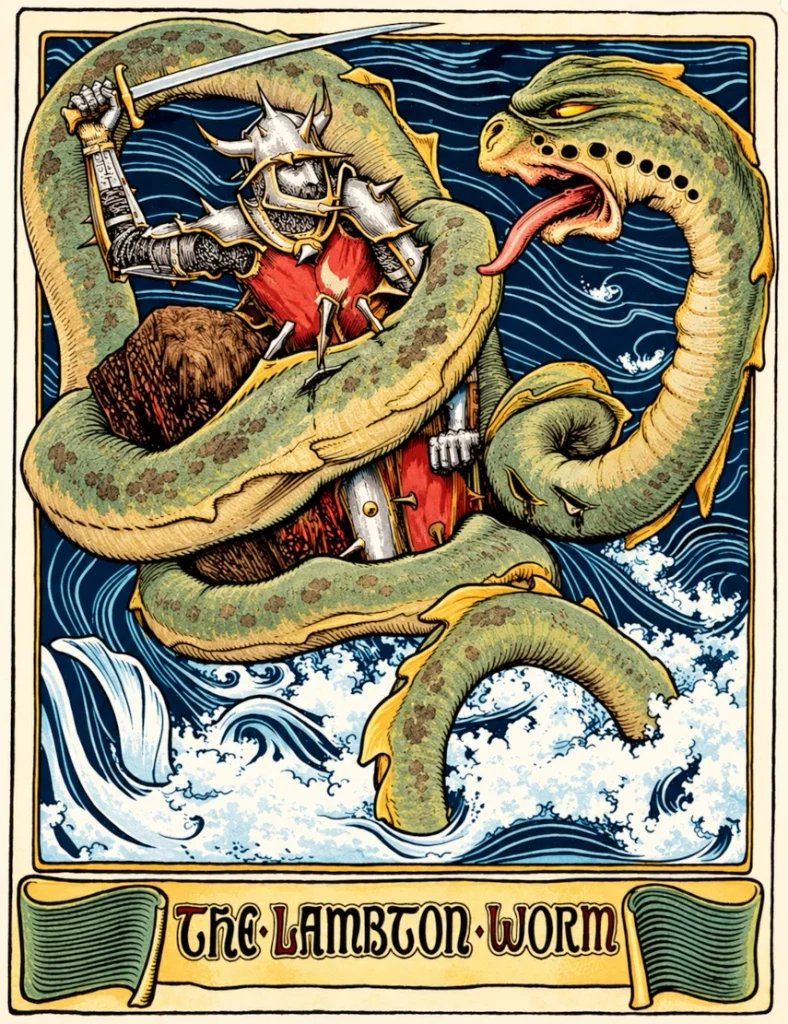
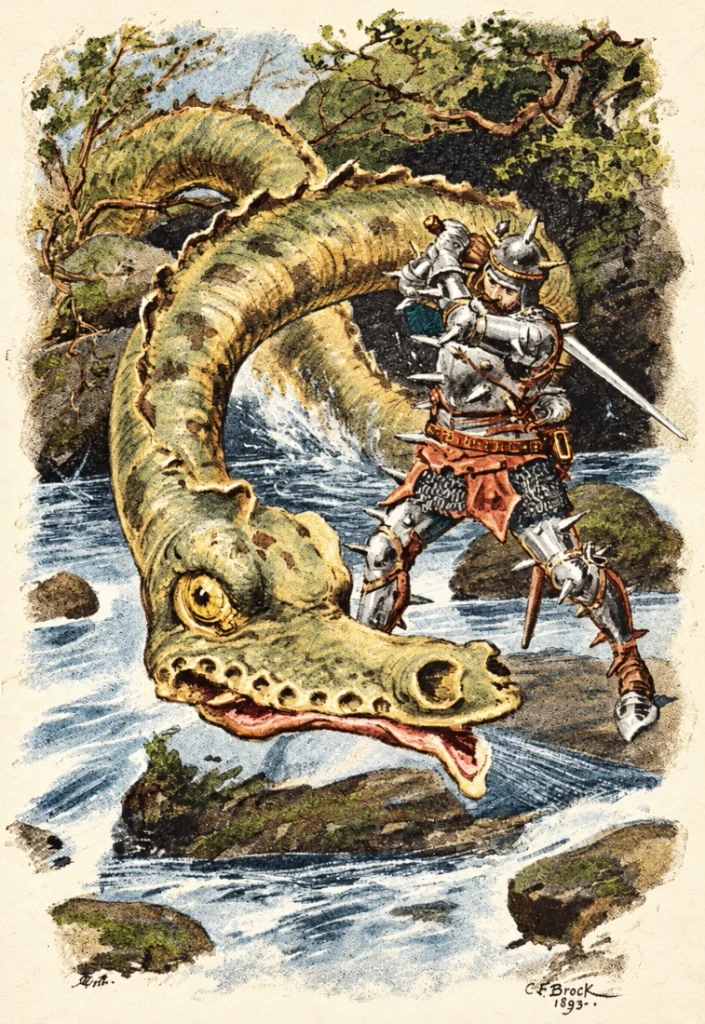
At last it reared its hideous head with gnarling fangs and blood-red eyes, and darted towards John, standing resolute with his sword aloft.
As it reached him, he brought down the blade upon its head, but the metal slid off the armour-like scales that covered the worm’s flesh.
Then John was paralysed, as the worm had coiled itself around him, slowly squeezing him tighter so that he was near to being crushed to death… until, the sibyl’s plan began to work, and every exertion of pressure on the part of the worm pushed the spear points further, piercing its scales as rushes of blood flooded from its wounds.
The Wear turned murky with the black blood. Freeing his arm just enough, John brought up his blade and finding a weak point, cleaved the worm in two. It writhed and squealed, using its final reserves of strength to kill, but finally flopped lifeless into the waters below. John was victorious.
A Wretched Curse
His father, watching the deadly contest from the battlements of Lambton Hall, rushed out to greet his son, forgetting the oath that John had been sworn to. By the Sybil’s decree, John should have to kill his father to save the family from the curse. Unable to do so, he killed the hound that had been let loose instead, and embraced the old man.
The worm was dead, but the spell was cast, and the Lambtons for seven generations would suffer its deadly consequences…
Origin of the Story
Though Durham historian, Robert Surtees is often touted as having provided the first written account, the actual honour goes to William Hutchinson half a century prior. In his great tome The History and Antiquities of the County Palatine of Durham, he writes:
“Near this place is an eminence called the Worm Hill, which tradition says was once possessed by an enormous serpent, that wound its horrid body round the base; that it destroyed much provision, and used to infest the Lambton estate, till some heroe of that family engaged it, cased in armour set with razors, and when it would have crushed the combatant by enfolding him, sustaining a thousand wounds, fell at last by his falchion.”
Still, a more full retelling was given by Surtees:
“The story, such as it is, full of plot and incident, certainly ranks amongst the most popular traditions of this country, and has been transmitted with very little variation for centuries from father to son, and various facts have been pressed into the service to establish the commination of sudden death that has been supposed to hang over the family.”
While cynical, Surtees lists some of the victims of the Lambton curse, the first being John’s son, Robert, who died of drowning. Other descendants fell prey to the omen:
“Sir Wm Lambton, who was Colonel of a regiment of foot, in the service of Charles I., was slain at the bloody battle of Marston Moor, and his son William (his eldest son by his second wife) inheriting the patriotism and gallantry of his father, “received his death‘s wound at Wakefield,” at the head of a troop of dragoons, in 1643.”
Certainly, a folktale, passed by word of mouth, will produce some variation upon a basic plot, such as minor characters or locations. For instance, Hutchinson claimed that of the spot where the worm coiled itself seven times was Worm Hill in Fatfield, near the Lambton estate, modern iterations point to Penshaw, it being a more prominent location, in order to enhance the size of the creature.
Another discrepancy exists as to whether it was an old crone (or Sybil, as more pleasantly described in a later Victorian retelling, meaning prophetess) or an old man, or both whom John encountered. Regardless, the story remains much the same.
Crusader Knights and Dragon Slayers
Surtees’ account goes on to give some interesting details. For one, he refers to John as a Knight of Rhodes. While John is also referred to as a Crusader, the main events of the Crusades were largely concluded by the time he was said to have lived in the 1300s.
The Knights of Rhodes were rather the continuation of the Order of Knights of the Hospital of Saint John of Jerusalem, which had been a major faction within the Crusader kingdoms. By John’s time, they had made their base on Rhodes in order to continue to defy the forces of Islam. John would certainly have seen action fighting in one of the innumerable conflicts that the order were still engaged in against the Ottoman Sultan and the Barbary Pirates.
Still, there is one story associated with the Knights of Rhodes that seems particularly pertinent: the slaying of a monstrous scaly creature.
The story goes that a serpentine beast was stalking Rhodes and terrorising the inhabitants. A young French knight, Dieudonné de Goza, found a way to pierce the creature’s scales and vanquish the monster. He was celebrated throughout the island and his tombstone later read, “Here lies the Dragon Slayer”.
Is it possible that John brought this story back with him from his own service, which then spawned the Durham legend?
Or were the Knights of Rhodes simply prolific killers of mythical creatures?
Of course, these tales no doubt derive from that of Saint George and the Dragon.
Already known in Georgia and Russia, the tale of St George comes to us from The Golden Legend in the 1260s, which became one of the first books to be printed by Caxton in 1483. With this wide circulation the fable became popular in England as a display of courage and Christian devotion. Soon St George overtook St Edmund as patron saint of the nation.
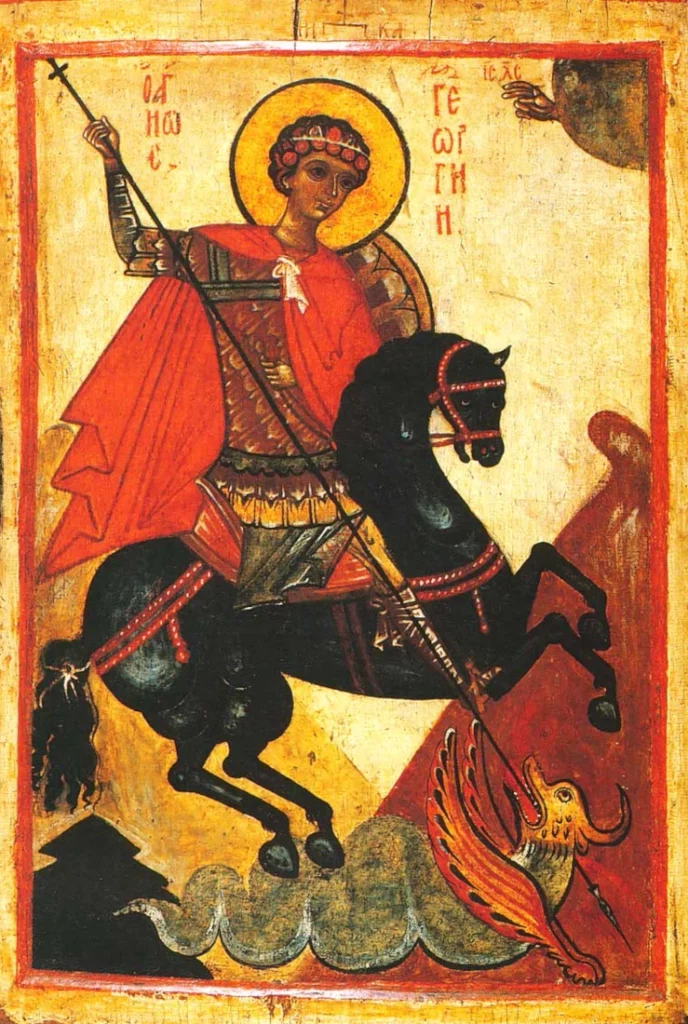
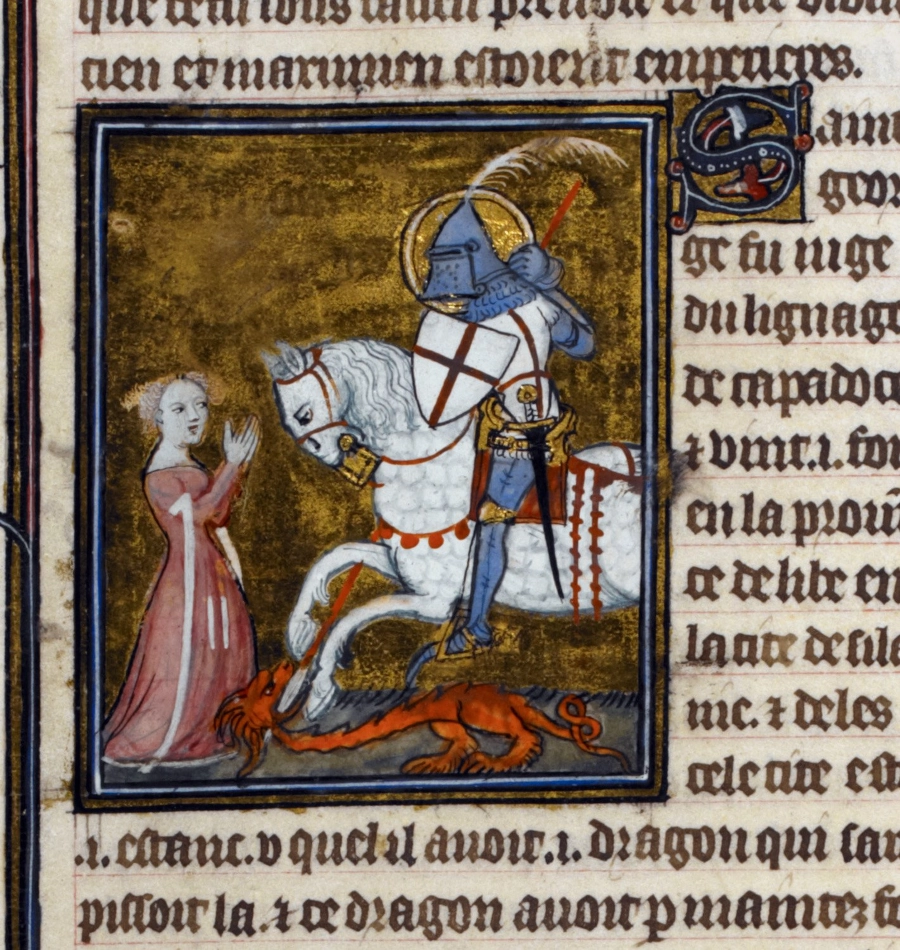
It is not surprising then that this should have influenced the local legend, replacing the setting of Libya with the banks of the Wear, and recasting the Roman tribune, George, with the lord-ling, John.
Certainly, the story ultimately has a religious basis: The worm symbolises the wrath of God levied on John for his impious ways. The moral of the story then, is not to go fishing in the Wear on Sundays!