By Crasterfarian

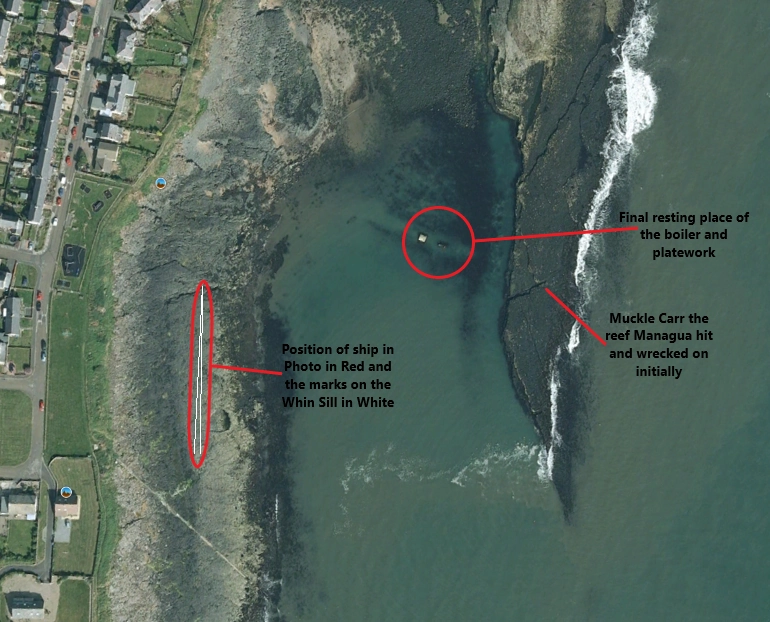
Anyone who grew up in Craster will know the remains we simply called “the boiler” that great rusting lump lying in the water just inside Muckle Carr and the scourge of speedboat hulls.
For years I was told it came from a wreck called the Managua, and that she’d once been a banana boat.
As it turns out, that old local story was not far wrong at all.
The Managua was a Norwegian steamship, built in 1890 by the Grangemouth Dockyard Company in Scotland for Johan Christian Giertsen of Bergen.
She measured 175 feet 6 inches long, with a beam of just under 28 feet, and was powered by a three-cylinder triple-expansion steam engine.
Norwegian shipping records show that she worked in the fruit trade, so the old tale of her being a “banana boat” was almost certainly rooted in truth, even though she was not carrying fruit on her final voyage.
On 19 November 1907, the Managua was on passage from Hamburg to Burntisland, travelling in ballast, when she came ashore in thick fog on Great Carr, or Muckle Carr as it’s known locally, just off Craster.
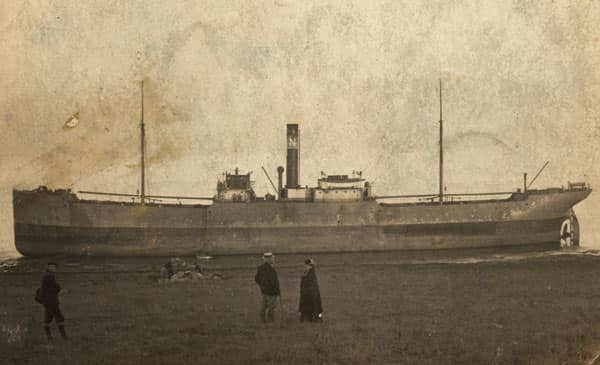
Contemporary reports say her bottom was severely damaged and that she came to rest with a heavy list to starboard.
Thankfully, the crew of 13, together with the captain’s daughter, were all brought ashore safely by Craster fishermen.
An act today which along with all the other souls saved from the tempest of the North Sea would have been global headlines

What became of her?
The Managua was a total loss, she must have struck the Muckle Carr and came over the top, taking on water and, with wind and tide, she ended up beam on to the foreshore just below where the play park is now, an ebbing tide left her stranded, aground,
It appears that at least some attempt was made to salvage or break her up.
Anything easy to reach and worth money would almost certainly have been taken: brass fittings, copper, metalwork, machinery and anything else that could be recovered.
Yet part of her remains
The rusting boiler in the water inside Muckle Carr, together with what looks like part of a bow or hull section, has long been identified locally as belonging to the Managua.
But why was the boiler left?
The simplest explanation is that a boiler was just too great a weight to remove easily from a wreck stranded on exposed rock in the winter of 1907 and the value of the scrap may not have justified the effort, splitting riveted plates off a hull is one thing, but breaking down a boiler in winter may have just been a bridge too far
There is also another possibility
It was Winter.
The ship may have been only partly dismantled, with the heaviest sections left where they lay. What remained could then have been shifted, torn apart and redistributed by the sea during later storms, leaving the boiler and other heavy pieces in the shallower, more sheltered water inside Muckle Carr.
In other words, the salvors may have started the job, and the North Sea finished it.
Grooves in the Whin Sill
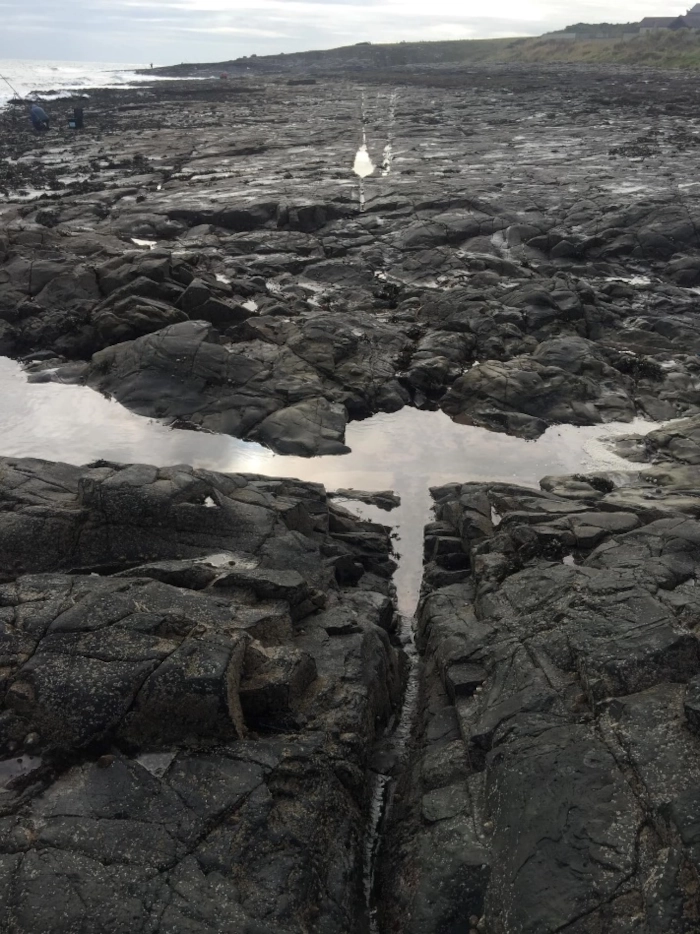
There is another clue on the rocks.
Long grooves can still be seen cut into the Whin Sill at the very place where the Managua is pictured ashore.
On Google Earth they can even be traced and measured, with one visible run coming out at about 200 feet.
That is longer than the ship’s recorded length of 175 feet 6 inches, but that does not rule the Managua out at all. In fact, it may support the idea that she moved along the rocks after grounding.
If the ship came up against the steeper rock at the northern end, she may have been unable to move any farther that way.
But with tide and sea pushing at her, she could well have worked southwards along the rocks, scraping and grinding her keel and bottom plating over the whinstone as she went. That would explain why the grooves are longer than the ship.
They may not represent one single static impression, but the path of a stranded vessel being lifted, shoved and dropped again over successive tides.
This makes sense with what we know of the damage.
Contemporary accounts say her bottom was badly stoved in. A vessel grinding back and forth on hard whinstone in a swell would have suffered exactly that sort of punishment.
So the grooves are physical scars left by the Managua, the rock still bearing the marks of her last movements more than a century later, and they will be there long after all we know has vanished into the ether
That is what makes the Managua such a fascinating Craster wreck.
She was not just a name in a list. She was a real working steamer with a life of her own: a Norwegian fruit carrier that crossed wider seas before ending her days on the rocks.
And unlike many wrecks, she seems to have left behind more than one reminder of her loss.
There is the boiler in the water, and the scars on the rocks.
Oh, and she was a bloody Banana Boat
With Love from the Crasterfarian XX